idsnowdog
Imperator of Indignation
A few weeks ago I was at a surplus store and they have old circuit boards. While looking for Germanium transistors I saw a board with six BC107 NPN silicon transistors and six BFX88 PNP silicon transistors. I was able to salvage them and they all tested good.
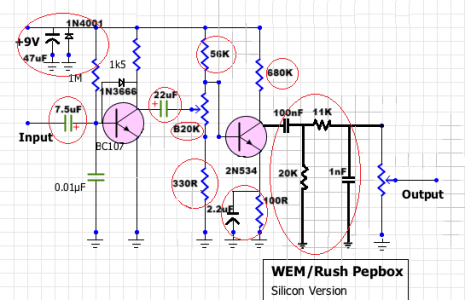
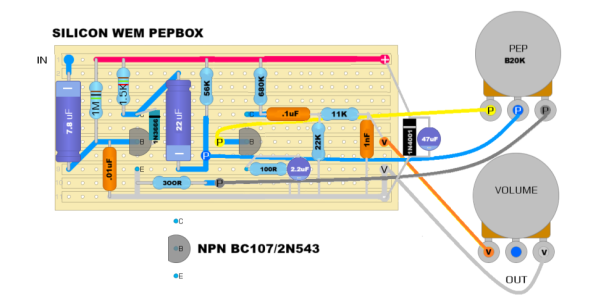
The Pepbox was the first British made fuzz box and is architecturally similar to the Maestro FZ-1 which was the first US made fuzz. The Beatles, The Animals, and others used the Pepbox. The difference between the Pepbox and FZ-1 is the Pepbox has two transistors while the FZ-1 has three. The FZ-1 has an input buffer while the Pepbox doesn't. The Pepbox also has some odd values for its input, coupling, and output capacitors. I believe Pepe Rush was trying to create a dark, thick, and "fractured" sounding fuzz to beef up bright low output pickups and low wattage amps. What you end up with though is a lot of blocking distortion and less output because too much energy is being wasted amplifying low frequencies below the audible range. I changed the input capacitor from 25uF to 7.5uF and the circuit still has plenty of low end, much better clarity, and is much louder because it's amplifying a frequency range that is much easier to efficiently amplify. The stock circuit also has a 3.3nF output capacitor which thought was a poor choice. Basically the designer was trying to tighten up the sound by forcing 50 lbs. of mud into a 5 lb. bag. So, I used a bandpass filter which allows 70hz to 13khz to pass to the volume control. I also couldn't see the point of using a 56K resistor in parallel with a 500K pot to get a 50K value when I could use a 50K pot instead?
The BC107 has a nice throaty midrange centric growl that sounds great in a fuzz. Unfortunately I burnt out three of the BC107s while breadboarding this circuit. I have never ran across such a fragile transistor before! Although I liked the sound of BC107s in Q1 and Q2 I thought it could use improvement. I used a 2N543 NPN silicon transistor in Q2 instead. The 2N543 has a wider frequency range and is very lush and harmonically rich which compliments the more narrowly focused BC107s growl. I added a Germanium diode clipper on a SPST to Q1 to emulate the earlier Germanium transistor variants. This is a very loud, thick, and rich sounding fuzz which still good note separation for chords. It also cleans up well with the volume knob.
The Pepbox was the first British made fuzz box and is architecturally similar to the Maestro FZ-1 which was the first US made fuzz. The Beatles, The Animals, and others used the Pepbox. The difference between the Pepbox and FZ-1 is the Pepbox has two transistors while the FZ-1 has three. The FZ-1 has an input buffer while the Pepbox doesn't. The Pepbox also has some odd values for its input, coupling, and output capacitors. I believe Pepe Rush was trying to create a dark, thick, and "fractured" sounding fuzz to beef up bright low output pickups and low wattage amps. What you end up with though is a lot of blocking distortion and less output because too much energy is being wasted amplifying low frequencies below the audible range. I changed the input capacitor from 25uF to 7.5uF and the circuit still has plenty of low end, much better clarity, and is much louder because it's amplifying a frequency range that is much easier to efficiently amplify. The stock circuit also has a 3.3nF output capacitor which thought was a poor choice. Basically the designer was trying to tighten up the sound by forcing 50 lbs. of mud into a 5 lb. bag. So, I used a bandpass filter which allows 70hz to 13khz to pass to the volume control. I also couldn't see the point of using a 56K resistor in parallel with a 500K pot to get a 50K value when I could use a 50K pot instead?
The BC107 has a nice throaty midrange centric growl that sounds great in a fuzz. Unfortunately I burnt out three of the BC107s while breadboarding this circuit. I have never ran across such a fragile transistor before! Although I liked the sound of BC107s in Q1 and Q2 I thought it could use improvement. I used a 2N543 NPN silicon transistor in Q2 instead. The 2N543 has a wider frequency range and is very lush and harmonically rich which compliments the more narrowly focused BC107s growl. I added a Germanium diode clipper on a SPST to Q1 to emulate the earlier Germanium transistor variants. This is a very loud, thick, and rich sounding fuzz which still good note separation for chords. It also cleans up well with the volume knob.