Pickup EQ curves

Inflames626

New member
Hello tone gods,

A couple questions/thoughts:

1) Something I've noticed that's troubling is that pickup manufacturers used to publish more technical data about their pickups than they do now. EMG back in the 90s used to actually print EQ curves in their literature (back in the EMGinc days with the old block letter logo). Being able to see this curve would be very helpful in helping me judge a tone without hearing it and would give me a better idea of its sound than judging by videos.

I realize that it isn't easy--woods, string gauge, amp settings, note position on the neck, all make a difference, and there's no substitute for playing a pickup yourself, but most of us usually end up spending a lot of money on used and new pickups just to try them. The return policy helps, but I would feel a lot better being able to see a curve.

And then of course there's the similar winds/magnet/construction rumor that companies use to speed up production and sell similar rebadged products. If players knew just how negligible the differences among some pickups actually were, they wouldn't shell out so much money for the newest or highly similar models, would they?

That said, has anyone run a tone from a signal generator somehow through various pickups and recorded the results visually on an oscilloscope or EQ curve? I use Voxengo SPAN to capture screen shots of me playing a direct signal in various places and then compare the shapes. I found out, for example, that a JB and an EMG HZ H4 are very similar, save the JB has a bulge around 150 hz that the EMG doesn't have. But it doesn't solve everything. I can definitely hear the HZ4 has more upper mids, but it doesn't show up on the shapes noticeably.

2) Has anyone discovered a "flat" pickup that colors the sound the least amount possible (besides the Lightwave pickup)? Of everything I've heard, the Lace Alumitones sound really even to me, almost like actives. Sometimes I like to color the sound with the pickup, but other times I want it to be more about the amp settings.

Thanks guys.
 
Re: Pickup EQ curves

This is a great question and I really can't see why it hasn't been done.

Stick a pickup in a standard guitar, play the thing a do the appropriate analysis - get a generalized/average eq curve.
 
Re: Pickup EQ curves

Microphone manufacturers post their response curves.
So do some speaker manufacturers.

That being said, it is good for a general idea of a pickup, but a response curve by definition does not show any induced harmonics or response to same time input (i.e. signal with harmonic content) or multiple inputs at the same time.

In my opinion measurements are never a replacement of experience, but can give a general direction.

That being said I would love to see frequency response curves done for all pickups.
 
Re: Pickup EQ curves

The pickup doesn't really have one.

The major effect is that it is a second order low pass filter with a resonance peak. Messing with the wind changes the frequency of the resonance peak, which also is the cutoff frequency (6 db/octave) of the LPF and the amplitude (height) of the peak. Those two are dominating the space and you can always perceive "more highs" as "less lows". So this becomes very difficult.

That was the coils. The next problem is that the magnets, especially when considering ceramics, or when considering the difference between rod magnets and passive rods with a magnet on the bottom, don't really "change the EQ". They change how the thing changes behavior when you play differently.

Publishing EQ curves would be highly misleading. I have most of them for SDs but they are essentially useless if you don't consider the dynamics.

There is nothing worse than looking at a frequency curve when your impression is actually dominated by dynamics. Just look at the distribution of some remasters and possibly compressed to death re-release. It sounds completely different but it has the same frequency distribution.
 
Re: Pickup EQ curves

uOpt put this one to bed I think.

But aren't you going to hear "less lows" more than "more highs" since the ear hears cuts more than boosts?

Which also brings to mind, what some people might consider highs, I would consider high mids, or lows low mids, etc. Very subjective.
 
Re: Pickup EQ curves

uOpt put this one to bed I think.

But aren't you going to hear "less lows" more than "more highs" since the ear hears cuts more than boosts?

I think it depends on how far into the mids the cut or boost strays. The ear is most sensitive in the mids (where voices are).
 
Re: Pickup EQ curves

SO you would need to see a light moderte and heavy string hit (or strings), and generate THREE curves typical of the curve at a given level of output

- Set pup to standard spec. Place guitar in vice
- Have "strum machine" hit unplugged standard strings until volume = preset threshold indicating an equal amount of force on any given strum.

Plug guitar in and take 20 strums through reference mic.

Repeat two more times at progressively louder (harder) string hits. Obviously the amp would impact too. Do it with a JCM 800 and a Twin Reverb.
 
Re: Pickup EQ curves

Whatever the stupid technical excuses may be why not, SD needs something better than their near-useless demos and their extremely misleading (I would say flat-out wrong) B/M/T numbers...not to mention having to open up the tone comparison chart, and the awkward method of comparing pickup specs side by side. I might try taking a hint from Di'Marzio on this one. Their B/M/T charts are far more accurate, and they list the output of each pickup. They list all their pickups within the chosen category side by side as a matter of course, with the B/M/T and output specs right out in the open. Even without audio samples, it's very easy to choose a Di'Marzio based solely on their Website. Not so much with SD. I'm not saying that one company is any better than the other...just that it's way easier to me to select the right Di'Marzio for my application.
 
Last edited:
Re: Pickup EQ curves

Whatever the stupid technical excuses may be why not, SD needs something better than their near-useless demos and their extremely misleading (I would say flat-out wrong) B/M/T numbers...not to mention having to open up the tone comparison chart, and the awkward method of comparing pickup specs side by side. I might try taking a hint from Di'Marzio on this one. Their B/M/T charts are far more accurate, and they list the output of each pickup. They list all their pickups within the chosen category side by side as a matter of course, with the B/M/T and output specs right out in the open. Even without audio samples, it's very easy to choose a Di'Marzio based solely on their Website. Not so much with SD. I'm not saying that one company is any better than the other...just that it's way easier to me to select the right Di'Marzio for my application.

I'm working on 3D charts that have time as one dimension so that you can see the attack and how it sustains out separately.
 
Re: Pickup EQ curves

I'm more interested in the EQ curve in a direct signal. Going through an amp would be okay for sound samples I guess, but I would prefer direct sounds too, which Ola Englund does I think.

I very much agree with Itsabass that the tone charts are not helpful. A JB does not have 5 on bass. Maybe like 7. My complaint with the DiMarzio site is all their sound samples, or most of them, are studio processed commercial samples. It doesn't help me much to hear the final product.

As primarily a DAW user and recorder, I think pickup choice is going to matter far more through a tube amp than for my uses, since I can tweak the signal as I wish. Live guitar is always a tricker situation. But I want a sound that needs as little EQ as possible, preferably just high and low pass filters.
 
Re: Pickup EQ curves

The processing thing is tricky. My own samples are processed for guitar and dry for bass. It's not clear to me what's better. One thing is for sure: one person's samples are of very limited value to other people.
 
Re: Pickup EQ curves

Hello tone gods,

A couple questions/thoughts:

1) Something I've noticed that's troubling is that pickup manufacturers used to publish more technical data about their pickups than they do now. EMG back in the 90s used to actually print EQ curves in their literature (back in the EMGinc days with the old block letter logo). Being able to see this curve would be very helpful in helping me judge a tone without hearing it and would give me a better idea of its sound than judging by videos.

I realize that it isn't easy--woods, string gauge, amp settings, note position on the neck, all make a difference, and there's no substitute for playing a pickup yourself, but most of us usually end up spending a lot of money on used and new pickups just to try them. The return policy helps, but I would feel a lot better being able to see a curve.

And then of course there's the similar winds/magnet/construction rumor that companies use to speed up production and sell similar rebadged products. If players knew just how negligible the differences among some pickups actually were, they wouldn't shell out so much money for the newest or highly similar models, would they?

That said, has anyone run a tone from a signal generator somehow through various pickups and recorded the results visually on an oscilloscope or EQ curve? I use Voxengo SPAN to capture screen shots of me playing a direct signal in various places and then compare the shapes. I found out, for example, that a JB and an EMG HZ H4 are very similar, save the JB has a bulge around 150 hz that the EMG doesn't have. But it doesn't solve everything. I can definitely hear the HZ4 has more upper mids, but it doesn't show up on the shapes noticeably.

2) Has anyone discovered a "flat" pickup that colors the sound the least amount possible (besides the Lightwave pickup)? Of everything I've heard, the Lace Alumitones sound really even to me, almost like actives. Sometimes I like to color the sound with the pickup, but other times I want it to be more about the amp settings.

Thanks guys.

Let's see if I succeed in making a point across:

An analogy of what you're asking is to judge the "Mona Lisa" by Leonardo Da Vinci by looking at a Spectrometer reading of it.

Or defining any song a "sequential difference in wave pressure".

Not going to happen. ;)

HTH,
 
Last edited:
Re: Pickup EQ curves

Let's see if I succeed in making a point across:

An analogy of what you're asking is to judge the "Mona Lisa" by Leonardo Da Vinci by looking at a Spectrometer reading of it.

Or defining any song a "sequential difference in wave pressure".

Not going to happen. ;)

HTH,

I'd prefer to think of it more as knowing what the Mona Lisa looks like from a picture in a textbook instead of having to go see it in person. :)
 
Re: Pickup EQ curves

In Flames!!

 
Re: Pickup EQ curves

That said, has anyone run a tone from a signal generator somehow through various pickups and recorded the results visually on an oscilloscope or EQ curve?

I do it for more than ten years now and have found it more than useful in my personal subjective tone quest. That said...

-it doesn't show how the guitar reacts;
-it doesn't translate the dynamic behaviour of a pickup - attack, decay, sustain, release;
-for these reasons, two pickups might exhibit the same spectrum when excited by a swept sine wave through low impedance coil, then sound extremely different when played;
-many people don't see how to decipher such screenshots so they trash it as useless.

FWIW, Artec pickups are described in this way, with frequency charts (which look close to what I obtain when I test a pickup):

http://www.artecsound.com/catalog/Pickups_ARTEC_2012.pdf

They even show how the capacitance of the cable used alters the resonant peak of the passive pickup considered. IOW: they have done their homework. :-)
 
Re: Pickup EQ curves

eq1.png


eq2.png


eq3.png


eq4.png
 
Re: Pickup EQ curves

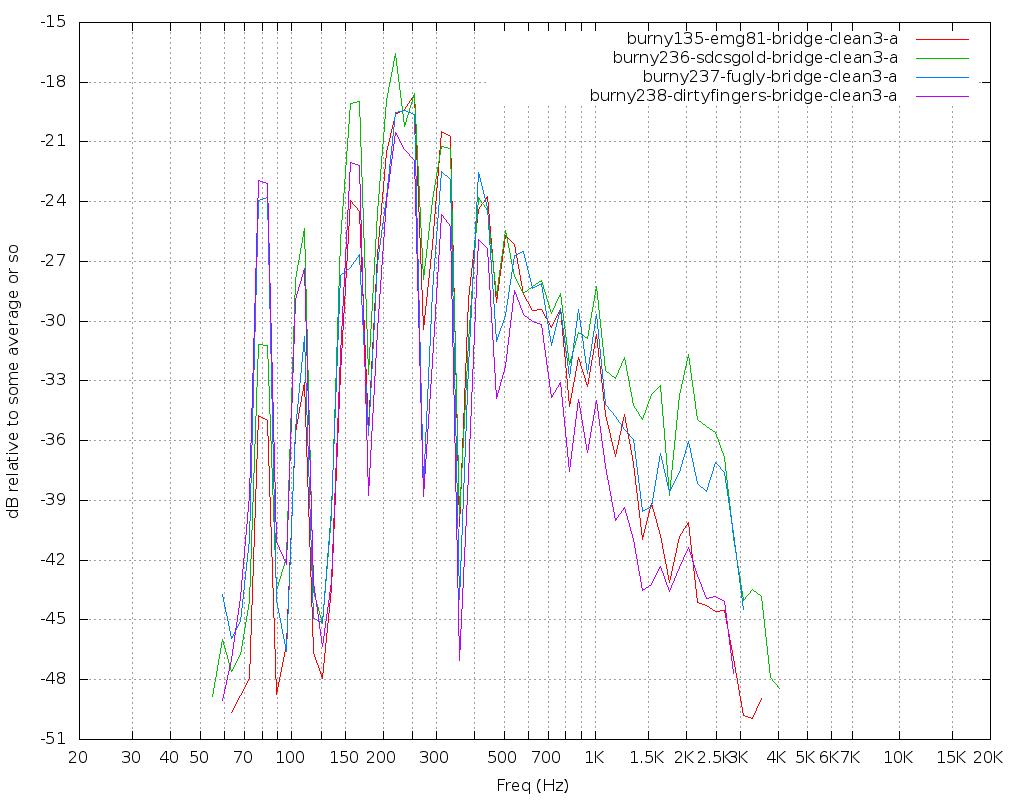
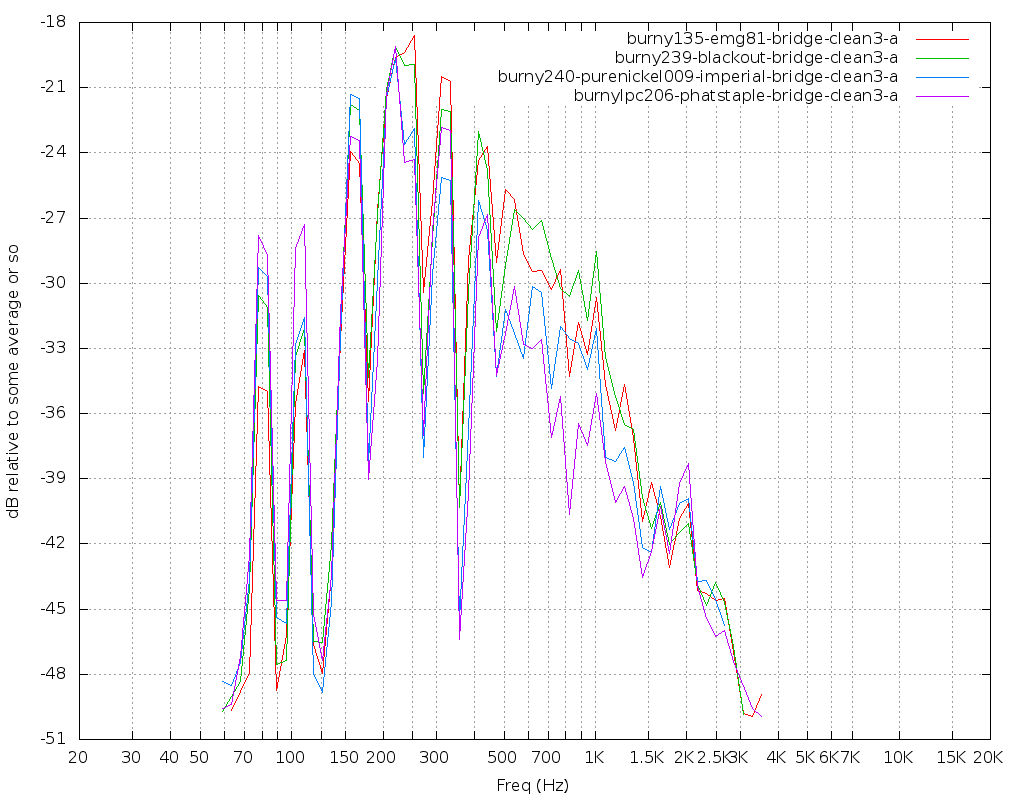
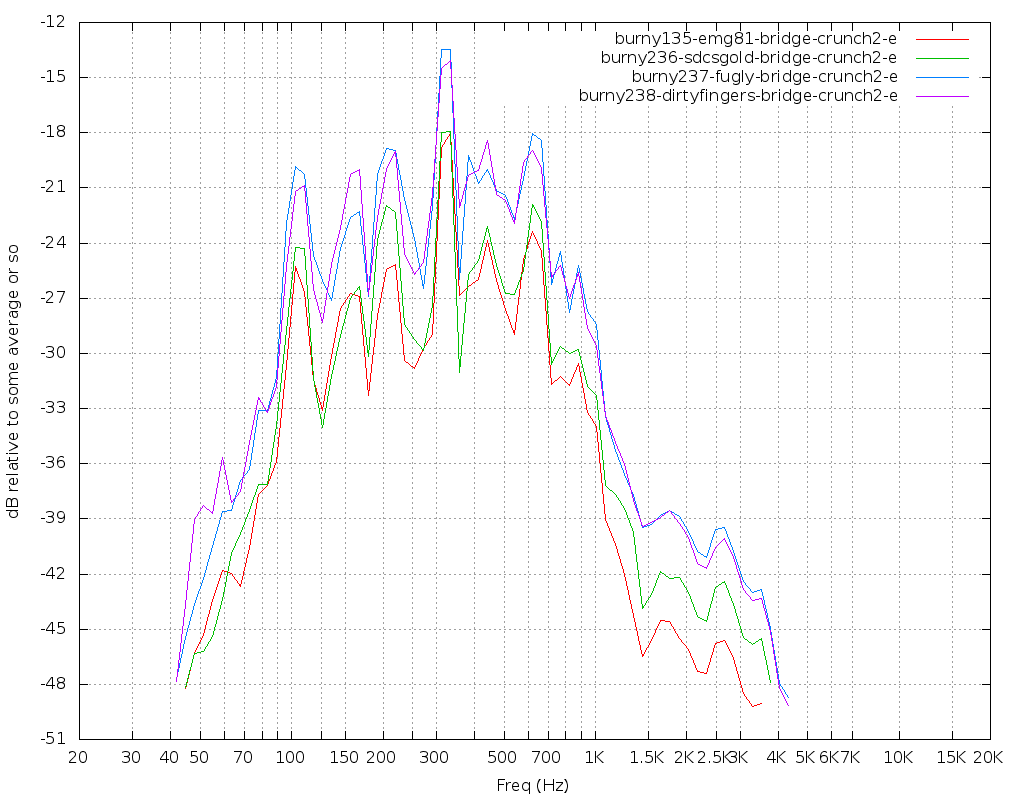
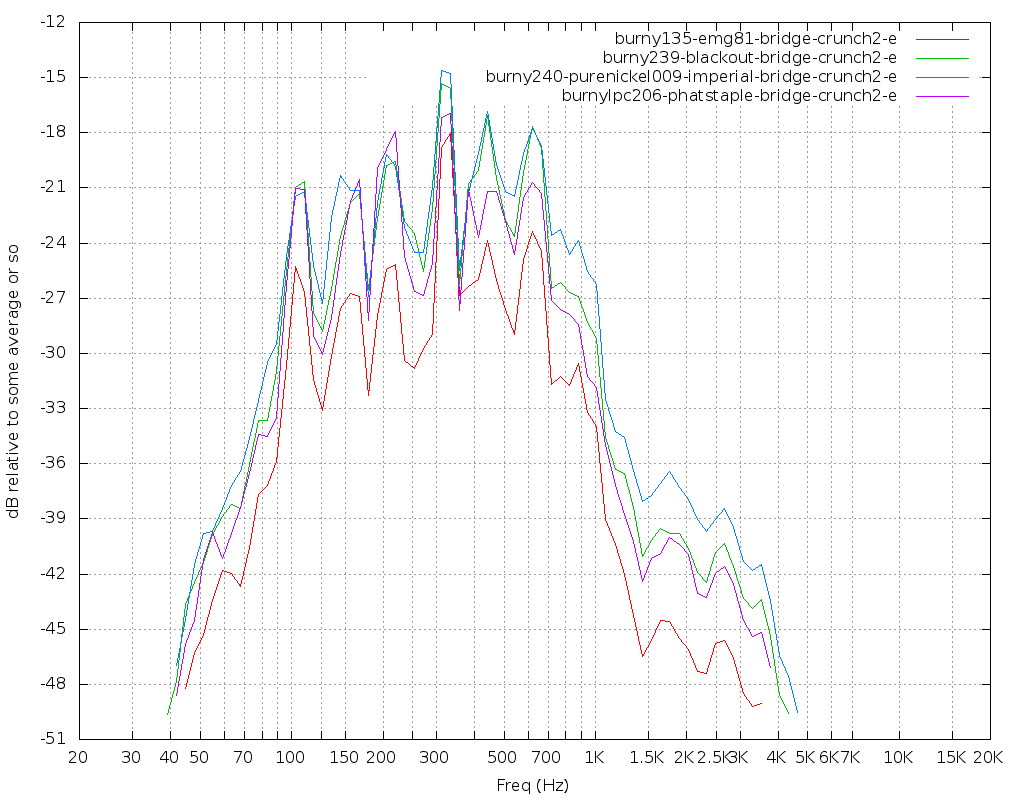
Again, I think uOpt has settled this pretty soundly. The curves are all very similar, yet we hear great differences--similar to what I had experienced with the HZ4 and JB's high end differences not being reflected in the curve.

Yet I can also see extreme rolloffs on the EMG 81 on crunch so it sits well in the mix, and why, to my ears, the Blackouts sound better. Even though the output on the EMG 81 is less than the Blackouts, though, something tells me the EMGs sound more middy because the highs and lows are rolled off so much.

Still, a crunch curve, to me, muddies that waters a bit because amp settings and mic placement are so important. I'd prefer just direct response curves.

What's really distracting is the spike around 350-400hz. That is not a pleasant frequency.

The cuts are much deeper at 1.5k than I remembered. I thought they would not do that until about 2.5-3k.

Isn't all this pickup stuff kind of antiquated nonsense though in that, like a tube amp, these devices are mechanical and prone to a lot of variables. Tube purists said tech would never replace tubes, but the Axe FX is really making headway against traditional technology.

How long before we get rid of these ancient notions of magnet and copper wire, replace them with a digital pickup, plug in our gear with USB, and we get a consistent, but non sterile, sound every time?
 
Re: Pickup EQ curves

What if you took the impulse response sequence from a Kemper, mounted each pickup at a fixed distance from the impulse to mimic dynamic, and did all the top pickups. Then, laid them all on a graph together with db and fast Fourier analysis?
 
Re: Pickup EQ curves

What if you took the impulse response sequence from a Kemper, mounted each pickup at a fixed distance from the impulse to mimic dynamic, and did all the top pickups. Then, laid them all on a graph together with db and fast Fourier analysis?


;)

/Peter
 
Last edited:
Back
Top