Chistopher
malapterurus electricus tonewood instigator
I could have sworn I already posted this, but I can't find it any where.
I modified my NYC Big Muff recently and just wanted to report back on my findings. Firstly the NYC Muff is a pain to mod. I kinda cheated a little bit by just bending the legs of the pots back to access the top of the circuit board, but I wouldn't recommend it. Also the PCB is very delicate, so there's a very low limit on how many times you can swap out the same part. I tried several mods, but there were only a few that made a meaningful difference.
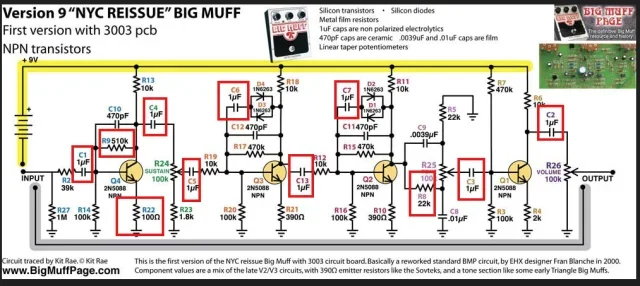
Before I get too far into things, I should mention that even a modern NYC BMP has the classic EHX behavior of not really sticking to a schematic. There were several components on mine that didn't line up with the schematics I found online.
First mod - Tone stack
BMP's have a seasaw filter for the tone control, meaning that this area will almost always be the most important mod on a pedal that uses one. It's also the source of the dreaded muff mid scoop. Stock mine had 22k resistors on both sides of the tone control, I doubled them to 39k, which made the mid scoop an octave lower and quite a bit shallower. I really like it. If you are new to this type of mod, you will want to socket both caps and both resistors on the tone control.
Second mod - Emitter Resistors
The BMP is essentially 4 cascaded transistor gain stages. A clean boost, followed by two overdrive stages, followed by the tone control, followed by one more clean boost to make up for the volume loss at the tone control. Each gain stage has an emitter resistor that is essentially a gain control for each gain stage. Lowering the value increases gain (among a few other things) and raising it lowers the gain. Stock the value was 120R for both of the overdrive stages, I increased them to 390R. This reduced the fizziness of fuzz, made it more dynamic, and also, for lack of a better word, made it sound "woodier".
For the second and third gain stages it is also worth it to experiment with the two capacitors in the feedback loop near the diodes. These effect what frequencies get boosted and distorted. I didn't touch them because I didn't feel the need to.
Other Mods
Supa mod - The Mark IV Tonebender (also known as a Supafuzz) has two significant modifications from a BMP. The first overdrive stage doesn't have any clipping diodes. Imagine if you had two overdrive pedals at moderate level and gain in series with eachother. That's how a stock Big Muff works. Now, lower the gain on the first one and jack the level way up. That's how a Supafuzz works. It gives you a harsher, edgier sound. I didn't care for it that much. The second difference is that a SupaFuzz doesn't have a makeup gain stage. This makes the circuit quieter, but Supafuzzes don't cut as much volume at the tone control as a Big Muff, so it's not as bad an idea as you'd think.
Coupling caps - Every stage in a BMP is separated by what is referred to as a coupling cap. Their main purpose is to stop DC from sneaking into your signal path, but they also can be used to cut bass out of your signal. If you want to modify a distortion pedal to work with bass, increasing the value of the coupling caps is almost always the first recommendation. My BMP came with HUGE coupling caps from the factory, so I didn't make any changes. In fact, most of the caps on my Big Muff (and most NYC's) are way bigger than other iterations of the circuit
I modified my NYC Big Muff recently and just wanted to report back on my findings. Firstly the NYC Muff is a pain to mod. I kinda cheated a little bit by just bending the legs of the pots back to access the top of the circuit board, but I wouldn't recommend it. Also the PCB is very delicate, so there's a very low limit on how many times you can swap out the same part. I tried several mods, but there were only a few that made a meaningful difference.
Before I get too far into things, I should mention that even a modern NYC BMP has the classic EHX behavior of not really sticking to a schematic. There were several components on mine that didn't line up with the schematics I found online.
First mod - Tone stack
BMP's have a seasaw filter for the tone control, meaning that this area will almost always be the most important mod on a pedal that uses one. It's also the source of the dreaded muff mid scoop. Stock mine had 22k resistors on both sides of the tone control, I doubled them to 39k, which made the mid scoop an octave lower and quite a bit shallower. I really like it. If you are new to this type of mod, you will want to socket both caps and both resistors on the tone control.
Second mod - Emitter Resistors
The BMP is essentially 4 cascaded transistor gain stages. A clean boost, followed by two overdrive stages, followed by the tone control, followed by one more clean boost to make up for the volume loss at the tone control. Each gain stage has an emitter resistor that is essentially a gain control for each gain stage. Lowering the value increases gain (among a few other things) and raising it lowers the gain. Stock the value was 120R for both of the overdrive stages, I increased them to 390R. This reduced the fizziness of fuzz, made it more dynamic, and also, for lack of a better word, made it sound "woodier".
For the second and third gain stages it is also worth it to experiment with the two capacitors in the feedback loop near the diodes. These effect what frequencies get boosted and distorted. I didn't touch them because I didn't feel the need to.
Other Mods
Supa mod - The Mark IV Tonebender (also known as a Supafuzz) has two significant modifications from a BMP. The first overdrive stage doesn't have any clipping diodes. Imagine if you had two overdrive pedals at moderate level and gain in series with eachother. That's how a stock Big Muff works. Now, lower the gain on the first one and jack the level way up. That's how a Supafuzz works. It gives you a harsher, edgier sound. I didn't care for it that much. The second difference is that a SupaFuzz doesn't have a makeup gain stage. This makes the circuit quieter, but Supafuzzes don't cut as much volume at the tone control as a Big Muff, so it's not as bad an idea as you'd think.
Coupling caps - Every stage in a BMP is separated by what is referred to as a coupling cap. Their main purpose is to stop DC from sneaking into your signal path, but they also can be used to cut bass out of your signal. If you want to modify a distortion pedal to work with bass, increasing the value of the coupling caps is almost always the first recommendation. My BMP came with HUGE coupling caps from the factory, so I didn't make any changes. In fact, most of the caps on my Big Muff (and most NYC's) are way bigger than other iterations of the circuit