
You are using an out of date browser. It may not display this or other websites correctly.
You should upgrade or use an alternative browser.
You should upgrade or use an alternative browser.
Briguy - what is your finishing regime.
- Thread starter Aceman
- Start date

Re: Briguy - what is your finishing regime.
Great thread topic! I'd love to hear what brand products people are using too. I'm finding some of the lacquer on the market is too soluble in common adult beverages for example.
Tools? Even my little 4 CFM DA sander will gum everything up so I end up mostly hand sanding. What do I need to do differently?
Great thread topic! I'd love to hear what brand products people are using too. I'm finding some of the lacquer on the market is too soluble in common adult beverages for example.
Tools? Even my little 4 CFM DA sander will gum everything up so I end up mostly hand sanding. What do I need to do differently?

Clint 55
OH THE DOUBLE THICK GLAZE!
Re: Briguy - what is your finishing regime.
Dudes I'm thinking about using UV cure polyester resin for the clear so it goes on thick and dries in minutes. This way it only takes a coat or 2 instead of 5000. You can also control the amount of surfacing agent you add to it if you choose which makes it sand really ez and not gum.
https://www.foamez.com/product/uv-cure-sanding-resin-quart/
Dudes I'm thinking about using UV cure polyester resin for the clear so it goes on thick and dries in minutes. This way it only takes a coat or 2 instead of 5000. You can also control the amount of surfacing agent you add to it if you choose which makes it sand really ez and not gum.
https://www.foamez.com/product/uv-cure-sanding-resin-quart/

justFred
Well-known member
Re: Briguy - what is your finishing regime.
I use Reranch sand sealer, primer, paint and clear coat - StewMac grain filler - Finesse-It II for final polishing after 2000 wet sand:
http://www.tundraman.com/Guitars/Finish/
I use Reranch sand sealer, primer, paint and clear coat - StewMac grain filler - Finesse-It II for final polishing after 2000 wet sand:
http://www.tundraman.com/Guitars/Finish/
Last edited:

BriGuy1968
New member
Re: Briguy - what is your finishing regime.
Wow... really?
Well, I am ABSOLUTELY NOT an expert on guitar finishing, although I work for a paint manufacturer and have worked in paint stores for almost 30 years. Thing is, though, that painting rooms, houses, schools, water tanks, floors, commercial buildings, roofs, equipment, machines... all the residential/commercial/industrial stuff that I’m ACTUALLY an expert at is different than the fine finishing that goes into a guitar, which is more like the furniture or possibly automotive industries.
My best-finished guitars were purchased pre-finished... I’ve actually only finished 2 guitars so far and a couple of necks, but I’ll happily tell you what I’ve done. I’m going to break it into separate posts for each one.
Wow... really?
Well, I am ABSOLUTELY NOT an expert on guitar finishing, although I work for a paint manufacturer and have worked in paint stores for almost 30 years. Thing is, though, that painting rooms, houses, schools, water tanks, floors, commercial buildings, roofs, equipment, machines... all the residential/commercial/industrial stuff that I’m ACTUALLY an expert at is different than the fine finishing that goes into a guitar, which is more like the furniture or possibly automotive industries.
My best-finished guitars were purchased pre-finished... I’ve actually only finished 2 guitars so far and a couple of necks, but I’ll happily tell you what I’ve done. I’m going to break it into separate posts for each one.

Chistopher
malapterurus electricus tonewood instigator
Re: Briguy - what is your finishing regime.
Early Fenders used a wide variety of automotive paint, anywhere from Buick to Ford to Cadillac colors were used, but if I remember correctly they bought a lot of GM paint. I don't know how long they did this or if in fact they still do it, but it's definitely characteristic of the early electric guitar companies to use "whatever's cheapest" for the less important parts of guitars. Other things include magnet grades, pickup bobbin colors, etc. Gibson was a big repeat offender.
...which is more like the furniture or possibly automotive industries.
Early Fenders used a wide variety of automotive paint, anywhere from Buick to Ford to Cadillac colors were used, but if I remember correctly they bought a lot of GM paint. I don't know how long they did this or if in fact they still do it, but it's definitely characteristic of the early electric guitar companies to use "whatever's cheapest" for the less important parts of guitars. Other things include magnet grades, pickup bobbin colors, etc. Gibson was a big repeat offender.
BriGuy1968
New member
Re: Briguy - what is your finishing regime.
Strat Build: BriGuy Georgiecaster (Ashleigh)

I’d love to say that I did the burst on this one, but I bought the body used and already finished on Reverb.com. The neck, though, was unfinished and in kind of rough shape. I got it from GuitarFetish’s Factory Buyout Clearance section for $15. Here’s what it was when I bought it:


I sanded it a LOT, starting with 150 grit to get rid of roughness and a couple of dings, and finishing with 220 grit. Once I was satisfied with its smoothness I masked off the fretboard and put a couple coats of standard polyurethane on it (sanding between coats with the 220 grit). I then masked off the edges of the headstock so I could paint the face black.

I used a standard oil-based flat black, knowing that the subsequent coats of urethane I was planning would bring it back up, but the flat finish would be easier for the clear to adhere to. I had ordered a custom water slide decal logo, and I almost ruined it by trying to put it on the flat black... it wouldn’t slide on the more porous surface and I tore it. (By the way, the instructions said to put it on a non-flat surface... I should’ve done what they said.) In any case, I managed to save it. Here it is with the flat black and the logo:

Finally a couple more coats of polyurethane and a VERY light sanding with some 320 and it was done.


I directed my daughter in doing another one in pretty much the same way for her project, but with a red face.
Strat Build: BriGuy Georgiecaster (Ashleigh)
I’d love to say that I did the burst on this one, but I bought the body used and already finished on Reverb.com. The neck, though, was unfinished and in kind of rough shape. I got it from GuitarFetish’s Factory Buyout Clearance section for $15. Here’s what it was when I bought it:
I sanded it a LOT, starting with 150 grit to get rid of roughness and a couple of dings, and finishing with 220 grit. Once I was satisfied with its smoothness I masked off the fretboard and put a couple coats of standard polyurethane on it (sanding between coats with the 220 grit). I then masked off the edges of the headstock so I could paint the face black.
I used a standard oil-based flat black, knowing that the subsequent coats of urethane I was planning would bring it back up, but the flat finish would be easier for the clear to adhere to. I had ordered a custom water slide decal logo, and I almost ruined it by trying to put it on the flat black... it wouldn’t slide on the more porous surface and I tore it. (By the way, the instructions said to put it on a non-flat surface... I should’ve done what they said.) In any case, I managed to save it. Here it is with the flat black and the logo:
Finally a couple more coats of polyurethane and a VERY light sanding with some 320 and it was done.
I directed my daughter in doing another one in pretty much the same way for her project, but with a red face.
Chistopher
malapterurus electricus tonewood instigator
Re: Briguy - what is your finishing regime.
I never noticed this before, but I must ask, what is the idea behind your string tree placement?
I never noticed this before, but I must ask, what is the idea behind your string tree placement?
BriGuy1968
New member
Re: Briguy - what is your finishing regime.
Mary Ann... I have no idea what to say this guitar is except “unique.”
THIS one I did the body finish... and it was a bit of an adventure...

I bought this body from GuitarFetish’s Factory Buyout Clearance (I love that place) for $25.00. I liked it because it was unique, but here’s what I started with:


But it was actually much rougher and dirtier in person... here it is when I took it out of the box:

And so began the sanding... and sanding... and sanding. As with the previous neck, I started with 150 grit and finished with 220, but this one took a lot more time. It was so dirty that, as I sanded, I actually discovered a very nice cream-colored bonding!

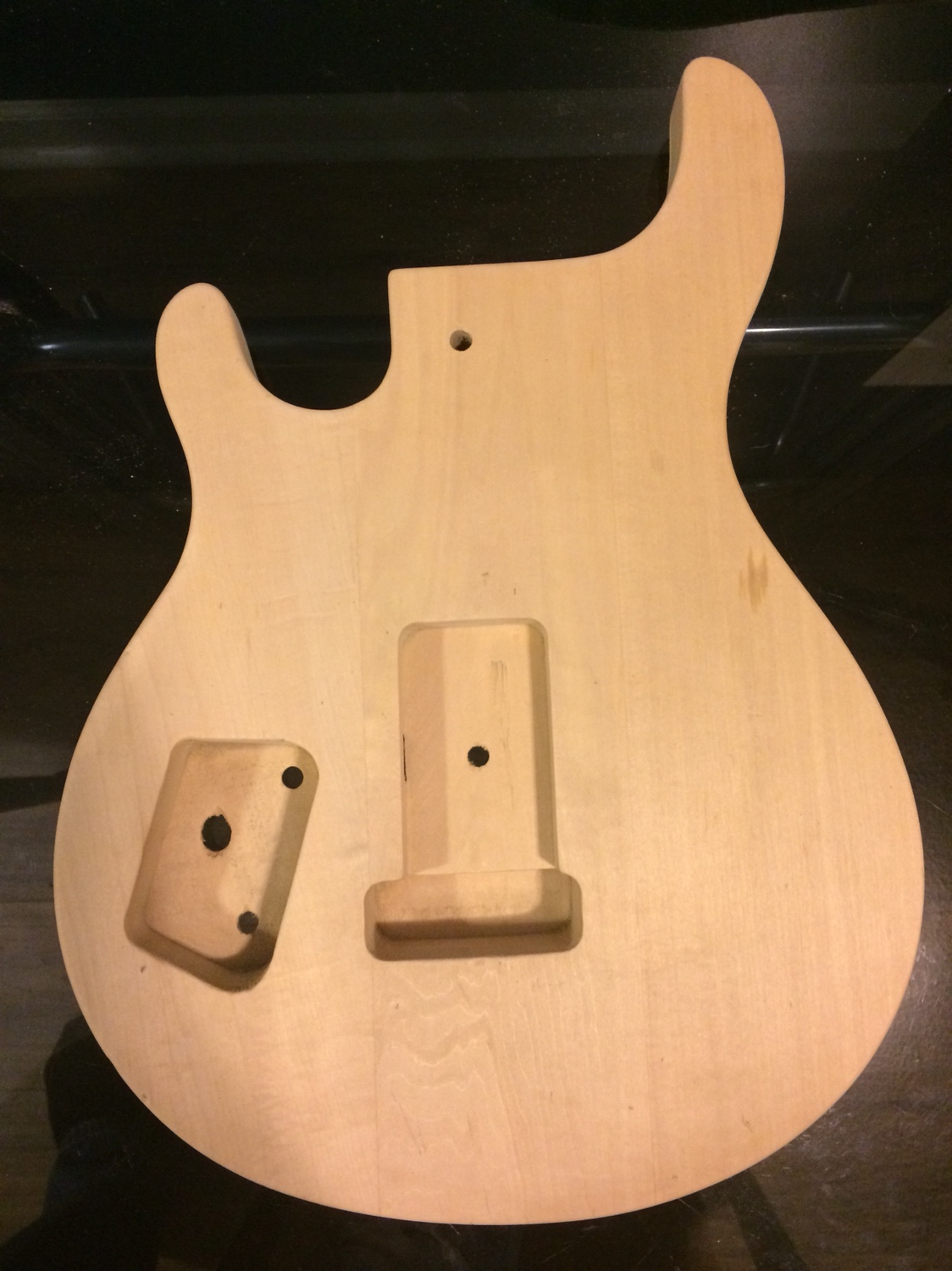

I started by staining the back and sides a medium-to-dark oak color. Then, I had it in my mind that I was going to rub a dark blue oil enamel into the grain to get a really cool look, but the grain wasn’t pronounced enough and the blue started taking on a greenish hue due to the yellowish wood underneath.


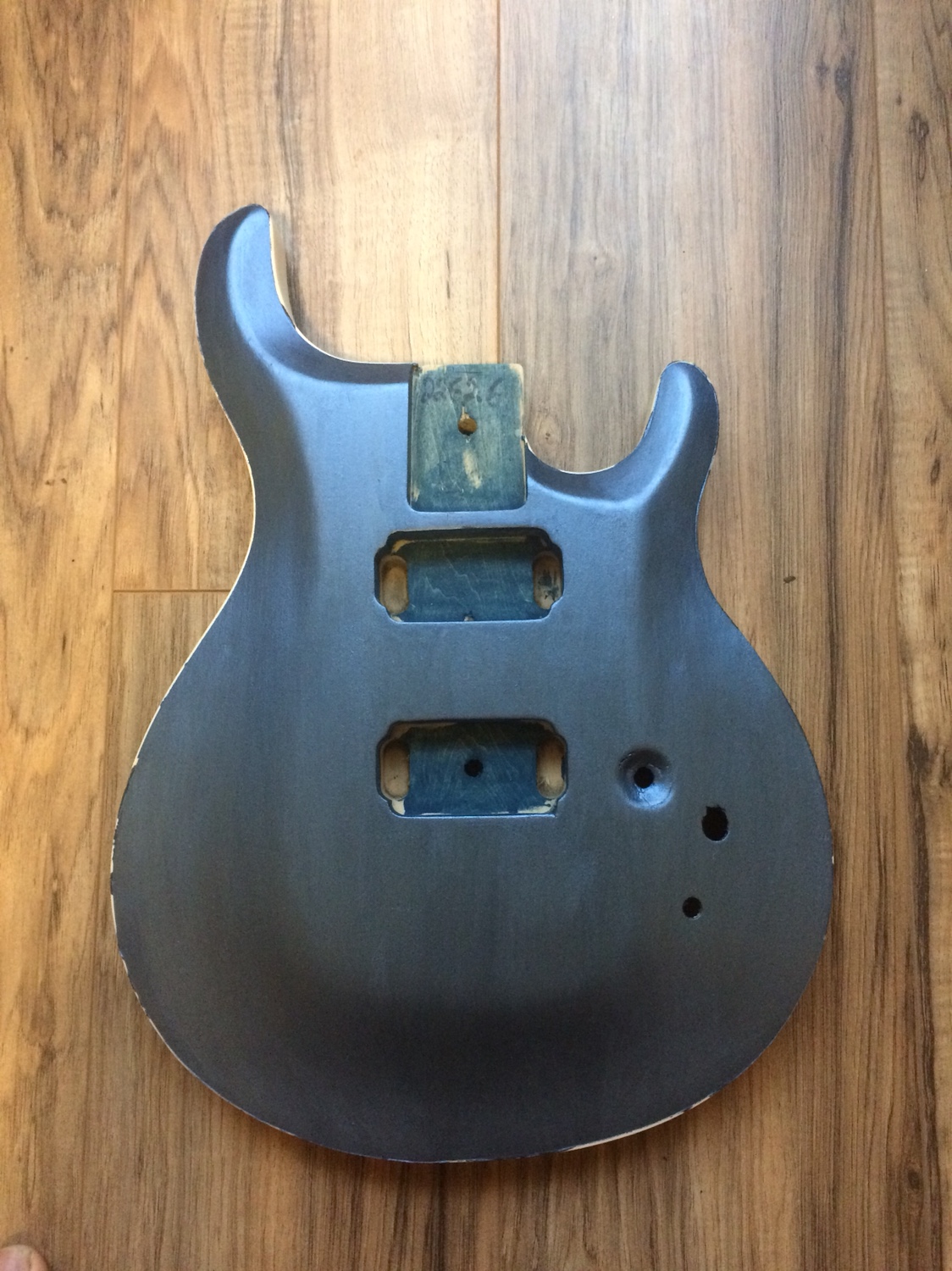
So I decided to use it as a basecoat and start faux finishing over top with some metallic glazes by Modern Masters that I had around. The first coat is a color called “Pewter” and I applied it by blotting it on with a rag:

The next coat is a color called “Shimmering Sky” and was applied in the same way.
Then came the coats of clear... ten of them. Here’s the product I used... it’s VERY hard (used on gymnasium floors) but it’s a waterborne acrylic so it will stay crystal clear instead of yellowing as it ages. It also went on with a brush and leveled quite nicely.


Now then... I’ve gotten comments about how ugly the piece of wood grained vinyl is underneath the controls. And those comments are absolutely correct... it’s ugly as hell! I never intended to have it there... and I’ve not revealed this publicly before now...
When I was doing the wiring I discovered that the channel for the wires to pass through from the pickups into the control cavity was too small to accommodate both pickups. “No problem,” I told myself, “I’ll just drill it out a little wider.”
Let’s just say that my (then 3-year-old) grandson chose the moment of drilling to barge in and tackle his Papa’s leg. The drill went way too far, coming out the front of the guitar right alongside of the volume control hole. I was heartbroken at first because there was no way to repair it and keep it hidden because of the finish. I settled for making use of a piece of vinyl flooring... flexible enough to mold to the carved top, but rigid enough to mount the controls to.


Mary Ann... I have no idea what to say this guitar is except “unique.”
THIS one I did the body finish... and it was a bit of an adventure...
I bought this body from GuitarFetish’s Factory Buyout Clearance (I love that place) for $25.00. I liked it because it was unique, but here’s what I started with:
But it was actually much rougher and dirtier in person... here it is when I took it out of the box:
And so began the sanding... and sanding... and sanding. As with the previous neck, I started with 150 grit and finished with 220, but this one took a lot more time. It was so dirty that, as I sanded, I actually discovered a very nice cream-colored bonding!
I started by staining the back and sides a medium-to-dark oak color. Then, I had it in my mind that I was going to rub a dark blue oil enamel into the grain to get a really cool look, but the grain wasn’t pronounced enough and the blue started taking on a greenish hue due to the yellowish wood underneath.
So I decided to use it as a basecoat and start faux finishing over top with some metallic glazes by Modern Masters that I had around. The first coat is a color called “Pewter” and I applied it by blotting it on with a rag:
The next coat is a color called “Shimmering Sky” and was applied in the same way.
Then came the coats of clear... ten of them. Here’s the product I used... it’s VERY hard (used on gymnasium floors) but it’s a waterborne acrylic so it will stay crystal clear instead of yellowing as it ages. It also went on with a brush and leveled quite nicely.
Now then... I’ve gotten comments about how ugly the piece of wood grained vinyl is underneath the controls. And those comments are absolutely correct... it’s ugly as hell! I never intended to have it there... and I’ve not revealed this publicly before now...
When I was doing the wiring I discovered that the channel for the wires to pass through from the pickups into the control cavity was too small to accommodate both pickups. “No problem,” I told myself, “I’ll just drill it out a little wider.”
Let’s just say that my (then 3-year-old) grandson chose the moment of drilling to barge in and tackle his Papa’s leg. The drill went way too far, coming out the front of the guitar right alongside of the volume control hole. I was heartbroken at first because there was no way to repair it and keep it hidden because of the finish. I settled for making use of a piece of vinyl flooring... flexible enough to mold to the carved top, but rigid enough to mount the controls to.
BriGuy1968
New member
Re: Briguy - what is your finishing regime.
You caught me!
See the roller nut? The sideways angle from the nut to the tuner was too much and the low E string kept jumping out of its slot. I tried to correct it with the string tree, which helped a little but not enough. That picture was taken at that time. If you look at the first pic in that post you’ll see that the string tree is now gone along with the roller nut... replaced by just the lower part of a FR-style locking nut. The real problem was (is) that in widening the neck pocket I did most of the wood removal on the lower/treble side. The string doesn’t travel perfectly straight along the neck to the nut and it ends up creating an angle which shouldn’t be there from the nut to the first tuner.
I actually have all the strings off her now with plans to fix it correctly, but I haven’t found the time to dig into it.
I never noticed this before, but I must ask, what is the idea behind your string tree placement?
You caught me!
See the roller nut? The sideways angle from the nut to the tuner was too much and the low E string kept jumping out of its slot. I tried to correct it with the string tree, which helped a little but not enough. That picture was taken at that time. If you look at the first pic in that post you’ll see that the string tree is now gone along with the roller nut... replaced by just the lower part of a FR-style locking nut. The real problem was (is) that in widening the neck pocket I did most of the wood removal on the lower/treble side. The string doesn’t travel perfectly straight along the neck to the nut and it ends up creating an angle which shouldn’t be there from the nut to the first tuner.
I actually have all the strings off her now with plans to fix it correctly, but I haven’t found the time to dig into it.

Lake Placid Blues
New member
Re: Briguy - what is your finishing regime.
Wise advice justFred.
1) Grain filler. Mahogany, and ash among the more common woods that will need grain filler. They will need multiple applications. Ash may require up to around 5 applications.
A)If you don't want the wood to absorb much filler/finish, apply a light coat of lacquer, or sand and sealer, or what ever is your clear coat, and allow it to cure long enough to shrink and fall into the pores a little bit. This will also protect the field of the wood if you plan on a transparent color or finish.
B)If your going for a transparent color or finish and you want the grain to stand out, dye the the grain filler a dark color before application.
C) Apply the grain filler with a rag or with your fingers, rubbing it in.
D) After about ten minutes, wipe most of it off with a rag soaked with mineral spirits or the solvent you need for the type of grain filler you are using. If you neglect to do this you will be pissed when you try to sand it off tomorrow.
E) Let dry and then sand it down to the bare wood with 220. Be sure not to sand the grain filler out of the grain, so easy does it.
F) This is a rinse and repeat step with ash and mahogany.
2) If your going to dye the wood or a apply transparent color now is the time, otherwise go to step 3.
3) Sand 'n Sealer. The sand and sealer is a clear coat that is a little thicker than normal. It is to fill in the remaining divets in the wood. Put on a coat and let dry. Then sand it lightly to level the surface, then do it a again. You will want to do this step even if on a closed grain wood such as maple or alder.
4) If your going with a transparent finish you can skip this step. If your going for a solid color, then now is the time to apply a white or possibly black under coat.
As with all finishing coats stop and repair any runs, drips, orange peel, sand throughs, before proceeding. Flaws will come back to haunt you. However, sometimes very minor flaws are better left alone as you might make it worse and you can go nuts over little things. If you are OCD you should not be doing this.
5) Apply the color coat. If it is a metallic color avoid sanding it.
6) Apply the clear coats. You will want a few on before touching it with any wet sanding or compounds.
7) Wet sanding. Start with maybe 800 depending on how not smooth it is and progress up to 2000+. Easy does it. If you sand through you will be pissed. Avoid touching any edges and corners at all.
8) Polishing compound. Finesse It is the standard.
I use Reranch sand sealer, primer, paint and clear coat - StewMac grain filler - Finesse-It II for final polishing after 2000 wet sand:
http://www.tundraman.com/Guitars/Finish/
Wise advice justFred.
1) Grain filler. Mahogany, and ash among the more common woods that will need grain filler. They will need multiple applications. Ash may require up to around 5 applications.
A)If you don't want the wood to absorb much filler/finish, apply a light coat of lacquer, or sand and sealer, or what ever is your clear coat, and allow it to cure long enough to shrink and fall into the pores a little bit. This will also protect the field of the wood if you plan on a transparent color or finish.
B)If your going for a transparent color or finish and you want the grain to stand out, dye the the grain filler a dark color before application.
C) Apply the grain filler with a rag or with your fingers, rubbing it in.
D) After about ten minutes, wipe most of it off with a rag soaked with mineral spirits or the solvent you need for the type of grain filler you are using. If you neglect to do this you will be pissed when you try to sand it off tomorrow.
E) Let dry and then sand it down to the bare wood with 220. Be sure not to sand the grain filler out of the grain, so easy does it.
F) This is a rinse and repeat step with ash and mahogany.
2) If your going to dye the wood or a apply transparent color now is the time, otherwise go to step 3.
3) Sand 'n Sealer. The sand and sealer is a clear coat that is a little thicker than normal. It is to fill in the remaining divets in the wood. Put on a coat and let dry. Then sand it lightly to level the surface, then do it a again. You will want to do this step even if on a closed grain wood such as maple or alder.
4) If your going with a transparent finish you can skip this step. If your going for a solid color, then now is the time to apply a white or possibly black under coat.
As with all finishing coats stop and repair any runs, drips, orange peel, sand throughs, before proceeding. Flaws will come back to haunt you. However, sometimes very minor flaws are better left alone as you might make it worse and you can go nuts over little things. If you are OCD you should not be doing this.
5) Apply the color coat. If it is a metallic color avoid sanding it.
6) Apply the clear coats. You will want a few on before touching it with any wet sanding or compounds.
7) Wet sanding. Start with maybe 800 depending on how not smooth it is and progress up to 2000+. Easy does it. If you sand through you will be pissed. Avoid touching any edges and corners at all.
8) Polishing compound. Finesse It is the standard.
Last edited:

Re: Briguy - what is your finishing regime.
I'm always afraid to use different products together as sometimes what you are adding will cause what you used previously to leach through. Because of that I've never tried the grain filler, just lots and lots and then lots again of the lacquer for natural wood finishes, I've never used poly. If you're painting a solid color then 2 part mix epoxy glazing compound works great but don't use the single part as it can soften up and leach through. I am liking the Deft and Premium Decor lacquer the most. The Minwax is harder to sand, washes away too easily, and doesn't seem as hard. Rustoleum makes some laquers but they are worse than the Minwax at coming off. You can easily remove the finish with simple isopopyl with the Rustoleum weeks after it was applied.
After 1500 I switch to rubbing compound, does the 2000 make much difference?
I'm always afraid to use different products together as sometimes what you are adding will cause what you used previously to leach through. Because of that I've never tried the grain filler, just lots and lots and then lots again of the lacquer for natural wood finishes, I've never used poly. If you're painting a solid color then 2 part mix epoxy glazing compound works great but don't use the single part as it can soften up and leach through. I am liking the Deft and Premium Decor lacquer the most. The Minwax is harder to sand, washes away too easily, and doesn't seem as hard. Rustoleum makes some laquers but they are worse than the Minwax at coming off. You can easily remove the finish with simple isopopyl with the Rustoleum weeks after it was applied.
After 1500 I switch to rubbing compound, does the 2000 make much difference?
Similar threads

- Replies
- 13
- Views
- 549


- Replies
- 6
- Views
- 353

- Replies
- 60
- Views
- 2K