DIY Acoustic Panels?

Mononoaware

Active member
Have you made these, and if so, what was your experience? We bought a new home, and my new office could use a few to reduce reflections.
 
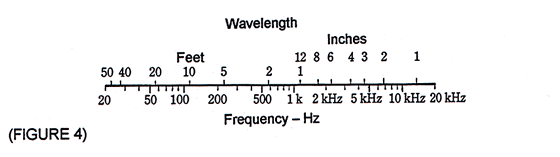
The thing to note about absorption is in order to absorb a wave, the thickness of the absorber has to be at least 1/4 the length of the wave. So notice that to absorb or trap bass waves down to 80hz theoretically it would need to be about 15 feet thick!
101x2_1.gif


You might be better off with some diffusion/absorbers like these.
https://www.gikacoustics.com/product/slatfusor-pl-poly-cylindrical-wood-slat-diffuser/

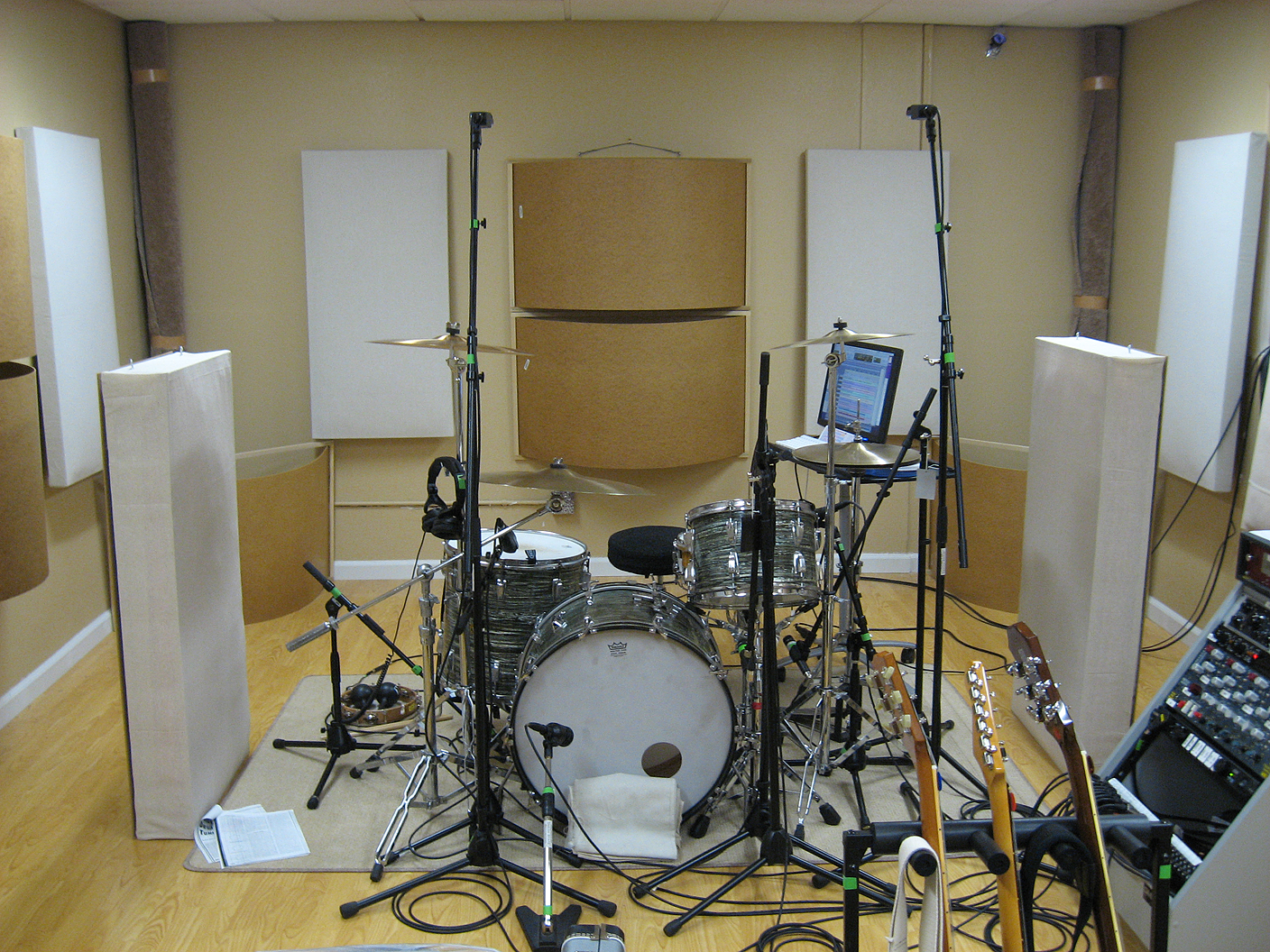
I made absorbers with cheap frame wood and R19 insulation. Very effective, but they do stick out about 2-4" from the wall. Actually I did a mix of absorbers and diffusers. I alternated so the diffusers kick the sound into the absorbers. A cheap effective diffusor is just using cheap 1/2" wood for a frame and tacking a panel of Masonite such that it bows in a shallow curve. There is a calculation of arc that determines what frequency it will diffuse down to (mine only diffused down to 125hz I think, I should have made them shallower). The greater the arc the lower the frequency it will diffuse, which is good because then it can sit closer to the wall and not stick out so much. I should have done mine floor to ceiling. The way I did it, there was still too much energy reflecting around the ceiling and floor areas.

IMG_7897.png
 
If you just want to cut down high end reflections, acoustic foam works well. You can also make panels like Beau is talking about, and they can be as simple as putting a slab of insulation on a piece of plywood, wrapping fabric around the front, and stapling it to the back.
 
You can also use rigid fiberglass insulation panels. They're 2' x 4' x 2" and hold their shape well. You can stack them for a double layer.
Absorbing bass frequencies is more demanding, and becomes more complicated

When I built my first studio back in the 80s it was in a suite that already had the walls in place. I added an angled wall to the large soundroom, making it asymmetrical (and allowing for an isolation booth) and added a soundproofing wall to help isolate the control room. But there were still two parallel walls and despite a 12' ceiling, it was still parllel to the floor.

Anyway, I found a lot of useful information about treatments and tuning in a book by F. Alton Everest called 'How To Build A Small Recording Studio From Scratch'. It's out of print now but a later edition co-written with Mike Shea is still available, and doubtless updated & even more useful.
 
Last edited:
NegativeEase would have a better idea of how to handle sound treatment for a small room. He's contributed to designing and building professional studios, and has a ton of experience working in them.
 
Can't edit my posts, but FYI mine was not a permanent installation. The room was rented and all those treatments were just hanging on the wall. I could tear down the whole thing in 15 minutes.
 
One of the big things is that to be most effective, the sound absorber needs to be as close as possible to the listener or the sound source. The closer you get to a middle distance the less effective.
 
One of the big things is that to be most effective, the sound absorber needs to be as close as possible to the listener or the sound source. The closer you get to a middle distance the less effective.

Hmm, don't know that to be accurate. If it absorbs waves, it absorbs waves and prevents reflections wherever it is. The key is that surfaces that reflect back to the listeners ears are treated, wherever those are. The way to identify which walls need to be treated is to sit in the listening position and have someone else take a mirror and move it along the wall. If you can see the speakers in the mirror, that's where you need the absorber (or diffusor, or both).
 
I should clarify that the further the deadener is from either the source or the listener, the larger surface area it has to have to be effective. In practice it is better to deaden closer to the source.
 
I should clarify that the further the deadener is from either the source or the listener, the larger surface area it has to have to be effective. In practice it is better to deaden closer to the source.

Doesn't that defeat any head room that you have?

Wait, wait, wait. . I get what you're saying now. I still vote for more, farther away though
 
Last edited:
Smooth hard surfaces produce reflections
this is why we call popcorn ceiling acoustic ceilings

If you could just get some cheap foam from the hardware

Put it over the walls
Paint it

If 1/4 inch wasn't so flimsy that would work

You don't have to cover the wall

Just break up the flat existing surface
 
Smooth hard surfaces produce reflections
this is why we call popcorn ceiling acoustic ceilings

If you could just get some cheap foam from the hardware

Put it over the walls
Paint it

If 1/4 inch wasn't so flimsy that would work

You don't have to cover the wall

Just break up the flat existing surface

Cheap foam will only absorb very high frequencies and throw the mix out of balance. If possible, it's better to treat the full range of frequencies equally. Putting an uneven, angled wall in that diffuses the sound would be better in that case.
 
The thing to note about absorption is in order to absorb a wave, the thickness of the absorber has to be at least 1/4 the length of the wave. So notice that to absorb or trap bass waves down to 80hz theoretically it would need to be about 15 feet thick!
101x2_1.gif


You might be better off with some diffusion/absorbers like these.
https://www.gikacoustics.com/product/slatfusor-pl-poly-cylindrical-wood-slat-diffuser/

I made absorbers with cheap frame wood and R19 insulation. Very effective, but they do stick out about 2-4" from the wall. Actually I did a mix of absorbers and diffusers. I alternated so the diffusers kick the sound into the absorbers. A cheap effective diffusor is just using cheap 1/2" wood for a frame and tacking a panel of Masonite such that it bows in a shallow curve. There is a calculation of arc that determines what frequency it will diffuse down to (mine only diffused down to 125hz I think, I should have made them shallower). The greater the arc the lower the frequency it will diffuse, which is good because then it can sit closer to the wall and not stick out so much. I should have done mine floor to ceiling. The way I did it, there was still too much energy reflecting around the ceiling and floor areas.

IMG_7897.png

This is a great job
 
Also, download one of the free real time analysers that do the basic functions of things like the expensive Smaart Live -I can send some links -You can really figure out the modal/ resonance issues if you want to go that far. If not there are sojme basic rules that can get your office sounding good without too much technical effort
 
Back
Top