Fret leveling question

Snoogles

Cranky-dologist
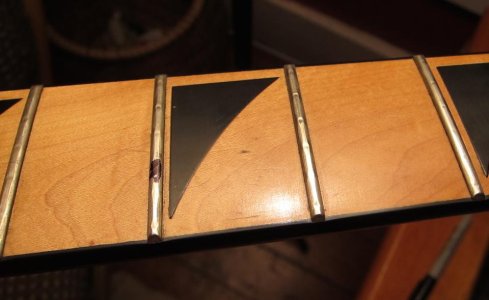
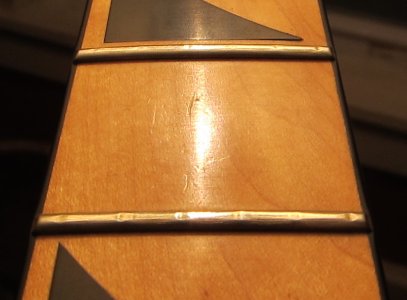
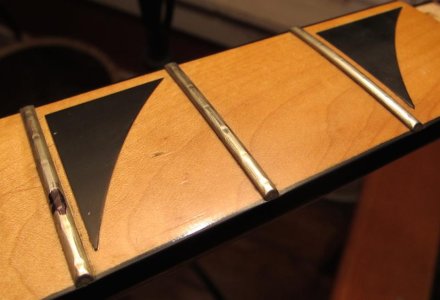
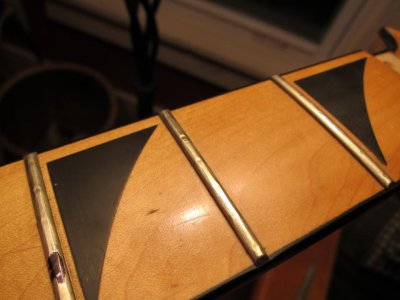
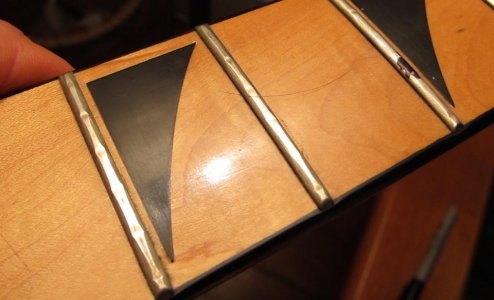
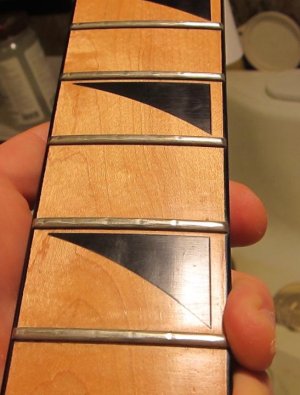
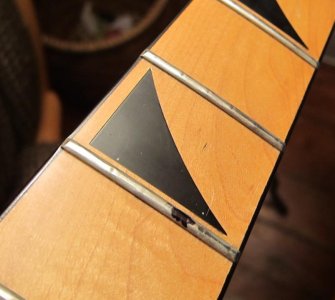
i got a neck that has indents on the frets from where the strings have been pressed down.
i straightened out the neck with a notched straight edge, then checked the levelness of all the frets and found only 4 spots where the fret was high.
so what do i do about these indents though?
do i just re-crown them (which it probably needs anyway)? or do an entire leveling process with the sanding beam and all of that?
the indents are pretty much all over the neck
IMG_0597.jpg

IMG_0598.jpg

IMG_0599.jpg

IMG_0600.JPG

IMG_0601.jpg

IMG_0602.jpg

IMG_0603.jpg
 
Re: Fret leveling question

Wow, I would have said to try sanding them with Emory cloth if it were just a few. But for that many, I would just do a re-fret.

Sent from my MotoE2(4G-LTE) using Tapatalk
 
Re: Fret leveling question

Wow, I would have said to try sanding them with Emory cloth if it were just a few. But for that many, I would just do a re-fret.

Sent from my MotoE2(4G-LTE) using Tapatalk

G'AAAAHHHGG!!!! an entire RE-FRET??!!

the dents aren't very deep. couldn't i do a sanding level job with a beam?
 
Re: Fret leveling question

Hey, just my opinion, and I by no means claim master status on necks.

Sent from my MotoE2(4G-LTE) using Tapatalk
 
Re: Fret leveling question

I've had a couple necks with similar issues (one w/ medium frets, one w/ smallish frets) — a professional levelling job made them better than new.

To my shock in both cases there was a lot of life left in the frets, even though I feared I'd need a re-fret.
 
Re: Fret leveling question

I'd say just a light leveling removing as few material as possible, and then crowning, polishing.
 
Re: Fret leveling question

Level and recrown them and then decide if they are high enough before refretting it?
Them's some damn big divots though
 
Re: Fret leveling question

The whole thing needs to be leveled and crowned. You can't just address a few frets that will make Some lower than others and you'll never get the action right

Jumbo frets can be leveled and crowned many times and still feel good
 
Re: Fret leveling question

this is a new development. upon closer inspection of the fret board i have discovered that its a bit wavy down the lenghth from 1st to 24th fret.
it dips ever so slightly after the first fret. and rises back up at the 6th. we're talking ever so slight. fraction of a milimeter.
then dips again at the 18th fret to the 24th. this dip is a little more significant. maybe 1/2 millimeter by the 24th
 
Re: Fret leveling question

now i have a theoretical question. doing an over-all level with the sanding beam levels the frets down the length of the fret board. but what about the levelness of the fret from low- to high-E string? what happens if the frets are slightly lower under the B, and E strings along the length of the fret board?
maybe i'll answer my own question: the strings will fret out when they're bent up to the higher section under the G-string?
 
Re: Fret leveling question

Keep the beam parallel with the centreline of the neck and it should follow the radius of the fretboard
 
Re: Fret leveling question

This info isn't intended to teach anyone how to do a level, crown and polish, but help anyone who doesn't know what the process is understand it.

Your frets qualify for a level, crown and polish because there is plenty of fret material (fret height) left. A refret is necessary when the frets have little height left. Tyoically, a neck can handle several levelings before it needs to be refretted.

The way I was taught to do a fret level, crown & polish is to mark each fret with a black marker.
Make sure the neck is straight.
Use a flat file along the length of the neck.
The file wearing off the marker will tell you where your high and low spots are.

Unfortunately, all frets will need to be filed down to the low spots of your divots. Otherwise, those spots will likely buzz or present other issues. This means the less worn frets will be filed flatter (squarer) than the worn frets. On less severe wear, you might be able to do only a portion of the neck, or a few frets. This is not true for the amount of wear on your neck.

You file as low as the lowest worn spots but the whole neck (fretboard) needs to be filed to an equal height. The marker reveals which frets are higher and lower and you keep going until the entire fretboard is level to the same height. This is where the term "level" comes from.

The squareness (flatness) is taken away when each fret is crowned.

Afterwards, you polish each fret with very light sandpaper to remove any residual file marks.

I have never had anyone complain afterwards. The improvement, if done correctly, is incredible. After a few levels on the same neck, the overall fret height might not be as appealing and that is when you consider a refret.

Hope this helps!
 
Re: Fret leveling question

A level and crown would work fine. Do you use a neck jig or not (to get the fretboard level under string tension)? I've always wondered if you could just get the fretboard level with your notched straight-edge and then level the frets with the beam?
 
Re: Fret leveling question

A level and crown would work fine. Do you use a neck jig or not (to get the fretboard level under string tension)? I've always wondered if you could just get the fretboard level with your notched straight-edge and then level the frets with the beam?

i personally don't have a neck jig. and maybe that's why i'm finding the fret board ever so slightly wavy. but i've seen plenty of youtube videos of whom i assume are professionals doing leveling jobs who aren't using jigs either.
 
Re: Fret leveling question

I'm "old school" and don't use a jig either.
I do have a 36" straight-edge that I use to verify the neck is straight before I start the level-filing.
30+ years and no issues yet ....
 
Re: Fret leveling question

I'd level, crown and polish too. No refret needed.

You asked what happens if the frets are lower all across the board around the B-G string. If you do it that way, bending would be a bit of a pain cause the string would choke on the high spots of the frets near the D-A string (not on the fret you're bending, but one higher. I.e.: if you bend on the B or G string, 9th fret, it might choke on the 10th fret near the D or A string, depending on how high you're bending).

I personally level the frets slightly LOWER in the middle to create a relief for bending strings. Works out fine.

I also run the frets over with a fretrocker to find the high and low spots.

It takes me, from start to finish, approximately 3 hours. that includes polishing. But at the end of the day, I end up with a superbly low action (around 1,2mm @ 22nd fret high E | 2mm @ 22nd fret low E).
 
Back
Top