Re: HSS wiring issue
While we wait back for a response about your question so we're 100% sure I'll start with a few tips since you're new to soldering. This is all in a positive and helpful manor. No as I call it on here pick measuring.
I've got a basic idea of the wiring as I've never played a Jaguar. My thing was always pointy heavy metal guitars. I just need to know about the switch. If anything I could draw you a diagram as that import blade switch was so poorly documented I pretty much made it a hobby to make wiring diagrams with it.
some tips
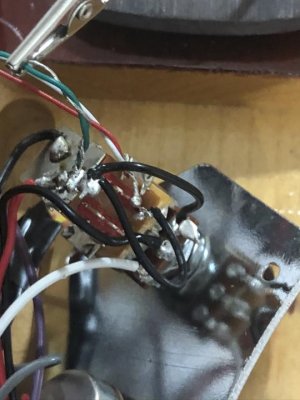
the green / bare wire on the push pull put some electric tape or heat shrink over it. Bare wires touching the backs of pots can result in some issues.
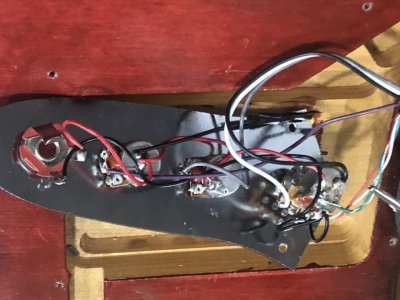
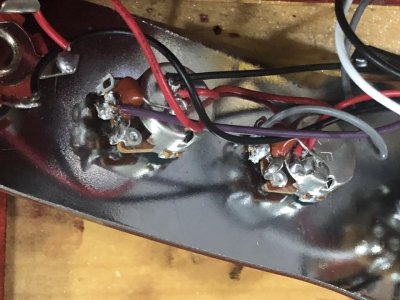
by the looks of it all the red wires connect the backs of the pots for ground right?
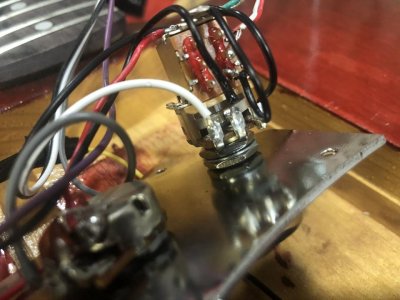
from the image "img_0060" it does not look like the push pull is grounded. The bottom terminals closest to the controls should be connected to the top or side of the push pull. Remember the entire thing is conductive and all you need is the one connection.
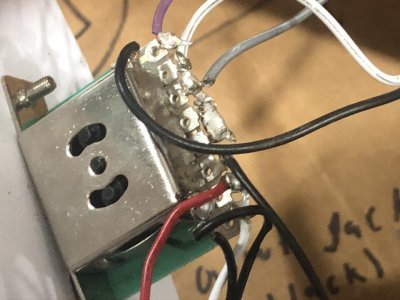
the first thing is to make sure after you strip the wire to twist up the exposed wire end and apply solder to the end of it. This avoids results like "img_0058" where the wire is all spread out and messy. Doing ambitious stuff like Jimmy Page wiring would be a nightmare without this. Plus you get much more stronger connections. You should be able to give a light tug to any connection and not get a wire fly off.
Next every few minutes stab the soldering iron with brass looking steel wool or wipe the tip down with a wet sponge. Don't worry you can keep the iron plugged in while doing this using either. "Brass looking steel wool" I forget the technical term as I bought a box of it so long ago. My expensive Hakko soldering iron I used every day last year still looks very new thanks to it. This prevents this hardened black substance on the tip of the iron. If the tip of the iron goes black it can be fixed. However without a silver shiny soldering iron tip it's tougher if not impossible for the iron to reach high enough temperatures. If it's a cheap hobby soldering iron and the tip is black sand it lightly with 220 or so grit sand paper. However don't rely on this as it's an emergency situation as once that plating on the irons tip goes you're going to slowly watch the irons tip fade away like a pencil.
After you clean all the junk off the soldering iron tip be sure to apply more solder to the tip of the iron. This means you'll work very easily as the iron
If your iron has a heat control. I would turn the temperature down to avoid burnt wire ends. My usual temperatures are 450f (232c) - 550f (287c). This is using lead free 0.8mm to lead 60/40 1.5mm. 450f is where I start every project and will only ever raise the temperature to 550f to more the less for pulling old wires or blobs of solder from previous work done on guitars. If your iron doesn't have one skip this step. I've done amazing work with basic 20-30w hobby soldering irons.
solder flat - this one is hard to describe but always make sure the wires ends solder flat. Never up. This creates more surface contact so less potential for the wires to be pulled off
tin most contacts. Use your discretion on this. On a build like this the only contacts I would not tin before soldering is the bottom of the push pull. That I'd push a capacitor lead (metal part you cut off) into both bottom contacts on the push pull. Besides that before any connection is made plan ahead. Backs of pots. Volume or tone pots apply solder and create a wall of it covering the contact. Then get your tinned wire and touch the top of the contact and let the wire slide through.
anyways the first place I'd give the most attention to is the switch. Any time I'd see burnt wires like that i'd pull all the old stuff off and start again.
pull the old wire out
cut the burnt end
strip and twist it
tin the wire end
tin the switch contact
and touch the iron near the switch contacts hole and let the newly prepared wire do it's job
count to 5 slowly as you hold the wire in place
if you can't tug it off once the solder cools down you're set
Good luck on your project. Those are some tips or approaches I've learned over the years and I've shipped stuff all over the world how confident I am with these techniques. I'm sure there is a ton of great videos on youtube if you're a visual learner like I am.
I really believe that you are honestly and sincerely trying to help people with your posts. And I really DO appreciate your caring attitude and willingness to help. But one piece of advice...it's better if your posts aren't so verbose.
You have lots of spare time. All of your posts are novels and waste everyone's time just reading through them. I can imagine how much time it takes to write them. Yes, sometimes you have some good things to say and your diagrams are
MUCH appreciated, but you really only need to post things that you KNOW are correct. If it's not true...either don't post it or precede it with "It's my belief/understanding/opinion that...".
Anyway, it is very
clear in his pic that the p/p pot is grounded (with black wire). Not very great soldering technique, but it is correctly grounded...as you had suggested.
"
Create a wall of (solder)"! What the heck!
Absolutely NOT. You need to read the thread I started about correct soldering techniques i posted a couple months ago. Learn how to solder correctly before advising others to do it incorrectly.
"
Burnt wires"? You don't own, nor have you ever used a soldering iron that can burn wire. What you are seeing in his pics are rosin flux. In all fairness, maybe you have never used rosin core solder and don't know what it looks like. In that case I apologize for being a little abrupt.
You are like a guitar that has been wired by a first-timer...some
really commendable things happening, some mistakes from lack of understanding that need correction, and some poor execution that could be improved upon.