
cheecharron
New member
Hi everyone,
I'm using a DPDT on/on/on switch to wire a series/tap/parallel switch for a humbucker. I've read about the benefit of putting a resistor in the tap circuit to retain a bit of the grounded coil, thus preventing the single coil from sounding too weak on its own. However, I haven't seen anything about doing that in a series/tap/parallel switch. There's probably a good reason for that, but I am a wiring novice, so I can't be sure. That said, if I adapted a common series/tap/parallel switch by putting a resistor where the red arrows are below, could this achieve the goal of adding a bit of the south coil to the full north coil on the split? From what I can tell, the resistor wouldn't affect the series selection, as the signal could proceed unhindered through the switch-enabled connection. It also wouldn't appear to affect the parallel selection. What happens in the tap selection is a mystery to me. Any thoughts?
Many thanks!
cheech
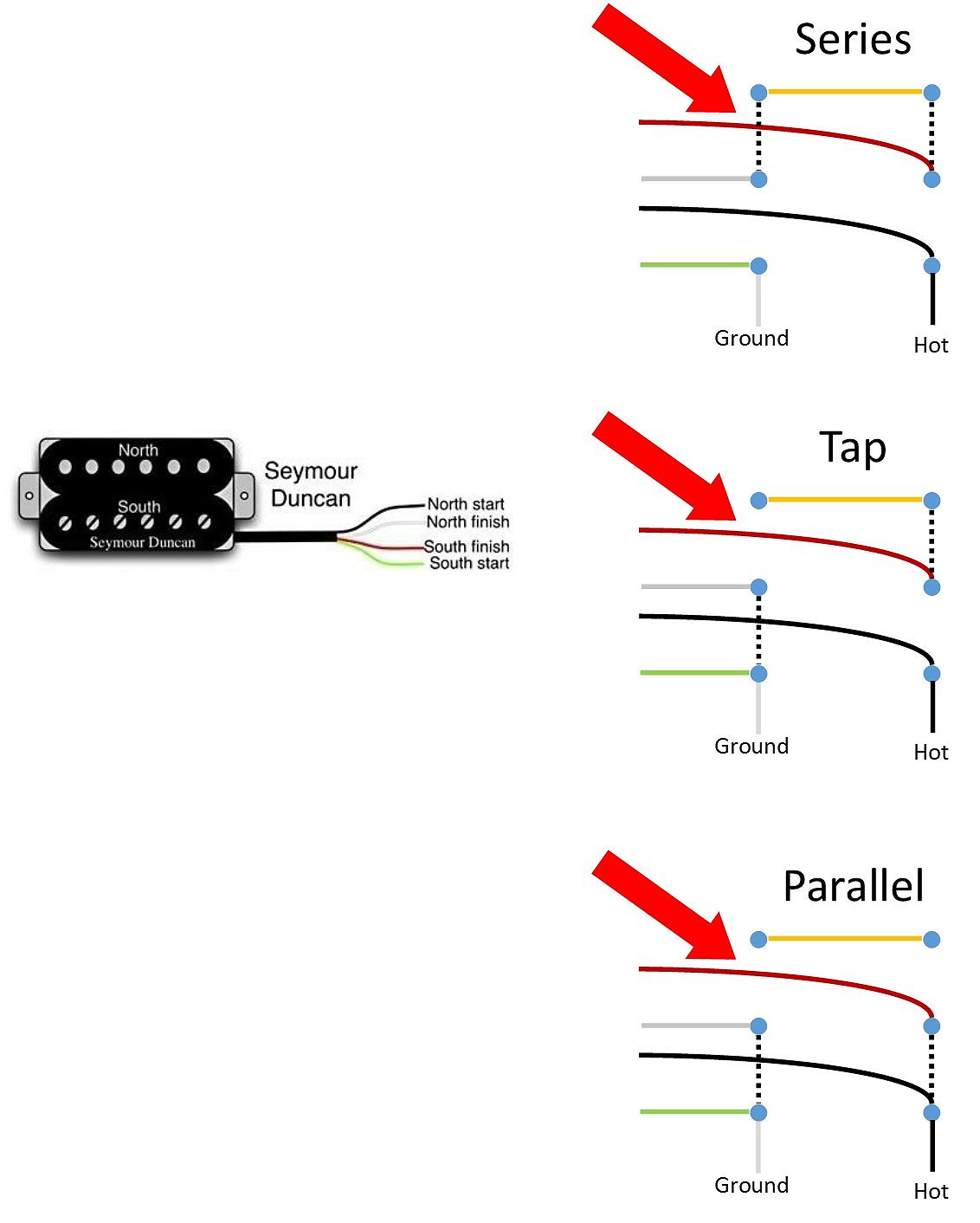
I'm using a DPDT on/on/on switch to wire a series/tap/parallel switch for a humbucker. I've read about the benefit of putting a resistor in the tap circuit to retain a bit of the grounded coil, thus preventing the single coil from sounding too weak on its own. However, I haven't seen anything about doing that in a series/tap/parallel switch. There's probably a good reason for that, but I am a wiring novice, so I can't be sure. That said, if I adapted a common series/tap/parallel switch by putting a resistor where the red arrows are below, could this achieve the goal of adding a bit of the south coil to the full north coil on the split? From what I can tell, the resistor wouldn't affect the series selection, as the signal could proceed unhindered through the switch-enabled connection. It also wouldn't appear to affect the parallel selection. What happens in the tap selection is a mystery to me. Any thoughts?
Many thanks!
cheech


