Shortening pole screws

eclecticsynergy

Well-known member
I'm assuming that shortening filister-type pole screws will give the same slight tightening/brightening effect as shortening hex screws does - this is correct, yes?

Am wondering whether it might be worth experimenting with this.
 
Re: Shortening pole screws

Yes it does the same thing. I just use a Dremel and cutoff wheels. You can also use a jewelers saw. Stay away from the screws at ACE Hardware because they aren't the same metallic composition.
 
Re: Shortening pole screws

Cool, I have a Dremel.

Will be doing just the bass side screws to start with. Do you think it's worth taking off a little bit at a time, or would that just be pointless extra work? Not sure if a couple mm difference would be significant.

I figure I can take almost a quarter inch off standard Duncan filisters and still thread them through the baseplate. How important is it for them to screw into the plate? Obviously they need to reach the magnet; just wondering if I should leave things a little longer than I'd pictured at first.

Thanks for any advice.
 
Re: Shortening pole screws

I shorten all poles on my humbuckers so they are even with the baseplates. I also radius the poles to mimic the curvature of the saddles and neck. It helps clarity quite a bit.
 
Re: Shortening pole screws

The effect of shortening filister screws is that allows the magnetic flow to be sent to the strings being slightly stronger.

Per se, this doesn't brighten the sound, but it definitely helps playing nuances based on touch-sensitivity and pick attack come across strongly.

I first set the filister screws stagger to even out the output differences between strings, so they basically look like this:
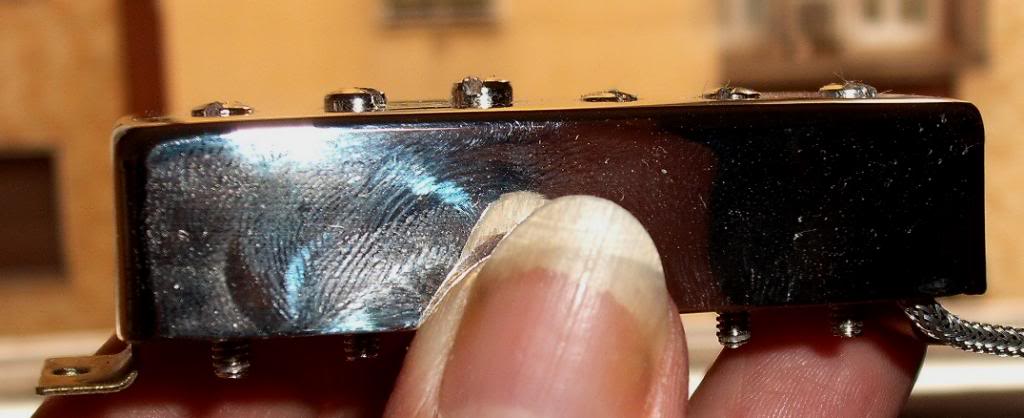


... THEN I cut'em flush with the baseplate. A MUST for neck p'ups, not so much a life-or-death issue on bridge p'ups, if you ask for my personal opinion based on over fifteen years of first-hand experience acquired in the performing of well over a thousand p'up swaps, mods, sweet-spot setting and general guitar setup optimized for both live usage and studio recording.

/Peter
 
Re: Shortening pole screws

The effect of shortening filister screws is that allows the magnetic flow to be sent to the strings being slightly stronger.

Per se, this doesn't brighten the sound, but it definitely helps playing nuances based on touch-sensitivity and pick attack come across strongly.

I first set the filister screws stagger to even out the output differences between strings, so they basically look like this:


... THEN I cut'em flush with the baseplate. A MUST for neck p'ups, not so much a life-or-death issue on bridge p'ups, if you ask for my personal opinion based on over fifteen years of first-hand experience acquired in the performing of well over a thousand p'up swaps, mods, sweet-spot setting and general guitar setup optimized for both live usage and studio recording.

/Peter
thanks for the instuction.
i figure this is the stagger for neck pickup ...?
 
Re: Shortening pole screws

The effect of shortening filister screws is that allows the magnetic flow to be sent to the strings being slightly stronger.

Per se, this doesn't brighten the sound, but it definitely helps playing nuances based on touch-sensitivity and pick attack come across strongly.

I first set the filister screws stagger to even out the output differences between strings, so they basically look like this:


... THEN I cut'em flush with the baseplate. A MUST for neck p'ups, not so much a life-or-death issue on bridge p'ups, if you ask for my personal opinion based on over fifteen years of first-hand experience acquired in the performing of well over a thousand p'up swaps, mods, sweet-spot setting and general guitar setup optimized for both live usage and studio recording.

/Peter
Cool. I may try this on a number of pickups now that I know more about it.
I assume the pic is taken looking from the bridge side, with low E string on the left.

It sounds as if you cut the screws off while they're still in the pickup, correct?

What do you use to cut them off?

Would the motor in a Dremel-type tool degauss the magnets?
 
Re: Shortening pole screws

Cool. I may try this on a number of pickups now that I know more about it.
Start with one. If you're able to hear a difference and assess that's worth your while it, then proceed with the others. Not every p'up out there produce sensible, audible results. Also, the fact that MORE magnetic flow is directed to the strings, will also alter the location of the "sweet spot" as well. It's like you've gotten a new p'up, ergo, you should treat it accordingly, including altering your amp's tone controls as well.
I assume the pic is taken looking from the bridge side, with low E string on the left.
Yes, that's correct. The depicted p'up is a bridge one, although it was used just to illustrate how the stagger of a typical neck p'up would look like. The actual stagger on the bridge p'up is less pronounced.
It sounds as if you cut the screws off while they're still in the pickup, correct?
No. At the beginning, after I set the stagger, I marked the screws with a sharpie, then I measured the lenght of every single one of them and took notes. In that way, I can cut'em before I put'em in. You can buy'em short now, mind you.
What do you use to cut them off?
I use a cutter for the length, then a Dremel to finish the base flat with a slight bevel.
Would the motor in a Dremel-type tool degauss the magnets?
I wouldn't know; the area I operate my Dremel on is located far away from the p'up/electronic area. Not because I think about degaussing, mind you; it's just the way my workspace is set.

/Peter
 
Last edited:
Re: Shortening pole screws

It's not rocket science. All forms of energy (electrical, magnetic, heat, etc) react similarly. If that energy has to travel a shorter distance, then more of that energy gets to its final destination. In the case of a pickup, if the screws are shorter, more magnetic energy reaches the string. This will increase attack, but, contrary to what Peter said, it will also increase brightness and harshness (which may be the same thing as attack). Is it a big difference? No, it's subtle but noticeable. The alloy of metal will also make a difference. Sometimes a huge difference. As far as I know, the brightest alloy that the screws are made in is 1020. You can get screws in 1010 alloy which is much warmer/softer, and in 1018 which is slightly warmer. I've heard that most pup manufacturers use 1018 but I could be wrong (someone please correct me if that's the case).
 
Back
Top