Toroidal Transformer Fitting

Davii

New member
I'm a little lost on how to fit a toroidal transformer that I have for a 1u power amp I've built. From Googling, I understand that it should only be connected to the chassis on one side, but other than that I'm not sure on which bit should go where, and concerned I'll mess it up :15:

I've 2 rubber washers, and a similarly sized metal plate with an indent in the center, plus the nut n' bolt. I've got a piece of aluminium attached to the rear of the case, and think I should have the bolt through that, then a rubber washer, then on the bottom, the metal plate + nut, then the other rubber washer???

Found this whilst Googling:
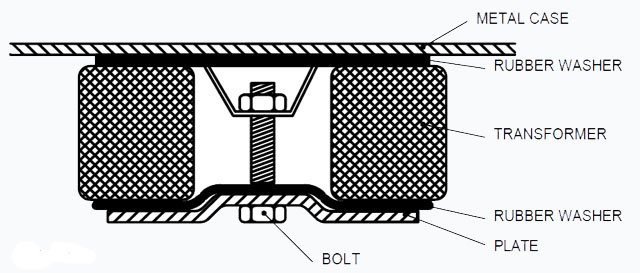
toroid_mount.jpg

That just leaves me scratching my head as to how to relate things to what I've got, so any help appreciated :)
 
Re: Toroidal Transformer Fitting

Could be wrong but seems pretty logical that the "metal case" in your diagram would be the chassis. Not sure what the \_/ shaped bracket is or how it attaches to the "metal case" but other than that, it looks pretty self explanatory. I've use one small torroidal transformer in a small power supply build. It didn't come with mounting hardware. I drilled a hole through the chassis and secured it with a bolt and nut, through the chassis, with a fender washer and rubber washer/gasket up top. No gasket on the bottom, although, for something large that may take some bumps, the rubber washer between the transformer and chassis makes sense. I'm unclear about the aluminum piece you attached to the rear of your case (unless that is a \_/ piece that you made), but again, it doesn't seem like it's rocket science.
 
Re: Toroidal Transformer Fitting

Could be wrong but seems pretty logical that the "metal case" in your diagram would be the chassis. Not sure what the \_/ shaped bracket is or how it attaches to the "metal case" but other than that, it looks pretty self explanatory. I've use one small torroidal transformer in a small power supply build. It didn't come with mounting hardware. I drilled a hole through the chassis and secured it with a bolt and nut, through the chassis, with a fender washer and rubber washer/gasket up top. No gasket on the bottom, although, for something large that may take some bumps, the rubber washer between the transformer and chassis makes sense. I'm unclear about the aluminum piece you attached to the rear of your case (unless that is a \_/ piece that you made), but again, it doesn't seem like it's rocket science.

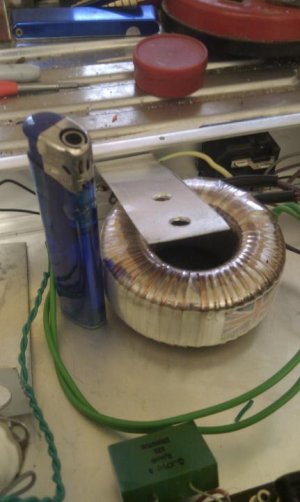
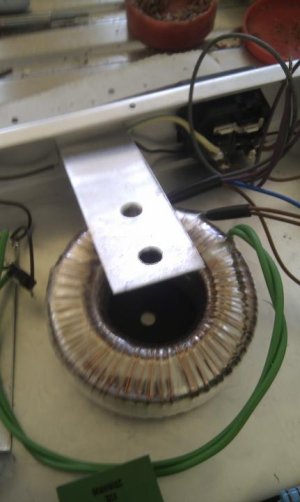
I thought I'd got it clear in my head, until I went to fit it, so maybe I'm overthinking it! I've no idea what the \_/ piece is either, which didn't help. As I can't bolt through the bottom of the case (bolt head or nut would snag on other stuff) I just cut a strip of aluminium to attach to the rear of the case:

IMAG0316.jpg

If I treat that strip like the "metal case" in the diagram, then I'm left with the metal plate at the bottom, which would be touching the case, making it earthed at either end, which I understand is a no-no. Putting another piece of rubber under it might solve that, or just have the rubber washer at the bottom, and do up the nut so that it pulls the center of the rubber washer up until the nut/bolt is clear of the case? Trimming the bolt as required etc.
 
Re: Toroidal Transformer Fitting

That diagram is okay except I'd omit the internal \_/ bracket and use a longer bolt so it came right through the wall of the case/ amp chasis or whatever you're mounting it to. That way you can access both the head of the bolt, and the nut.

Is this a transformer for a valve (tube) amp, or something smaller for a solid-state project ?

I built my 40 watt tube amp using torroidal transformers for both the power supply and the output. Thus, they are reasonably large and heavy. After a while, due to heat, the rubber insulation discs will become a little sticky and help hold the transformers in place. The nuts i used are of the Nyloc type, they have a nylon insert that helps prevent them becoming loose. Because I can access both the head of the bolt and the nut, i can slightly tighten the fixture at any point if i feel i need to.

EDIT ... looks like you posted again whilst i was typing this repsonse.

Hmm, that's gonna be tricky. You definitely don't want to create a conductive 'loop' around the windings of the transformer.

What is the electronic item in question, and how big and heavy is the transformer ? It's difficult to get a sense of scale from that pic. Can you take another pic with a ruler, lighter or other familiar object to give a sense of the size ?
 
Last edited:
Re: Toroidal Transformer Fitting

That diagram is okay except I'd omit the internal \_/ bracket and use a longer bolt so it came right through the wall of the case/ amp chasis or whatever you're mounting it to. That way you can access both the head of the bolt, and the nut.

Is this a transformer for a valve (tube) amp, or something smaller for a solid-state project ?

I built my 40 watt tube amp using torroidal transformers for both the power supply and the output. Thus, they are reasonably large and heavy. After a while, due to heat, the rubber insulation discs will become a little sticky and help hold the transformers in place. The nuts i used are of the Nyloc type, they have a nylon insert that helps prevent them becoming loose. Because I can access both the head of the bolt and the nut, i can slightly tighten the fixture at any point if i feel i need to.

EDIT ... looks like you posted again whilst i was typing this repsonse.

Hmm, that's gonna be tricky. You definitely don't want to create a conductive 'loop' around the windings of the transformer.

What is the electronic item in question, and how big and heavy is the transformer ? It's difficult to get a sense of scale from that pic. Can you take another pic with a ruler, lighter or other familiar object to give a sense of the size ?

I think commercially available rack gear has the bottom of the case made with the necessary indent in it, though this transformer was advertised as being suitable for popping into a 1u case. Clearance is going to bit tight anyway, but think I could get away with a sandwich of rubber washer, plate, rubber washer (or equivelant) if need be.

IMAG0318.jpg
 
Last edited:
Re: Toroidal Transformer Fitting

Thanks for the new pic, that illustrates perfectly the scale of things. The transformer looks tiny.

What is the electronics item in question ? Is it something that will be moved around a lot, or something that will spend it's life operating from a shelf, like a piece of hi-fi gear or electronics test equipment ?

Because if it was something that won't be moved around, I'd just glue it and the rubber discs in there with a great glob of silicon.

Another alternative now we know the size .... the mounting bolt will be small. Thus the head will be small.
It could be possible to drill a pilot hole through the case, turn the case over and place a small steel tube underneath (such as an auto socket, guitar slide or a suitable block of wood with a dimple gouged into it) for support, and create a recess (indent) for the bolt head by tapping down with the ball end of a small hammer, or using a hammer with a suitable punch.
 
Last edited:
Re: Toroidal Transformer Fitting

Thanks for the new pic, that illustrates perfectly the scale of things. The transformer looks tiny.

What is the electronics item in question ? Is it something that will be moved around a lot, or something that will spend it's life operating from a shelf, like a piece of hi-fi gear or electronics test equipment ?

Because if it was something that won't be moved around, I'd just glue it and the rubber discs in there with a great glob of silicon.

Another alternative now we know the size .... the mounting bolt will be small. Thus the head will be small.
It could be possible to drill a pilot hole through the case, turn the case over and place a small steel tube underneath (such as an auto socket, guitar slide or a suitable block of wood with a dimple gouged into it) for support, and create a recess (indent) for the bolt head by tapping down with the ball end of a small hammer, or using a hammer with a suitable punch.

It's just a 4W guitar power amp intended to be placed in a rack of recording gear at home, where it will stay, so no concerned over the riggors of the road. I had thought about attempting the recess, but decided that would more than likely be tricky given my skills to make any worthwhile job of it.

Did you mean that the transformer itself would be glued to the rubber washers, with one of those washers subsequently glued to the bottom of the case?
 
Re: Toroidal Transformer Fitting

The transformer is wrapped in a type of plastic. You aren't going to get any grounding from the chassis. It's not like a metal cased transformer where the case would be grounded with the chassis. The rubber gaskets should be just to protect the plastic wrap from getting worn through by contact with metal mounting surfaces or mounting hardware. It shouldn't matter if there is contact at the both sides. But maybe I'm missing something.
 
Re: Toroidal Transformer Fitting

I'd assumed it's floating, so to speak, just checking on whether you meant for the rubber washers to also be glued to the transformer as well :)
 
Re: Toroidal Transformer Fitting

Did you mean that the transformer itself would be glued to the rubber washers, with one of those washers subsequently glued to the bottom of the case?

That's it exactly. Glue the rubber disc to the case, and the transformer to the disc (or the way you described it, just two different ways to achieve the same result). Maybe also lightly glue the second disc to the top of the transformer or the inside of the case lid if they are going to be close together once everything's closed up.
 
Re: Toroidal Transformer Fitting

That's it exactly. Glue the rubber disc to the case, and the transformer to the disc (or the way you described it, just two different ways to achieve the same result). Maybe also lightly glue the second disc to the top of the transformer or the inside of the case lid if they are going to be close together once everything's closed up.

It does sound like the quickest/easiest solution. There should be ok clearance, so I may leave the aluminium strip there, so that it clamps down on the top rubber washer as the lid goes on as well. Will certainly be doing things differently next time! Thanks for the suggestions :)
 
Re: Toroidal Transformer Fitting

Hmmm, i dunno about leaving the aluminium bracket there .... might be better to remove it and attach some thicker, spongier rubber to the lid that will lightly compress onto the top of the transformer to some degree as the lid gets screwed down, for both insulation and a firmer grip on the donut. But i think basically what we've discussed is the way to go, it should be plenty safe and secure.

(btw, I have a 1-unit rack case and a torroidal transformer for a project i may eventually get around to doing one day ... but that rack case i have came with internal rails with slots and holes that can be mounted in many ways within the case, and used to attach internal items without bolt heads showing on the outside of the enclosure. It just cost somewhat more money than the plainer types that don't have such internal mounting rails).
 
Re: Toroidal Transformer Fitting

The case top slides in, so I may not have many options for something to clamp down without coming off in the process of sliding it in. I had a good look for a more suitable case, but wasn't coming up with much in the way of options. Certainly nothing offering the sort of helpful options for internals that you've mentioned, even on the higher priced ones. I'm sure I'd found that kind of thing before, but Sod's Law prevailed at the time of buying, grr!
 
Re: Toroidal Transformer Fitting

The case top slides in,

Aha, right, well there goes the idea of the 'compression rubber' then. Just stick the top rubber disc to the top of the transformer for protection in case the lid ever got pressed down while the unit was powered up. The mounting to the base should be plenty strong in this case, with such a small, light transformer that won't be subjected to 'life on the road'.
 
Re: Toroidal Transformer Fitting

Well, gluing the transformer went fine, hooked up the remaining bits, and fired things up...

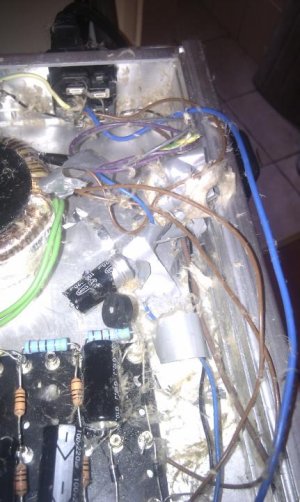
It actually worked! Unfortunately, right up until the point my trying to be sneaky with a soft start resistor didn't pan out, and the reservoir cap exploded!

IMAG0319.jpg
 
Re: Toroidal Transformer Fitting

Well, gluing the transformer went fine, hooked up the remaining bits, and fired things up...

It actually worked! Unfortunately, right up until the point my trying to be sneaky with a soft start resistor didn't pan out, and the reservoir cap exploded!

Ooops !

Good news about mounting the tiny torroidal, not so good about the exploding electro. You'll have a few hours of fun cleaning that up (I know, I've had to do it in tube amps when a big old electro has given out). But if you go back one step next time and forget about the soft-start, you'll probably be fine.
 
Re: Toroidal Transformer Fitting

Ooops !

Good news about mounting the tiny torroidal, not so good about the exploding electro. You'll have a few hours of fun cleaning that up (I know, I've had to do it in tube amps when a big old electro has given out). But if you go back one step next time and forget about the soft-start, you'll probably be fine.

I've got a replacement cap ordered, rated at/for a suitable voltage this time. I couldn't get what I wanted rated any higher than 100v (hence the soft start resistor), so of course I found one immediately the moment it blew. And yeah, what a faffin' mess!
 
Re: Toroidal Transformer Fitting

I've got a replacement cap ordered, rated at/for a suitable voltage this time. I couldn't get what I wanted rated any higher than 100v (hence the soft start resistor), so of course I found one immediately the moment it blew. And yeah, what a faffin' mess!
You did have it around the right way ? Having the polarity reversed on an electrolytic cap is a quick way to blow them up. The bigger they are and the higher the voltage, the more dangerous they become if connected in reverse.
 
Re: Toroidal Transformer Fitting

You did have it around the right way ? Having the polarity reversed on an electrolytic cap is a quick way to blow them up. The bigger they are and the higher the voltage, the more dangerous they become if connected in reverse.

I'd nearly made that mistake early on, when soldering things in, but did have correct orientation. It's noticable that you can be distracted a fair bit by getting placement right, that something simple like that is easy to overlook. Even with all the prep. work! Hopefully, it's just a too optomistic use of componants, and the suitable rating on the new cap will sort things :)
 
Back
Top