Re: Are S&D hotrod pickups EMI shielded?
Poor shielding. I didn't fully understand the shielding concept when I did it months ago, so I didn't shield things properly. No grounding on them and poorly overall.
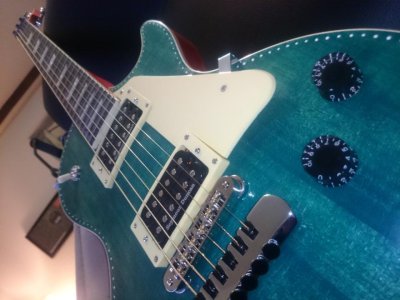
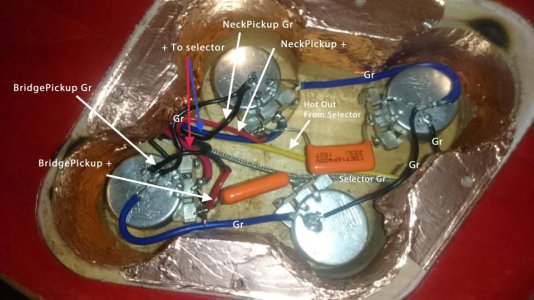
Here is the guitar, the pic from the cavity was before I grounded the pots, shielded the front partially and grounded the shielding:
Hi Sacco
Congrats, good looking guitar. I’d like to post some tips, as
a training exercise (per Mincer) when looking at circuits. I hope your control cavity probably does not look like the picture anymore, but the purpose of my post is an attempt to point out some problems with the photo of your control cavity as it was posted.
The first four problems are related to the grounding of the volume and tone pot internal resistors. If you look at the back of the pot, with the lugs up, #1 is on the left, #3 is on the right. For a modern Les Paul wiring, #1 lug should be soldered to the pot case, or somehow soldered to the ground circuit. Check out other wired Les Paul style control cavities on the web. NOTE: For 50’s vintage PAF wiring, the tone pot ground and cap is soldered differently to the volume lugs. But that’s a different conversation.
The next problems are associated with ground loops, study up on them. As the cavity is wired, when I last checked, you have a huge ground loop with 4 wires connecting all four pots. Only three can be linked. (And depending on how ground wires go to and back from the switch even less). You must maintain a linear ground path from the jack, through the pots, to the switch (and maybe back to a pot). No loops.
Also, if only one or more of the pots, or cable shielding contacts the cavity foil (the foil appears to be grounded to the jack) you will create other ground loops at each point where they contact. Ground loops act like antennas and pickup noise. The cavity foil may cause more harm than good at this point. BTW most/all vintage Les Paul’s don’t have shielded cavities.
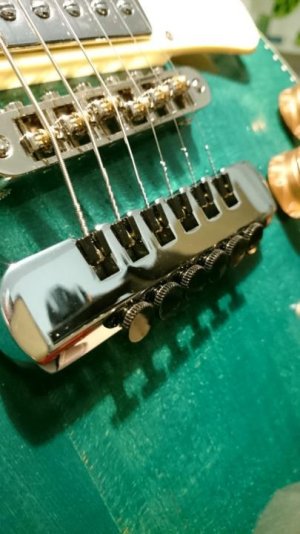
The next problem area appears to be the string ground. The wire that comes from the string bridge should connect to the ground circuit. If the short black wire just above the Bridge volume pot is the bridge ground it looks like it could be connected to the Bridge volume + lug. If that is true, then it needs to be reconnected to the back of a pot. To test this, use your meter and connect it to the strings you should get continuity from the strings to the ground lug of the jack. (Which is the dangerous part of electric guitars on “live unfamiliar stages” where amps or mics might be connected to power outlets with powered/grounded/polarity differences, there’s ways to protect yourself, but get this noise free first).
It’s difficult to see how/where the pot ground is connected to the jack ground. I see the braided Selector Ground attached to the Jack but I can’t identify where the pots are connected to the Jack ground. The Selector Ground looks like braid, you need to be careful that it doesn’t touch something already grounded (like the foil, creating another ground loop and more noise).
If you’re cavity still looks like the photo, then I think the easy fix to all this is totally remove a ground wire from the back of one tone pot AND its respective volume pot. Connect the tone pot case to the jack ground. Disconnect the switch ground from the Jack and attach it to the volume pot case where you just disconnected from it tone pot case. You should now have a ground circuit that runs from the jack to each pot and up to the switch, its linear, there are no loops. Ground the #1 lug to its case for all four pots, and pay attention to the string ground, it needs to be soldered to the ground circuit.
In the end, there should be a linear ground circuit, the string ground should be attached anywhere to the circuit. Each pickup wire shield should be carefully soldered to the ground circuit (so you don’t accidently melt/penetrate the insulation and short to the pickup hot wire). And one side of each pot resister should be connected to ground.
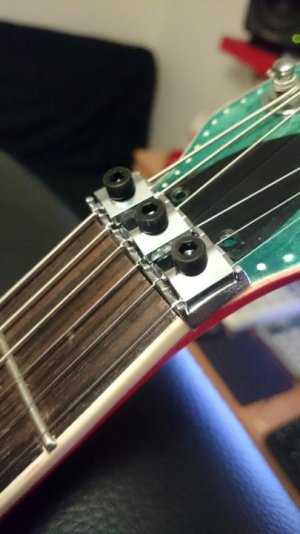
BTW, you have a non-electrical problem with intonation because of how the locking nut is installed. The Floyd Rose style locking nuts are tricky to install. The neck needs to be routed/shaped so that there is an exact 90 degree angle between the base of the nut and the vertical end of the fingerboard. It looks like the bridge edge of the nut is tilting away from the fingerboard (IE the nut base is on the same angle as the headstock). Your string length is now not the same as the fret scale length especially at the first fret.
As a former Lurker
I hope my first tips to this forum help