Bartolinis

Re: Bartolinis

I would guys, but there's also the problem that I'm having trouble finding a maple P bass neck with vintage stain (think butterscotch color, not white maple).

The truss rod on this import--even maxed out, there's a considerable gap midway down the neck.
 
Re: Bartolinis

I don't blame anyone for being particular about what they like on a bass. But honestly, if you are dissatisfied with the electronics, and the neck has issues, and the body is plywood, I would think about just dumping it on Craigs List, and buying a new Squier P or a used Fender P, since you like Precisions (I'm a Jazz guy myself). You might still want to upgrade from that, but it is a much better starting point -- you don't have to upgrade it for it to be useable.
 
Re: Bartolinis

BlueTalon, good point.

My only problem with going and buying all that is I'll probably just tear the electronics out of those too and try stuff from every manufacturer until I find something.

Since I'm a guitarist, I've yet to find what kind of bass electronics I like (MM, PP, PJ, P, J, soapbar). Add onto that Alnico vs ceramic, active vs. passive, and wiring options, and I've a long way to go and a lot of money to spend.

I'll have to post a song using this bass to see if you guys can tell if it's a plywood body. ;)
 
Re: Bartolinis

Vintage stained necks seem to be hard to find. White maple necks are easy, but I find the vintage stains often aren't available.
 
Re: Bartolinis

Normally, maple necks are not stained. The "vintage" discolouration is all in the varnish. Modern recreations mix a small amount of translucent brown pigment in the clear varnish to achieve the same effect.

I concur with BT. Sell the problem plywood bass. Put the money that you might willingly have spent on upgrades towards a complete, new instrument. A brand new Squier or a pre-owned Fender (MIM) instrument should be giggable straight out of the box. Upgrade the pickup(s) as soon as you can afford to.
 
Re: Bartolinis

BlueTalon, good point.

My only problem with going and buying all that is I'll probably just tear the electronics out of those too and try stuff from every manufacturer until I find something.

Since I'm a guitarist, I've yet to find what kind of bass electronics I like (MM, PP, PJ, P, J, soapbar). Add onto that Alnico vs ceramic, active vs. passive, and wiring options, and I've a long way to go and a lot of money to spend.

I'll have to post a song using this bass to see if you guys can tell if it's a plywood body. ;)

I just re-read your earlier posts, and I believe I was incorrect about something. I was under the impression that you liked Precision basses specifically, but I see you are open to other basses, and in some cases don't even really care for a P. So let me ask you this -- do you prefer a Precision neck over a Jazz neck? Because if you do not have a clear preference for the P neck, if the Jazz neck is as comfortable to you, then I would strongly suggest dumping your bass on CL, and getting a Squier/Fender MIM Jazz to be your new starting point.

The reason for this is that a whole world of options opens up to you with a Jazz rather than a Precision. You have a much wider range of options when it comes to the electronics. And if you were to order a new bass, you could get the neck you want from the very beginning (which is true of the P also). I don't know if you prefer a vintage tinted maple fretboard on your vintage tinted maple neck, but doing a quick search I was easily able to find several basses with tinted necks, most with rosewood fretboards. The maple on maple might be a little harder to find.

It's probably going to cost you more to get exactly what you want, but that's the price you pay for having particular tastes. Welcome to my world.

The good news is that you can get exactly what you want. If you can't find it or order it already on a bass, you can just have it custom made. Warmoth has a few tinted Jazz bass neck in stock, but they can make a neck for you using any wood combination. If this interests you, I suggest trying to get your hands on some unfinished necks to try before ordering. You can get close to the vintage tint with something like canary wood or goncolo alves, without the need to pay for a finish. I got a bubinga neck with a wenge fretboard from Warmoth because it was on sale in their online showroom and because it looked cool, and I am sooooooo glad I did! It feels incredible and plays very fast. Seriously, I can play faster on that neck than on any other bass I tried before, and things like slides are much easier.
BN3892A.jpg

BN3892B.jpg

Warmoth1e_zpsdf7394d3.jpg
Warmoth1j_zps435d0b9c.jpg


Regarding the plywood body -- if you were to just post a sound clip, it wouldn't tell us much without an A/B comparison. But I guarantee you that with all else being equal, you will hear the difference. And not only that, you will feel the difference. And the combination of those two things might just take your breath away. The first time you pick up and play a really solid bass guitar is an experience that will stay with you for a very long time.
 
Last edited:
Re: Bartolinis

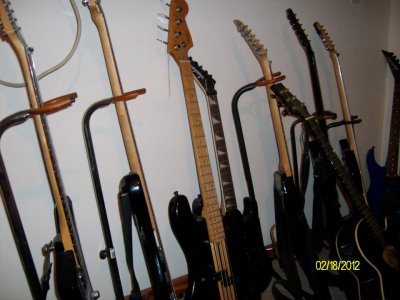
Here's a picture of the bass, guys, except now it has a Fender Original P instead of a Basslines SPB3:

To the left of it is my 1997 Peavey Foundation 5, a hum cancelling passive alder/maple J bass, the only other reference I have to compare as far as basses.

The Foundation is much easier to mix, as it has low end but also cuts through. I'm assuming that it is very close to a P in the neck because Peavey has been copying Fender for years. It's a big fat slab neck but the strings feel somewhat close together for a 5.

That said, I think the cut problem is because the P has nothing under the bridge, and I'm concerned that my main problem is I need something under the bridge and the P just can't do it. It seems best if you want a bass tone that is very closely in the mix with the guitar to the point that it sounds like the guitar's low end, like a lot of thrash metal (Steve Harris, one of my idols, excepted).

Obviously the maple stripes are painted on, but it's somewhat of a unique looking bass. I would like to find a similar looking bass but of better build quality.

The bridge is the worst part. It seems like lightweight, slightly corroded brass. From what I understand, the bass, branded Global, ST75BB, is a 70s lawsuit Korean P copy. Here's a link to one almost identical to mine, but with a better bridge and under another brand name.

http://www.ebay.com/itm/Lori-Bass-Vintage-Bass-Guitar-Precision-Style-P-Bass-/261442221004?

The worst part, as I said, is the truss rod and high action, but even James Jamerson's bass had high action, and he felt it improved the tone.

A couple of thoughts I have about it is that it does seem mushy--maybe like a halfway point between a solid body and a semi hollow (John Walker, of the heavy metal band Carcass, actually uses a semi hollow in a high gain B tuned situation, something I've never seen anyone else do). It's fine at around 100 hz for thumping though, but that seems to be all it does. Then again, I did do my most recent track with the tone knob all the way down for a more vintage feel.

Also, I've had the bass for years and I don't think I could get out of it what I've put into it, which admittedly hasn't been much (new nut, truss rod set up, CTS pots, vintage .1 cap, Switchcraft jack). I think I could at least use it as a test bed for new P bass pups until I know what I want as far as basses. I mean, I don't even know if I like flat vs. round strings yet.

I'm finding that, as far as the Bartolinis, Lollars, Fralins, Nordstrands, Aguilars, and all the fancy companies out there, they may sound better than mass produced pickups on an individual basis and in individual basses. The thing is, it's so much easier to find EMGs and Duncans at good deals on the used market that, unless you know exactly what boutique winder's model you're going for and how it will sound in your bass, investing the additional money in a high end brand doesn't seem worth it.

I just thought I'd ask about Barts, Aguilars, etc., in case I run across them at a good price.

Regarding the J, I haven't played one enough to know, but so far I like the fat old style P bass necks. It feels like a bass. Narrow guitar like necks such as ESP and Ibanez basses may be more comfortable, but they feel cheap to me. That said, I do like using those models when I use actives, but right now I'm on a vintage kick. The thing that has always turned me off about a J is that offset dorky looking body. But if I can find a J neck on a P body that is J or PJ, I might try it.

I'd appreciate thoughts and comments. :)
 

Attachments

  • SANY0186.jpg
    SANY0186.jpg
    77.1 KB · Views: 0
Last edited:
Re: Bartolinis

Thanks! It's a Hipshot. Which segues very nicely to a broader topic -- replacement hardware.

Assuming you are working toward a quality bass eventually, one that has the looks, feel and sound you want, you are going to want something better than that POS bridge that comes standard on cheap Fender copies and most cheap Fenders. My favorite is Schaller, but there are many good ones including Hipshot, Babicz, Gotoh, KSM, even Fender makes some good bridges. I'm not a big fan of Badass bridges (they're out of production anyway) but some people swear by them, and I'd rather have that than the cheapo Fender bent peice of metal. I like having the extra mass and weight, but some people don't -- fortunately, there are enough options for all of us. The Babicz in particular was specifically designed to be a lightweight direct replacement for Fender bridges.

Tuners also come in many varieties. The most important criteria for me is that the gears are tight. I don't want any slop or play, at all, and it should feel absolutely smooth when you turn them. The higher gear ratio, the better. Again, these can be heavy or light. On a Fender style 4-string bass, though, the typical lightweight tuners would look pretty odd. I prefer wider posts, as it puts less stress on the string, but it is just a preference. Good makers of tuners include Schaller, Hipshot, Gotoh, Grover, and again, Fender makes some good ones.

I dare say that IMO, hardware matters more on a bass than it does on a guitar. Not that you ever want low quality stuff on a bass or guitar, but with a bass, the vibrating strings have a lot more inertia in them, which means it puts more physical demands on the hardware at either end. The same amount of metal that might be suitable for a guitar bridge, for example, might not be quite strong enough to hold up to the full stress of heavier bass strings, and could cost you some sustain. There are different opinions an the matter, but since I'm writing this post, you get my opinion. :)

Regarding the pickup search, I empathize. There are a lot of botique pickup makers out there, and most of them have a diehard following. I will tell you this, though, I took a gamble on some Fender Super 55 dual-inline hum-canceling pickups on ebay. As pickups go, it was an inexpensive gamble. I sent my bass body and pickups down to Michael at Turnstyle Switch where he did a custom electronics job for me. When he got everything wired up, put a neck on it, strung it up and plugged it in, he was astounded at how good they sounded. When I finally got the bass back, put together and set up, I was giddy. Every time I play somewhere, I get comments about the tone. Anyway, I throw that out there for your consumption. The bottom line is you don't have to break the bank to find good sound, and you also don't have to limit yourself to SD or EMG to find reasonably priced good sounding pickups.

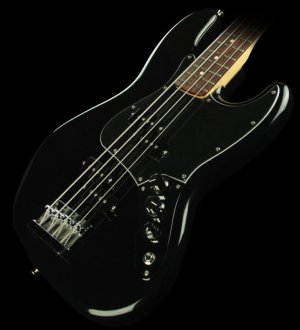
One other thing that might interest you -- Fender makes a bass with two precision pickups in it. It's a jazz body, which you'd have to deal with, but it could be fun, and it would give you the bridge punch you are looking for. Plus, as Fender basses go, it's not that expensive. It even has a bridge that's a step up from their cheapo stuff. (I'd still replace it, though.)

10599_BLACKTOP_Jazz_BASS_RW_Black_MX12168024_1.jpg
 
Last edited:
Re: Bartolinis

Thanks! It's a Hipshot. Which segues very nicely to a broader topic -- replacement hardware.

Assuming you are working toward a quality bass eventually, one that has the looks, feel and sound you want, you are going to want something better than that POS bridge that comes standard on cheap Fender copies and most cheap Fenders. My favorite is Schaller, but there are many good ones including Hipshot, Babicz, Gotoh, KSM, even Fender makes some good bridges. I'm not a big fan of Badass bridges (they're out of production anyway) but some people swear by them, and I'd rather have that than the cheapo Fender bent peice of metal. I like having the extra mass and weight, but some people don't -- fortunately, there are enough options for all of us. The Babicz in particular was specifically designed to be a lightweight direct replacement for Fender bridges.

Tuners also come in many varieties. The most important criteria for me is that the gears are tight. I don't want any slop or play, at all, and it should feel absolutely smooth when you turn them. The higher gear ratio, the better. Again, these can be heavy or light. On a Fender style 4-string bass, though, the typical lightweight tuners would look pretty odd. I prefer wider posts, as it puts less stress on the string, but it is just a preference. Good makers of tuners include Schaller, Hipshot, Gotoh, Grover, and again, Fender makes some good ones.

I dare say that IMO, hardware matters more on a bass than it does on a guitar. Not that you ever want low quality stuff on a bass or guitar, but with a bass, the vibrating strings have a lot more inertia in them, which means it puts more physical demands on the hardware at either end. The same amount of metal that might be suitable for a guitar bridge, for example, might not be quite strong enough to hold up to the full stress of heavier bass strings, and could cost you some sustain. There are different opinions an the matter, but since I'm writing this post, you get my opinion. :)

Regarding the pickup search, I empathize. There are a lot of botique pickup makers out there, and most of them have a diehard following. I will tell you this, though, I took a gamble on some Fender Super 55 dual-inline hum-canceling pickups on ebay. As pickups go, it was an inexpensive gamble. I sent my bass body and pickups down to Michael at Turnstyle Switch where he did a custom electronics job for me. When he got everything wired up, put a neck on it, strung it up and plugged it in, he was astounded at how good they sounded. When I finally got the bass back, put together and set up, I was giddy. Every time I play somewhere, I get comments about the tone. Anyway, I throw that out there for your consumption. The bottom line is you don't have to break the bank to find good sound, and you also don't have to limit yourself to SD or EMG to find reasonably priced good sounding pickups.

One other thing that might interest you -- Fender makes a bass with two precision pickups in it. It's a jazz body, which you'd have to deal with, but it could be fun, and it would give you the bridge punch you are looking for. Plus, as Fender basses go, it's not that expensive. It even has a bridge that's a step up from their cheapo stuff. (I'd still replace it, though.)

View attachment 54868

Thanks BlueTalon. I think the main problem is I need something under the bridge. I just haven't decided if a PP or a PJ would work (PP would probably sound almost the same as a dual soapbar--I prefer true singles so a PJ concerns me as far as hum, hence my considering a PP).

Materials certainly make a difference, especially in a live situation. I just record mostly, so I can EQ out frequencies I don't like. Then again, that's time consuming, and it's much better to have a bass that gives you that tone straight away.

I find mixing bass to be more difficult than guitar. If the difficulty in guitar is finding a musical distortion you like, the difficulty with a clean, fat Fender sound is finding something that compliments the guitars and bass drum well in the mix, especially with all the overtones and dynamics a bass has.

A lot of people just pile on the fundamental to fill out the guitar and bass drum and say that's good. I prefer the bass to sound more like a guitar and stand out on its own without overpowering the song. Country bass, especially in the 80s, would be a good example--clean, fat, punchy, clear.

With bridge mass and stuff, I don't know. You could add on too much metal or wood and get a darker sound than you want.

Anymore, as far as modifying instruments or analog gear physically to get a certain sound, it just seems less financially practical. I can definitely understand it for live situations, though.
 
Last edited:
Re: Bartolinis

I'd avoid the PJ arrangement, but not because of single coil hum (that too, but more later). It's just hard to get a good balance, since the P mostly overwhelms the J in such basses.

Adding a higher mass bridge will never make the sound go dark. There are other things you might do to get that effect, but a good bridge won't be one of them. My bass is as bright as I could possibly want, and I like it that way. A good high mass bridge will help with articulation, which IMO is the key to good bass sound.

Speaking of articulation, I had an experience recently that changed my whole paradigm regarding a bass "sitting in the mix." I now think it's kind of a wives tale. Here's what happened.

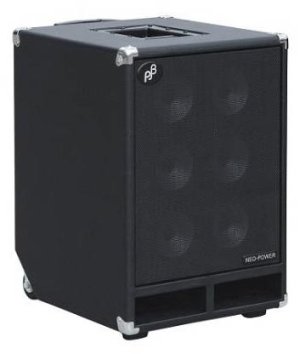
TalkBass had a get-together in Seattle in late March. I went, and I brought my bass and my amp setup -- a TC 250w head and a Phil Jones 6x5 cabinet. More importantly, I brought my best friend who plays guitar. He observed while I schmoozed. Now, you gotta imagine the scene --over 50 bass player in a restaurant, with at least 30 amps and at least 60 basses, all checking each others stuff out. Once it got started, there were anywhere up to 10 bass players all playing different things at the same time. It was a cacophony, chaotic thunder. (And as my friend pointed out, it wasn't just bass players playing, it was bass players testing the limits of their skills on different equipment, so it was really loud and muddy.) My friend noticed something interesting -- no matter who was playing what, he could always clearly hear whoever was playing through my rig. At first he wasn't sure, but he watched hands, and sure enough, he was hearing my amp. The thing that set my amp apart from the others was the small drivers. Having six 5" speakers in the cab allowed for greater articulation than anyone else's rig.

I have come to conclude that finding a bass tone to "fit in the mix" is actually a compromise. The idea is that the bass needs to carve out its own part of the mix, so it can be heard even when drums and guitar are intruding into bass zone. To do that, a lot of guys bump up their mids. I don't like to do that, I prefer a scooped sound. I found out at the get-together that it didn't matter. If my bass and amp could articulate well enough to cut through ten other basses fully occupying the bass zone, it's going to cut through when drums or guitar are partially occupying the bass zone.

Anyway, about single coils: I think this is another area where it matters more on guitar than it does on bass. Again, this is my opinion, and some don't agree with me. But in my experience, a hum canceling J pickup with inline split coils (not stacked) gives you the same brightness and response as a single coil J, the only difference being you don't get hum. If you did decide to go for a PJ bass, you could pull it off with a split-coil J. Otherwise, a J with two such pickups would allow you to use any combination you want without regards to excess noise.
 
Re: Bartolinis

Thanks so much. What an informative post.

I know exactly what you mean. When I was EQ'ing after recording recently, the bass got everything from about 300hz-1 kHz. This was in Amplitube--I actually had two signal chains: Fender Bassman for the low end and a GK MB15 for the stuff with more attack. I usually do a high pass at about 100 Hz for bass and guitar with bass getting 100 and guitar at 200, unless the guitar is low tuned and needs to chug. 400 region is messy and I find a lot of muddiness and honk on drums, especially toms. Snare and kick drum click are both at about 1 kHz. It's just that everything seems to compete for that 2 kHz range that we can hear easily and it's hard to get everything to glue without being indistinct or standing too far apart.

A hint (I mean just a smidgen--don't remember if it was 32nd or 64th) of delay also helped the bass tone stay consistent, ring out longer, and sound kind of like a good fretless. It was also better than resorting to compression.

There's warmth and gold in a passive tone around 500-600-800 though, whereas an active bass with all lows and highs might encourage me to scoop and slap.

I prefer bass with less mids when the bass is by itself. It sounds awesome. But in a band mix it disappears on me.

When this song is finished I'd like to run it by you and see if you think I've done a good job with such a cheap bass.

I didn't know they made bass cabs with 5"s. I thought 8"s were about as small as they went.

I know a lot of guys prefer 8 8"s. I have a Carvin R1000 combo with a 15", 2 8s" and a horn, and to me the 15" is pretty necessary. Otherwise the tone gets too growly, like an Ampeg. I'd probably have fun with an 18" if they still made them for bass instead of just as sound reinforcement. I understand a smaller speaker has a firmer bottom, but I also think smaller speakers are what makes the difference between an overdriven, guitar like bass tone and the Fender tone I like.

Most of the hum canceling ones I've heard have stacked coils--that might be why I don't like the sound as much. Going full soapbar kind of concerns me because I'm afraid I'll have too much pickup under the string and lose brightness. Maybe a quad coil soapbar would work and I could go through all the coil configurations to set it up like a dual P. Some people like reverse P's like on some of the older Jackson basses.

Thanks so much BlueTalon, especially for the inline J. I really hate stacked humbucking singles for guitar and from what I've heard on bass stacked humbuckers lose brightness and dynamics relative to a true single. Since I just record I think all I would run into would be computer monitor interference with a true J, but if I can have hum canceling and keep the tone that would be nice.

These inline Js--they don't split, right? I've heard of some hum canceling pups that split and others that don't. The ones that do split people don't seem crazy about since one is a dummy coil or something. Or maybe those are the ones that don't split. Anyway, I thought they had Js with four conductors.

Anyway, I fancied a hum canceling J that would cancel hum live and split with a push pull and give me true single sounds for studio applications where noise isn't big deal, but if that's like guitar, a split hum is never quite like a real single, and I didn't want to water down my tone for the sake of more wiring possibilities.
 
Re: Bartolinis

I asked a tech one time about the possibility of tapping into the split on J hum-cancelers, he said it was a bad idea, so I never pursued it. I had something specific in mind, and it turned out there are better options for what I was trying to do. If you do decide to go with a spolit-coil J, just wire it and treat it as you would a single coil J.

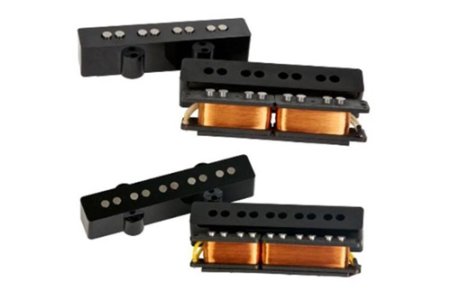
This is a dual inline split-coil J. As you can see, all a string sees is a single coil pickup, so that's what it sounds like. And I will tell you that I have never noticed any kind of drop off or other funkiness with the A & D strings, no matter how I play them or bend them. You might look at the design and worry about how the magnetic patterns are affected where the coils are nearest to each other, but the effect is not noticeable to me, even when I'm specifically listening for it.

split-coil J.jpg


Yeah, Phil Jones is in a class by himself. As far as I know, he's the only one using drivers that small. But his stuff is top-of-the-line, and it's one of the better kept secrets of the bass world. You owe it to yourself to experience one firsthand, if you get the opportunity.
 
Last edited:
Re: Bartolinis

I didn't know they made bass cabs with 5"s. I thought 8"s were about as small as they went.

Phil Jones is in a class by himself. As far as I know, he's the only one using drivers that small. His stuff is top-of-the-line, and it's one of the better kept secrets of the bass world. You owe it to yourself to experience one firsthand, if you get the opportunity.

I use a tc electronic amp and cab set up. Initially, I imagined that a vertical 2x10 cab would lack depth and that a 1x15 cab would be a desirable addition. I soon learned that the stock RC210 cabinet delivered at all sound pressure levels. (When I decided to try setting my old Marshall DBS 7210 cabinet on edge, that sounded good too.)

The tc electronic rigs seem to be designed to benefit from coupling with the floor. The Phil Jones micro amps seem to like proximity to a wall.
 
Last edited:
Re: Bartolinis

I like my TC amp, I certainly wouldn't be opposed to getting another one if I need it.

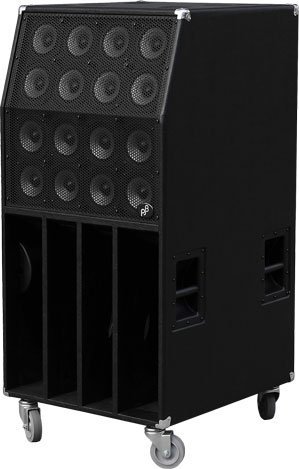
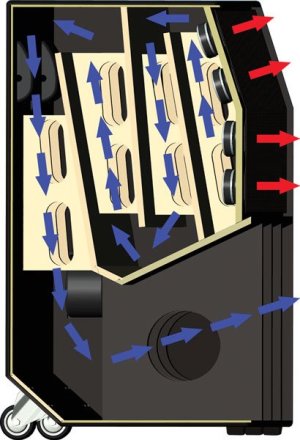
I'm not sure what you are referring to when you say Phil Jones "micro amps" -- are you referring to their small stuff or their whole lineup? They do make some very small models, but they also have larger gear. My 6x5 cabinet compares sizewise to a 210 or 115, and it's on the smaller end of their available cabs. One of my dreams for when I win the lottery (if I ever play) is to get a Phil Jones 16H horn cab. It's big, and I would compare it's low output to anything.

89.jpg Oh, and my 6x5 cab also: philjones6b_01.jpg
 
Re: Bartolinis

Man the porting on that 16H is huge. How many watts do you run into that BlueTalon? I understand that bass vs. guitar wattage is something on par of 3:1. I'm also aware that wattage does not determine volume as much as number of speakers (doubling wattage makes like a 3 db difference I think for guitar).

Btw, doesn't bother me that we've got off topic on this guys. I'm learning a lot.
 
Re: Bartolinis

Oh, I don't have a 16H, that's still a distant dream for when I have extra money. But to answer your question, if/when I ever do get one, I would probably run a Genz Benz Streamliner 900 through it. The real reason I want it is so I can get one of Skip Fantry's Knuckle Quake basses, tune the thing an octave low, and have something that can actually handle it.

But I do have the other cab, and I run a 250W TC Electronics head through it. It's my gig rig for indoor settings, and it has no problem with good tone at lower levels or keeping up with louder guitar players.

BTW, the idea behind the 16H is to have as long of a horn as possible to handle low fundamentals, in a user friendly cab size.

90.jpg
 
Re: Bartolinis

I asked a tech one time about the possibility of tapping into the split on J hum-cancelers, he said it was a bad idea, so I never pursued it. I had something specific in mind, and it turned out there are better options for what I was trying to do. If you do decide to go with a spolit-coil J, just wire it and treat it as you would a single coil J.

This is a dual inline split-coil J. As you can see, all a string sees is a single coil pickup, so that's what it sounds like. And I will tell you that I have never noticed any kind of drop off or other funkiness with the A & D strings, no matter how I play them or bend them. You might look at the design and worry about how the magnetic patterns are affected where the coils are nearest to each other, but the effect is not noticeable to me, even when I'm specifically listening for it.

View attachment 54893

It's a bad idea because those pickups work in essentially the same way that a p-bass pickup does; one coil picks up the E & A, while the other picks up the D & G. If you were to split it, only half of your strings would produce signal.

On another note, I really like and prefer a PJ setup, but only with a reversed P as IMO it fixes a lot of the issues with the traditional P alignment. It's true that the P pickup is louder than the J, but with this setup it really isn't a huge issue as it sounds more like a fuller-sounding Jazz than a Traditional Precision anyway. Lastly regarding amplification, I've played the TC amps and Phil Jones cabs, and they're really not my cup of tea. I much prefer an Ampeg through a fEARful. (anyone familiar with Talkbass should know what that is)
 
Last edited:
Back
Top