Ha! But poplar also varies a lot in weight. I've played a 7.5lb Steve Morse Music Man, but my poplar Music Man (with the same body size) was just at 9lbs.Poplar is very popular.

Ha! But poplar also varies a lot in weight. I've played a 7.5lb Steve Morse Music Man, but my poplar Music Man (with the same body size) was just at 9lbs.Poplar is very popular.
Yeah man, I've done that. exactly that. I had 3 necks and 3 bodies, same pickups for all, same bridge. Rosewood neck ebony board, maple neck ebony board, maple neck and maple board; mahogany body, ash, black korina.There are way, way, WAY too many variables in electric guitars to really say that one type of wood sounds one way. Was the wood kiln dried or air dried? Does player 'A' have brass saddles and player 'B' titanium? Are all of the screws tightened identically, bridge and neck? Is the nut plastic, bone, Tusq? Until someone has the time, money, and inclination to build multiple IDENTICAL guitars, with the only variable being the wood, in order to do a true, proper comparison, these ongoing discussions are moot...

Warmoth has a video with body wood swaps with other parts the same.There are way, way, WAY too many variables in electric guitars to really say that one type of wood sounds one way. Was the wood kiln dried or air dried? Does player 'A' have brass saddles and player 'B' titanium? Are all of the screws tightened identically, bridge and neck? Is the nut plastic, bone, Tusq? Until someone has the time, money, and inclination to build multiple IDENTICAL guitars, with the only variable being the wood, in order to do a true, proper comparison, these ongoing discussions are moot...

When I hear people talk about how resonant their guitar is unplugged, I just cringe a little, because, unless your pickups are highly microphonic, that's just lost signal.
This is not always true.Sure, but just because it doesn't look pretty doesn't mean it isn't a good wood for building. They just use opaque finishes for basswood.
All acoustic guitar pickup systems that I know of have at least one microphonic pickup. Be it a piezoelectric pickup or a literal microphone. Unrelated, the LR Baggs Anthem SL, my favorite acoustic pickup, is on sale for quite a bit off on Sweetwater for Black Friday todayI have no knowledge about but it seems to me this collides with the semiacoustic type of electric guitar tone, where you clearly ear the difference compared to solid body, even if the pickup are not microphonic
I've got an ad hoc experiment on this going right now as we speak. I'm trying to start up a wood shop. In order to not waste my efforts on expensive wood, I am reclaiming some of the treated pine from my old porch. Each body is made of six boards. The first body blank I made has two errors based around the fact I have never used a hand planer. As such the first body blank has less than stellar wood to wood contact. The second body blank is a lot better.I'm my opinion (for what it's worth?), the greatest effect of the physical electric guitar comes with mechanical coupling. The tighter, sturdier, denser, etc. that the guitar is, the less string vibration is absorbed into the guitar, and thus, diminished less.
All acoustic guitar pickup systems that I know of have at least one microphonic pickup
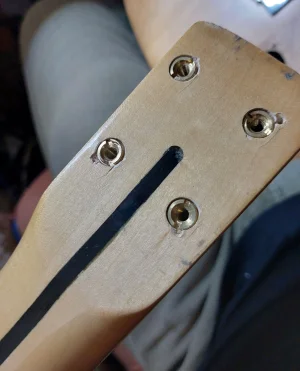
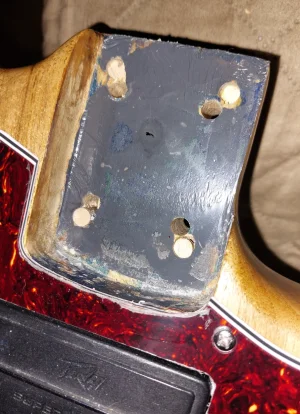
I don't understand how this isn't the standard these days.I think when I get brave enough to start making necks, threaded inserts are going to be a permanent part of my process. Not because I think you should constantly be taking the neck off, but because it's always bothered me how weak a connection point that is.
threaded inserts are going to be a permanent part of my process.
'Tradition' is part of it, but also inserts cost time and money. And the number of people that takes the neck off of a guitar is pretty small. But, I'm with you. If you do this a lot, inserts are fantastic.That would be a great improvement over cheap models, I don't know why builders don't use it as a feature