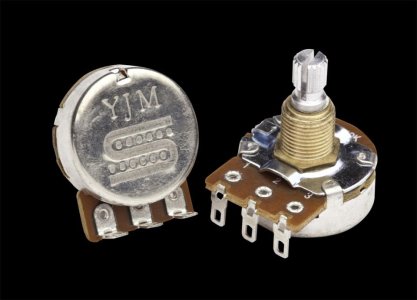
I saw that blog post the other day, and it surprised me to see an endorsement for linear use in tone controls, but audio exclusively for volumes. I've never for the life of me been able to figure out how one could arrive at this position.
I saw that blog post the other day, and it surprised me to see an endorsement for linear use in tone controls, but audio exclusively for volumes. I've never for the life of me been able to figure out how one could arrive at this position.
I agree. And the blog is flawed. (Only slightly, but it is an info blog.)
Stephen makes this point: "The wiper is moved via a rotating shaft across the track to affect the resistance." In the context of his example, that's incorrect. It affects the output voltage, or, the potential. That's why its called a potentiometer. The resistance, ie., the "load", doesn't change for the circuit it's connected to.
In guitar wiring, a potentiometer can be wired either as a potentiometer, (volume control), or rheostat, (tone control). In the rheostat mode, then yes, the resistance changes with rotation.