Chistopher
malapterurus electricus tonewood instigator
If you have the skill level to swap pickups, you have the skill to mod pedals.
I was thinking yesterday that if you took every Big Muff ever released, you could make just about distorrion sound you want, from an overdrive-ish sound to a fat wall of fuzz. Most individual units are pretty much one trick pony's. The reason for that is, even today, EHX likes to cut costs on components. The Big Muff is fairly agnostic to the specific value of components, so back in the day they just put whatever specific electrical values they could get for cheap in there. They don't do it as much today, but even my pair of modern big box NYC Muff came off the shelf with a few different components.
Overview
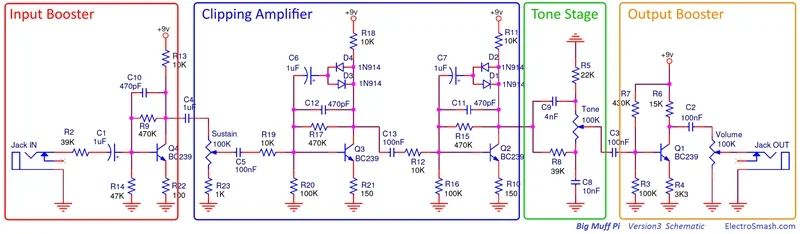
What a coincidence that this circuit, for how big it is, is actually quite simple. In a big box it is very easy to see the components too. For our purposes we will break it into two sections: the tone control, and the gain stages. The signal enters a clean gain stage, hits the gain control, hits two overdrive stages, hits the tone control, and then hits a clean gain stage. It's a very easy circuit to relate the schematic to the pedal sitting in front of you, so don't rely on the part numbers (C12, R2, etc) and verify with a multimeter that the part you are swapping out is in the neighborhood of the schematic. For this post I'll refer to ElectroSmash's part labeling
Tone Control
The tone control is by far and away the most important part of the BMP sound. If you turn it left, it cuts treble, turn it right it cuts bass, leave it in the middle it cuts mids.
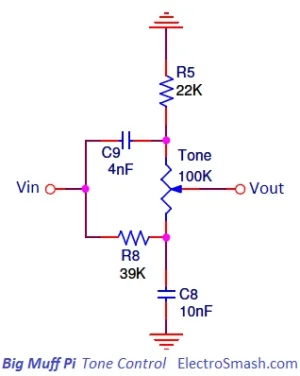
Only 4 components need to be modded if you want a tone control tuned to your ear. C9 and R5 are the bass cut. What you are looking for is the smaller cap connected to the tone control, and the resistor connected to it.
C9 - Raise value for more bass, lower for less bass and more perceived treble
R5 - Raise for less mid-scoop and a little less bass, lower for more mid scoop
C8 - Raise for less treble, lower for more treble
R8 - Raise for less mids and a little less treble, lower for more mids and a little more treble
With how interactive these are, usually I can get where I want by just tweaking R8 and C9. Here is a fun calculator that helps you visualize. If you don't like a scooped Muff, you can adjust it to make it flat or mid boosted
Note the tone control is after the clipping, so all these changes will not affect the character of the distortion
Gain Stages
Now here's the fun part, the clipping. If you are well versed in circuits theirs a lot to play around with here, but lucky for us, if you aren't a nerd it's pretty tough to mess anything up. The trick is that every component in a BMP comes in pairs, so it's best to think of this section as two high gain overdrives back to back. These mods are generally more subtle than modding the tone control. I've organized them most obvious to most subtle.
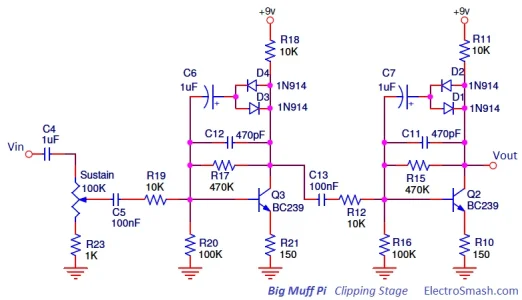
R21 and R10 - These guys function similar to gain knobs. Lower the values to get more gain. Raise them to get less gain. Too much gain this way will cause transistor distortion. I prefer to lower these to about 470. Lower gain gives a darker sound
R19 and R12 - These guys trim the input volume of each gain stage. Increase them for lower volume and less distortion.
Note both these mods do similar things, but there is some nuance. I generally prefer touching R21 and R10 if I want less distortion, and lowering R19 and R12 if I want more distortion.
C6, C7 - These effect what frequencies clip. Larger caps make it fuzzier, lower caps make it closer to an overdrive
Diodes - The diodes don't have as near profound an effect on the BMP sound as they would on say a DS-1 or a TS. The most common diode mod I see is to just yank D4 and D3. Adds more bass and volume to the signal and slams the mess out of the next gain stage. The Supa Tonebender does this. If you're even crazier, yank the second set of diodes. Who knows what will happen, it'll be loud and dirty though. I don't generally swap diodes though
C12, C11, C10 - Increase these for a smoother sound with less treble. If you want more rasp to your sound, it's generally better to just remove them.
C1, C2, C3, C4, C5, C13 - Increase these caps to make the pedal play better with lower range instruments.
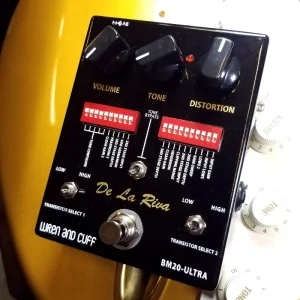
Transistors- There is little reason to swap the transistors on a BMP. My W&C De La Riva has an option to switch Q2 and Q3 with germanium transistors, and it doesn't make too big a difference.
I was thinking yesterday that if you took every Big Muff ever released, you could make just about distorrion sound you want, from an overdrive-ish sound to a fat wall of fuzz. Most individual units are pretty much one trick pony's. The reason for that is, even today, EHX likes to cut costs on components. The Big Muff is fairly agnostic to the specific value of components, so back in the day they just put whatever specific electrical values they could get for cheap in there. They don't do it as much today, but even my pair of modern big box NYC Muff came off the shelf with a few different components.
Overview
What a coincidence that this circuit, for how big it is, is actually quite simple. In a big box it is very easy to see the components too. For our purposes we will break it into two sections: the tone control, and the gain stages. The signal enters a clean gain stage, hits the gain control, hits two overdrive stages, hits the tone control, and then hits a clean gain stage. It's a very easy circuit to relate the schematic to the pedal sitting in front of you, so don't rely on the part numbers (C12, R2, etc) and verify with a multimeter that the part you are swapping out is in the neighborhood of the schematic. For this post I'll refer to ElectroSmash's part labeling
Tone Control
The tone control is by far and away the most important part of the BMP sound. If you turn it left, it cuts treble, turn it right it cuts bass, leave it in the middle it cuts mids.
Only 4 components need to be modded if you want a tone control tuned to your ear. C9 and R5 are the bass cut. What you are looking for is the smaller cap connected to the tone control, and the resistor connected to it.
C9 - Raise value for more bass, lower for less bass and more perceived treble
R5 - Raise for less mid-scoop and a little less bass, lower for more mid scoop
C8 - Raise for less treble, lower for more treble
R8 - Raise for less mids and a little less treble, lower for more mids and a little more treble
With how interactive these are, usually I can get where I want by just tweaking R8 and C9. Here is a fun calculator that helps you visualize. If you don't like a scooped Muff, you can adjust it to make it flat or mid boosted
Note the tone control is after the clipping, so all these changes will not affect the character of the distortion
Gain Stages
Now here's the fun part, the clipping. If you are well versed in circuits theirs a lot to play around with here, but lucky for us, if you aren't a nerd it's pretty tough to mess anything up. The trick is that every component in a BMP comes in pairs, so it's best to think of this section as two high gain overdrives back to back. These mods are generally more subtle than modding the tone control. I've organized them most obvious to most subtle.
R21 and R10 - These guys function similar to gain knobs. Lower the values to get more gain. Raise them to get less gain. Too much gain this way will cause transistor distortion. I prefer to lower these to about 470. Lower gain gives a darker sound
R19 and R12 - These guys trim the input volume of each gain stage. Increase them for lower volume and less distortion.
Note both these mods do similar things, but there is some nuance. I generally prefer touching R21 and R10 if I want less distortion, and lowering R19 and R12 if I want more distortion.
C6, C7 - These effect what frequencies clip. Larger caps make it fuzzier, lower caps make it closer to an overdrive
Diodes - The diodes don't have as near profound an effect on the BMP sound as they would on say a DS-1 or a TS. The most common diode mod I see is to just yank D4 and D3. Adds more bass and volume to the signal and slams the mess out of the next gain stage. The Supa Tonebender does this. If you're even crazier, yank the second set of diodes. Who knows what will happen, it'll be loud and dirty though. I don't generally swap diodes though
C12, C11, C10 - Increase these for a smoother sound with less treble. If you want more rasp to your sound, it's generally better to just remove them.
C1, C2, C3, C4, C5, C13 - Increase these caps to make the pedal play better with lower range instruments.
Transistors- There is little reason to swap the transistors on a BMP. My W&C De La Riva has an option to switch Q2 and Q3 with germanium transistors, and it doesn't make too big a difference.