
You are using an out of date browser. It may not display this or other websites correctly.
You should upgrade or use an alternative browser.
You should upgrade or use an alternative browser.
Do you need a treble bleed if all the other pots are no-load?
- Thread starter '59
- Start date

dystrust
Well-known member
Re: Do you need a treble bleed if all the other pots are no-load?
A no-load tone pot is effectively bypassed on 10, so the treble bleed wouldn't be doing anything. As soon as you touch the tone knob at all, the treble bleed would resume working.
I personally dislike treble bleed circuits and prefer to use 50s wiring instead. IMO a treble bleed using only a capacitor is painfully harsh and requires a resistor to be added in series to tame the effect somewhat (the Kinman circuit). Unfortunately the specific cap and resistor values need to be tuned for each guitar and pickup which can be a real PITA. I also like the volume & tone control interaction that 50s wiring offers, so I don't bother with treble bleeds.
If you have one volume pot and one no-load tone pot, if the tone is on 10 does a treble bleed become useless?
A no-load tone pot is effectively bypassed on 10, so the treble bleed wouldn't be doing anything. As soon as you touch the tone knob at all, the treble bleed would resume working.
I personally dislike treble bleed circuits and prefer to use 50s wiring instead. IMO a treble bleed using only a capacitor is painfully harsh and requires a resistor to be added in series to tame the effect somewhat (the Kinman circuit). Unfortunately the specific cap and resistor values need to be tuned for each guitar and pickup which can be a real PITA. I also like the volume & tone control interaction that 50s wiring offers, so I don't bother with treble bleeds.

beaubrummels
Well-known member
Re: Do you need a treble bleed if all the other pots are no-load?
Hmm, I thought a treble bleed works on the volume, regardless of whether there's a tone control in circuit or not?
I think the question of whether you need a treble bleed depends on what exact problem you have and whether it will solve it, or another option would solve it better. For example, some solutions can be a sever change and might affect the taper, which wouldn't work for some players. Other solutions, like 50's wiring are more subtle and also have interaction artifacts between the volume and tone. Need to know if you are experiencing the whole guitar going dark when turning down, or just certain pickups? and are you using the tone control much? playing clean? distorted? metal?
Hmm, I thought a treble bleed works on the volume, regardless of whether there's a tone control in circuit or not?
I think the question of whether you need a treble bleed depends on what exact problem you have and whether it will solve it, or another option would solve it better. For example, some solutions can be a sever change and might affect the taper, which wouldn't work for some players. Other solutions, like 50's wiring are more subtle and also have interaction artifacts between the volume and tone. Need to know if you are experiencing the whole guitar going dark when turning down, or just certain pickups? and are you using the tone control much? playing clean? distorted? metal?
dystrust
Well-known member
Re: Do you need a treble bleed if all the other pots are no-load?
I was under the impression that pickups getting dark as the volume is rolled down is a side effect of modern wiring which implies a tone control. My Charvel is wired with just a volume pot, and it doesn't loose treble as th volume is rolled down.
Hmm, I thought a treble bleed works on the volume, regardless of whether there's a tone control in circuit or not?
I was under the impression that pickups getting dark as the volume is rolled down is a side effect of modern wiring which implies a tone control. My Charvel is wired with just a volume pot, and it doesn't loose treble as th volume is rolled down.
Chistopher
malapterurus electricus tonewood instigator
Re: Do you need a treble bleed if all the other pots are no-load?
If I remember any of my electrical studies, the reason that you lose treebles when you cut the volume pot is because when two resistors are in parallel, as the volume and tone are, adjusting the value of one affects the value of the other. Since the volume control and tone are used as variable resistors, lowering the volume lowers the resistance value of the tone pot, allowing more treebles to escape.
If you have a no-load pot the second resistor out of the circuit so the answer to your question (to the best of my knowledge) is yes. You do not need a treble bleed.
If I remember any of my electrical studies, the reason that you lose treebles when you cut the volume pot is because when two resistors are in parallel, as the volume and tone are, adjusting the value of one affects the value of the other. Since the volume control and tone are used as variable resistors, lowering the volume lowers the resistance value of the tone pot, allowing more treebles to escape.
If you have a no-load pot the second resistor out of the circuit so the answer to your question (to the best of my knowledge) is yes. You do not need a treble bleed.
Re: Do you need a treble bleed if all the other pots are no-load?
I am assuming your no load pot won't be in no-load phase all the time. Otherwise you'd just cut out the tone circuit entirely. Hence for all those times where you have the tone circuit engaged then the vol/tone rolloff will occur.
I am assuming your no load pot won't be in no-load phase all the time. Otherwise you'd just cut out the tone circuit entirely. Hence for all those times where you have the tone circuit engaged then the vol/tone rolloff will occur.
Chistopher
malapterurus electricus tonewood instigator
Re: Do you need a treble bleed if all the other pots are no-load?
But I don't think it's as drastic as with a tone control loading the circuit, correct?
As you lower your volume, you lower the signal's resistance to ground and this bleeds off highs first. This occurs independent of the tone.
But I don't think it's as drastic as with a tone control loading the circuit, correct?

Nostalgic Distortion
New member
Re: Do you need a treble bleed if all the other pots are no-load?
Yep....
A no-load tone pot is effectively bypassed on 10, so the treble bleed wouldn't be doing anything. As soon as you touch the tone knob at all, the treble bleed would resume working.
I personally dislike treble bleed circuits and prefer to use 50s wiring instead. IMO a treble bleed using only a capacitor is painfully harsh and requires a resistor to be added in series to tame the effect somewhat (the Kinman circuit). Unfortunately the specific cap and resistor values need to be tuned for each guitar and pickup which can be a real PITA. I also like the volume & tone control interaction that 50s wiring offers, so I don't bother with treble bleeds.
Yep....

Clint 55
OH THE DOUBLE THICK GLAZE!
Re: Do you need a treble bleed if all the other pots are no-load?
Yes, I think that's right.
But I don't think it's as drastic as with a tone control loading the circuit, correct?
Yes, I think that's right.
Re: Do you need a treble bleed if all the other pots are no-load?
So I have a Alnico II 59/Custom with two 500k pots. The reason I'm asking is I'm using a nodded version of the TBX. An added question is how major would the difference be between two 500k pots and one 500k pot? Would that difference make the guitar too bright, or is it not that drastic a change? And finally, would it be better if I changed the volume to 250k to maintain the original tone? But in that case would the 250k side of the pot be too dark?
Sorry for all the questions, I just don't wanna risk messing up my guitars tone.
So I have a Alnico II 59/Custom with two 500k pots. The reason I'm asking is I'm using a nodded version of the TBX. An added question is how major would the difference be between two 500k pots and one 500k pot? Would that difference make the guitar too bright, or is it not that drastic a change? And finally, would it be better if I changed the volume to 250k to maintain the original tone? But in that case would the 250k side of the pot be too dark?
Sorry for all the questions, I just don't wanna risk messing up my guitars tone.
Re: Do you need a treble bleed if all the other pots are no-load?
500k on the volume vs 250 provides a tonal shift that you cannot compensate for just by turning knobs. The pickup will be a little less 'tamed' and have a stronger mids to treble response.
As a contrast a 500k tone pot can simply be turned down to the point where it reads 250k (typically about 6-7 on the dial), and the tone will be the same as a 250k pot on 10.
500k on the volume vs 250 provides a tonal shift that you cannot compensate for just by turning knobs. The pickup will be a little less 'tamed' and have a stronger mids to treble response.
As a contrast a 500k tone pot can simply be turned down to the point where it reads 250k (typically about 6-7 on the dial), and the tone will be the same as a 250k pot on 10.
Re: Do you need a treble bleed if all the other pots are no-load?
Ok, just one last question. But before that, here's the diagram I'm using:
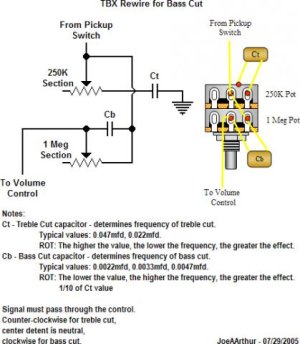
Is there any way to add a resistor into this to make it so that the "no-load position" sees 500k without interfering with the 250k and 1meg sides of the pot?
Ok, just one last question. But before that, here's the diagram I'm using:
Is there any way to add a resistor into this to make it so that the "no-load position" sees 500k without interfering with the 250k and 1meg sides of the pot?
Similar threads

- Replies
- 21
- Views
- 897


- Replies
- 8
- Views
- 465

- Replies
- 14
- Views
- 890

