
You are using an out of date browser. It may not display this or other websites correctly.
You should upgrade or use an alternative browser.
You should upgrade or use an alternative browser.
Does a two-point bridge stay in tune better?
- Thread starter Napthol
- Start date

beaubrummels
Well-known member
I find the mount, whether two or six, is not related to tuning at all. There are two point systems made out of cheap metal where the blade of the bridge wears and it affects the position and stability of the bridge system as a whole. A six point system (traditional Fender) can stay in tune fine if the saddles are set up right and the nut is cut right and the string is wrapped/tied/set in the tuning post correctly/well. EVH did their first album with a normal Fender-style bridge on his vibrato guitar. He 'abused' it and it returned to zero and sounded in tune just fine.


Chris Pile
Well-known member
So one guy on the whole internet says something, and you just believe him?
I've been doing this for 45 years, and there is no hard and fast rule for anything having to do with guitar. It depends on the condition of the instrument, how well it was setup, and how the player uses it. Almost anything can be made to work well.
Never forget - the first 3 Van Halen albums were recorded before the Floyd Rose ever existed.
I've been doing this for 45 years, and there is no hard and fast rule for anything having to do with guitar. It depends on the condition of the instrument, how well it was setup, and how the player uses it. Almost anything can be made to work well.
Never forget - the first 3 Van Halen albums were recorded before the Floyd Rose ever existed.
Last edited:

Securb
One of Jerry's Kids
No Goober. I have heard plus read they stay in tune better. Why would Fender invent them in the first place? Because they were bored and had nothing better to do with themselves?
Plus Fender themselves say it offers more tuning stability in their description.
Keep in mind when Fender (or any other manufacturer) speaks it is the marketing people talking, not the engineers. Sometimes a design change is not about improvement but about the availability of materials and optimizing manufacturing processes. The issue with most opinions on the internet and guitar forums is if something is "better" the alternative must be bad or garbage. Even if we agreed the 2-point bridge was better, how much better is it, enough to make a noticeable difference? I actually prefer my six-screw bridges they are easier to maintain and set up. I have zero tuning stability issues. As Chris said any well-maintained and properly set up piece of hardware is going to work.

PFDarkside
of the Forum
Saying EVH played in tune with a 6 screw is like saying Hendrix controlled 3 100W Marshall stacks with fuzz and Jordan won a playoff game with the Flu. Complete masters of their domains.
I find that while 6 screw and 2 post tremolos can be setup to play well and in tune, 2 posts are easier to get to that point and can stand a wider range of situations staying in tune. The six screw has a vintage feel and the stamped saddles have a vintage tone. But for me the two post is easier to setup where you need few tricks / knowledge to make it work well.
I find that while 6 screw and 2 post tremolos can be setup to play well and in tune, 2 posts are easier to get to that point and can stand a wider range of situations staying in tune. The six screw has a vintage feel and the stamped saddles have a vintage tone. But for me the two post is easier to setup where you need few tricks / knowledge to make it work well.
beaubrummels
Well-known member
The biggest difference between 6 and 2 I've experienced is that 2-point designs typically allow floating the bridge better and in those cases will return to zero better.
Securb
One of Jerry's Kids
Saying EVH played in tune with a 6 screw is like saying Hendrix controlled 3 100W Marshall stacks with fuzz and Jordan won a playoff game with the Flu. Complete masters of their domains.
I find that while 6 screw and 2 post tremolos can be setup to play well and in tune, 2 posts are easier to get to that point and can stand a wider range of situations staying in tune. The six screw has a vintage feel and the stamped saddles have a vintage tone. But for me the two post is easier to setup where you need few tricks / knowledge to make it work well.
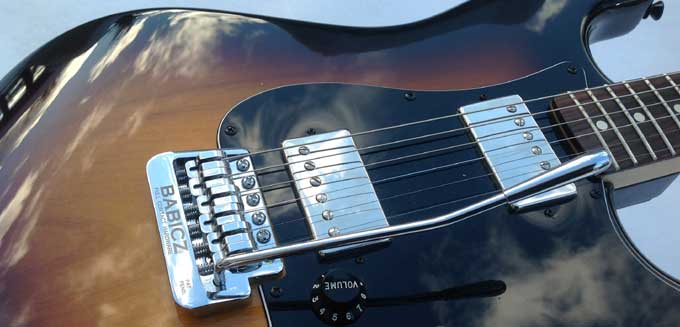
Love that you bolded "for me" because it does simply come down to preference more than any characteristics of the tremolo design. I know we are referring to OEM Fender 6 screw trems for the sake of this discussion. However, my Babicz 6 screw has a very modern feel, tone, and sustain. In my experience.



GuitarStv
Sock Market Trader
From a mechanical point of view, fewer points of contact on the edge of a bridge should result in less unwanted resistance . . . which should result in slightly better tuning stability with a floating bridge design.
Blocked/non-floating bridge? Then it really doesn't matter much. Dull/flat/worn edge contact points? Then you'll also have worse tuning. Any friction from any other point in the bridge? This can tip the equation.
Blocked/non-floating bridge? Then it really doesn't matter much. Dull/flat/worn edge contact points? Then you'll also have worse tuning. Any friction from any other point in the bridge? This can tip the equation.
Securb
One of Jerry's Kids
From a mechanical point of view, fewer points of contact on the edge of a bridge should result in less unwanted resistance . . . which should result in slightly better tuning stability with a floating bridge design.
Mechanical measures are often way too minuscule to be felt by human hands. If all comes down to the player's preference. One option is not superior to another, if one was and offered noticeably superior tuning stability you would not find 6 screw tremolos in very high-end guitars.

Chistopher
malapterurus electricus tonewood instigator
Two point bridges will stay in tune better than 6 point bridges if you make a habit of adjusting your bridge without a lick of understanding how they work.
PFDarkside
of the Forum
Yeah, I’ve never tried the Babicz 6 screw. With Jeff’s knowledge and experience I bet it’s great.Love that you bolded "for me" because it does simply come down to preference more than any characteristics of the tremolo design. I know we are referring to OEM Fender 6 screw trems for the sake of this discussion. However, my Babicz 6 screw has a very modern feel, tone, and sustain. In my experience.

fretburner
Well-known member
I've had 2 Am Std Strats and 1 MIJ with a 6pt trem. I could not say one is better than the other when doing "light" whammy work.
That said, a Gotoh Wilkinson VS100 is better than any Fender trem ever produced.
And I was told that the Gotoh 510 is even better than the Wilk.
For OEM stuff, EBMM trems are amazing.
I like 2pt trems. I prefer them to 6pt and Floyds.
That said, a Gotoh Wilkinson VS100 is better than any Fender trem ever produced.
And I was told that the Gotoh 510 is even better than the Wilk.
For OEM stuff, EBMM trems are amazing.
I like 2pt trems. I prefer them to 6pt and Floyds.
GuitarStv
Sock Market Trader
Mechanical measures are often way too minuscule to be felt by human hands. If all comes down to the player's preference. One option is not superior to another, if one was and offered noticeably superior tuning stability you would not find 6 screw tremolos in very high-end guitars.
I agree with you that at the end of the day it's just what the person wants to play but high end guitars aren't a very convincing argument. There are plenty of high end guitars made with inferior design choices. Hell, some people pay extra for a high end guitar to be damaged before they touch it. Guitarists are a strange and illogical group.

GuitarStv
Sock Market Trader
prs usually has very good engineering on their usa models
I was actually thinking about the 3x3 string angles on most Gibsons. Doesn't matter how high end the guitar is, the G string won't stay in tune as well as on other guitars because of that design choice. There are ways to mitigate the problem, but it's fundamentally a poor design, kept only for tradition.
Similar threads


- Replies
- 2
- Views
- 321
