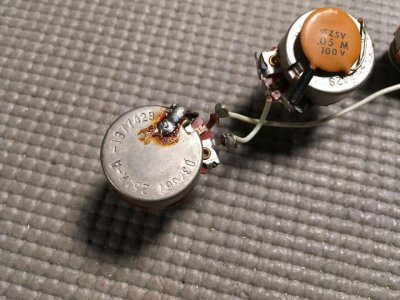
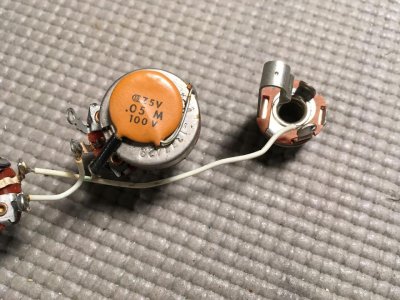
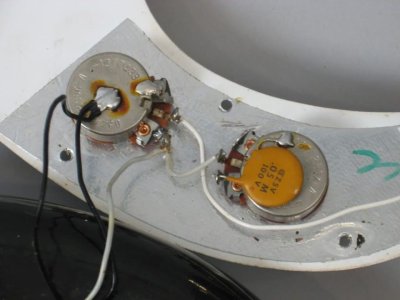
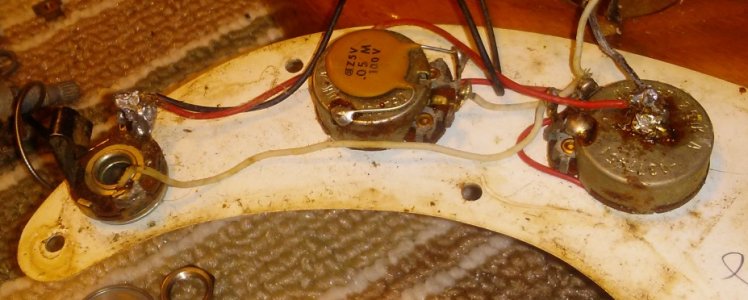
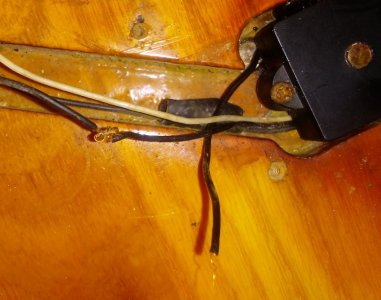
Don't solder like this.

Artie

Peaveyologist
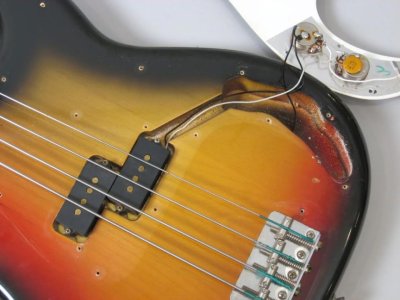
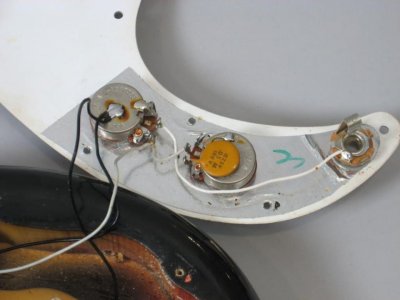
I'm posting this as an FYI for those who are learning, or trying to hone, their soldering skills. This is a customers P-Bass. They want me to restore it's wiring so no one can tell that its been worked on. :banghead:

Please don't solder like this, or make connections like this. ;)

P-Bass-01sm.jpg

P-Bass-02sm.jpg

Artie
 
Re: Don't solder like this.

Obvious that this was done by someone who didn't know the basics of soldering and with an iron that was not hot enough (not enough watts and/or too small of a tip) and he thought that if he just added more solder it would make the connection better. WRONG.

At LEAST a 40 watt iron, 50 watt is better. Heat the metal, add the solder, let it flow like water, only enough solder to coat the connection. No glob/blob necessary.

Thanks for posting that Artie, to clearly show how NOT to solder.
 
Re: Don't solder like this.

Not only that, but if you do one guitar wiring project for yourself, you'll save the cost of a decent temp controlled soldering iron. Especially given what folks are charging for pup replacements these days. (Not me, mind you.) :D

BTW, Doc. Thanks for that link to that multi-colored wiring assortment you linked to somewhere. I snagged a box. Nice wire.
 
Re: Don't solder like this.

Not only that, but if you do one guitar wiring project for yourself, you'll save the cost of a decent temp controlled soldering iron.

I totally agree. If you're going to do even a little soldering yourself, it's a no-brainer to get a good soldering iron/station.

My soldering station also has a hot air gun built into it. Not necessary (I got along for many years without it), but it is a great convenience and didn't add much to the total cost of the station. I use a lot of shrink tubing so it makes sense for me to have the hot air.
 
Re: Don't solder like this.

Yup. I have a heat gun. Same difference. Heat shrink tubing is your friend.

P.S. If you use a heat gun, don't point it at the paint job. ;)
 
Re: Don't solder like this.

Granted, it's poor soldering. As long as you put some electrical tape around that wire/wire connection it should be fine though. :P
 
Re: Don't solder like this.

Man, that looks like my 16 year-old self solder work. Sheesh.

I had the privilege of learning proper technique while living/working in CA from a lady who worked in the tech industry for 40 plus years. She was revamping hardware PCB's for a product that needed a resistor added between two components and she had the skill and touch to do it. I would build demo cases that involved some soldering and her mentoring improved how I do it.

A good iron (Weller WLC100 is really good), desoldering braid, a solder pump and heat shrink are all necessary for me.
 
Re: Don't solder like this.

No.

I wouldn't trust that. Cut it and resolder. Then shrink tube.


I agree that what you're describing is a prettier way to do things. I've been using a guitar for almost 20 years with a couple twisted wire/wire connections that are electrical taped though (really botched a lot of things while learning to wire stuff on this guitar). It has been perfectly reliable for that entire time. I mean, the romex connections in your house are largely pairs of wires capped with a twist on connector . . . obviously a wire to wire mechanical only connection can be pretty reliable.
 
Re: Don't solder like this.

I agree that what you're describing is a prettier way to do things. I've been using a guitar for almost 20 years with a couple twisted wire/wire connections that are electrical taped though (really botched a lot of things while learning to wire stuff on this guitar). It has been perfectly reliable for that entire time. I mean, the romex connections in your house are largely pairs of wires capped with a twist on connector . . . obviously a wire to wire mechanical only connection can be pretty reliable.

An interesting comparison. However, the twist-on Romex connectors have been tested and proven reliable nearly 100% of the time in a home setting. Wire connections in a guitar, even when soldered (but with a cold solder joint) have proven over the years to be highly UN-reliable. Wires twisted together and taped have been proven to be even MORE un-reliable. 100% unreliable? No! You have been lucky in your success with this type of repair/connection.

Just because you or anyone else may have had success doing it this way does not mean that that is a good way to do it. If I'm going to give advice to someone, you can bet your bottom dollar that I'm going to suggest the BEST way to do it. Not some haphazard way that you have been "lucky" with, even for 20 years.
 
Re: Don't solder like this.

I was thinking...what would be the best connectors over time? All molex connectors? Soldering has some challenges in that not everyone can do it, and even if done well, it isn't always reliable over time.
 
Re: Don't solder like this.

I was thinking...what would be the best connectors over time? All molex connectors? Soldering has some challenges in that not everyone can do it, and even if done well, it isn't always reliable over time.

Actually, Dave, if a solder connection is done well and done correctly, there is no reason it won't last and be reliable in a guitar for at least 100 years.
 
Re: Don't solder like this.

Molex connectors can be susceptible to moisture; computer-like ZIF connections don’t take motion/bending and rely on solder indirectly (and sometimes worse, glue.) I would bet on solder, with a reinforced wiring harness to prevent possible stress transmission.
 
Re: Don't solder like this.

Even with a perfect, as original soldering job, there'll be no way an educated and experienced collector won't know it has been re-done.

Probably not that critical on that particular bass anyhow, though. It's not like it's a near mint slab board P or sumthin' like that. Looks to me like a post -'67 that has already been screwed with.

P.S. I just looked up the pot code, and it's '74.

Here are a few pix I found online (all from the same harness). It sold for only $155. This is the best route for the owner to take, if they really want to restore the bass as well as possible.
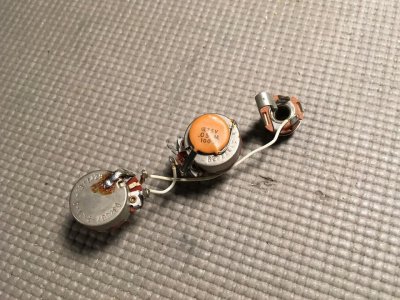
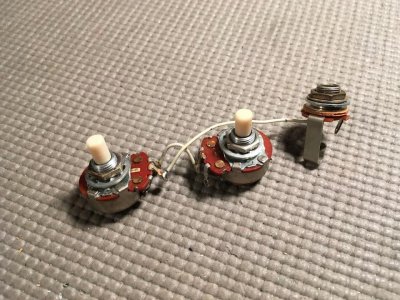
hiwmkgblagyiooggzkwr.jpg

ehkp1t9ejurdazyxmbwo.jpg

qpkksxbvrz1vcxgwexya.jpg

b8tdyv3pyts05g5dkprg.jpg

And some pix from a very clean '74:
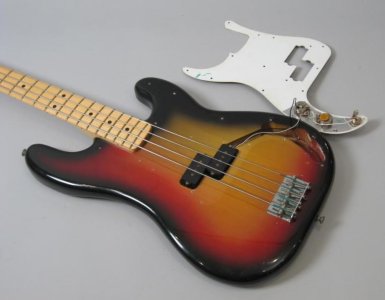
1974FenderPrecisionBassSunburstOHSC008-1.jpg

1974FenderPrecisionBassSunburstOHSC002-1.jpg

1974FenderPrecisionBassSunburstOHSC004-1.jpg

1974FenderPrecisionBassSunburstOHSC005-1.jpg

As you can see, they didn't use a ground wire to the jack. They used the aluminum foil under to guard to serve as a ground connection between all pot chassis and the jack ground. Same with old aluminum guard Ps from the '50s, and '60s Ps with the full sized aluminum plate under the guard. But sometimes you see factory ground wires anyhow, usually with cloth insulation.
 
Last edited:
Back
Top