Dual split P advice

Inflames626

New member
Hi guys,
Although I usually play guitar, I record bass as well. I'm thinking a PP, PJ, or MM will be best for me. A regular P lacks articulateness and a regular J in the neck, I think, is kind of useless.

I bought an SPB3 a while back but found it too boomy. Replaced it with a Fender P 62 reissue and was very pleased.

So, if I go with a PP, I'm thinking of putting the SPB3 under the bridge, thinking that the excess bass and hotness will be compensated for by the bridge position.

Thoughts on a PP setup?

Thanks.
 
Re: Dual split P advice

Hi guys,
Although I usually play guitar, I record bass as well. I'm thinking a PP, PJ, or MM will be best for me. A regular P lacks articulateness and a regular J in the neck, I think, is kind of useless.

I bought an SPB3 a while back but found it too boomy. Replaced it with a Fender P 62 reissue and was very pleased.

So, if I go with a PP, I'm thinking of putting the SPB3 under the bridge, thinking that the excess bass and hotness will be compensated for by the bridge position.

Thoughts on a PP setup?

Thanks.

A few things to get out of the way before I respond:
I really like EMGs for bass. They have a tightness and clarity I've just never found in passive pickups.
I've tried the SPB3, but I find it scooped, boomy, and brittle-bright; pretty much the worst of all worlds. I greatly prefer a SPB1 or SPB2 if we're sticking to the SD line.
Lastly I'm primarily a guitar player who only plays bass for writing / recording.
In short I may be biased, so feel free to take the following with a grain of salt.

I've played a few dual P setups and didn't care for them; I generally don't care for the traditional P-bass setup at all. Having the low string coil farther from the bridge while have the higher strings closer tends to make the whole scooped / boomy / brittle problem worse. The solution IMO is to reverse the P pickup; tighter bass, smoother highs, and most importantly more midrange. It seems you're planning on building a new bass, so this may be a viable option. Adding a J at the bridge (I really like the STK-J2 Hot Stack for this) helps fill the mids out further.

Two of the basses I currently have access to are set up this way with a reversed EMG-P and EMG-J. The third I'm in the process of converting to EMGs; a JCS (modified J) at the neck and a 35TW at the bridge. The latter is a dual-mode pickup that sounds like a MM in 'humbucker' mode while sounding like a JCS in 'single' mode.
 
Re: Dual split P advice

Thanks for the reply, Dystrust.

I normally play active when it comes to guitar, but when it comes to bass, I think passives sound warmer. Active pups cut through more, but since I use a DAW, I can usually compensate for that with EQ.

I like actives as well, but to me that sound consistent almost to a fault, like a synth bass, almost. I'd probably use actives if I played slap bass.

Generally, I like a warm, clean, fat Fender sound, with enough transients coming through so you can hear the pick attacks and not get the bass confused with the low end of the guitar.

I'd say the tone I'm going for is mid period Dark Tranquillity records. This would be a perfect example, at about 2 mins:

http://www.youtube.com/watch?v=Dd0FhZtnuUQ

I talked to the bass player on this via email, Martin Henriksson, and he told me the following. I assume he used a dual soapbar Ibanez, which would probably be equivalent to a J bass. By "H" he means B, I think, which is a convention in Germany and Sweden.

"Hi!
Niklas forwarded me your email.
If my memory is correct i played on an Ibanez 5-string through a Peavey Mark VI amp and Peavey cabinets, a 4x10 and a 1x15.
One thing that differs on Projector compared to the earlier albums is that I started using thicker strings, 135-045. This and the fact that there is a lot more "normal" bassplaying going on gives the (in my opinion) much fuller basstone. But I still tuned it like a guitar, the 5th string was not a low B, but rather a high H, like on a guitar. Projector (and all our albums except for Gallery and Haven) are in C#. So that means I tuned (low to high) C# - F# - H - E - G#. This tuning let me do a lot of guitarlike stuff, especially playing complete chords. And also some ridiculously highpitched riffs :)

Cheers!

Martin Henriksson / Dark Tranquillity
 
Re: Dual split P advice

I'm somewhat familiar with Dark Tranquility, but I can't say I know their catalog that well. Regarding the specifics of the email, that amp is SS if I remember correctly and didn't seem to have a lot of its own character. The sound should be pretty easy to approximate with a decent DI and some EQ. Ibanez made a few JJ 5-strings in the early 90s, but I agree with you that it's likely soapbars and also passive pickups with on-board active EQ (though he may have set it flat). Voicing-wise a lot of soapbars tend to be closer to a P-bass than a J, but this is a generalization and may not apply in all cases. A dual-P setup may work for you to get a similar sound, but I would lean toward a P/J with reversed P for the additional versatility.
 
Re: Dual split P advice

Thanks much.

This came out in 99, but I think the amp is early 90s and most likely the bass too.

Yeah it gets complicated because they can do so much within a soapbar--stack coils, arrange it like a P, or have it be a smaller form factor MM. I just meant a dual soapbar would be like a J in that it has 2 pickups. My guess is that manufacturers are going to soapbars just because they're easier to make and they resonate with humbucker minded guitarists.

Choosing a bass pup type has been really difficult for me. It's like, "Should I go with a humbucker in a single coil housing, a true single, a single in a soapbar, a P in a soapbar?" etc.

I have a Peavey Foundation 5 that has nice stock pups. Can't replace them though because they are soapbar but they're the double dog ear type. I guess the closest would be Bartolinis. They're fatter than a J but I don't know that they're as big as a soapbar.
 
Re: Dual split P advice

Dystrust, I'd say David Ellefson has good bass tone, too. It's full but very articulate. I know he uses EMG dual coils now, but I'm wondering what he used back in the day.
 
Re: Dual split P advice

Dystrust, I'd say David Ellefson has good bass tone, too. It's full but very articulate. I know he uses EMG dual coils now, but I'm wondering what he used back in the day.

Being a bit of a Megadeth fan at one point, It just so happens that I have a decent idea of what he played at various times:
KIMB - RIP: BC Rich Mockingbird w/ dual DiMarzio Ps into Ashley preamp -> SS poweramp -> 4x12 loaded with Cerwin Vegas.
SFSGSW - CTE: Jackson Concert Bass w/ Jackson P/J & OEM active circuit. I think it was a mid-boost, but I'm not 100% sure. This site should have specifics if you really want to know. During this time he played GK800RBs into Hartke 4x10s & 15s.
Youth - Risk: Singnature Modulus w/ EMG DCs. Those pickups are typically used with an active circuit, but I couldn't say for sure which one. Maybe an EMG BQ?
A bit of a guess here, but David can be seen using an SVT-II into Ampeg 8x10s on the Evolver video. He switched to the Mackie / Peavey setup for the Cryptic Writings tour, and the album itself sounds like DI but that's just a guess. Same live rig for Risk & TWNAH.
TWNAH: Fender P-Deluxe 5 for the tour, saw the Modulus in a few studio shots.
 
Re: Dual split P advice

Thanks.

I was checking out some YouTube clips of the 91 Rock in Rio show. Looks like he has a Jackson Concert bass with just P's here.

I thought I remembered him saying he used a GK head on RIP on a RIP 20th anniversary web post. The plugin emulations of that that I have used are bright indeed. I often use it in combination with a Fender black or silverface for the lows.
http://www.youtube.com/watch?v=GmXLNqzleUU
 
Re: Dual split P advice

I remember the Cryptic Risk TWNAH switch over, at least the Peavey and Fender use. Saw them live on Risk and TWNAH and definitely remember him using Fender on that. I think he used the Peavey Zodiac for a while after that.

I generally like Peavey's basses. No complaints here.
 
Re: Dual split P advice

The bass I'm using now is a 70s Korean lawsuit P with maple neck and fretboard (body is plywood) and the 62 RI and vintage spec capacitors on the tone knob (.1 I think). Almost identical to Harris's tone except for the flatwounds.

I like it when you want the bass to be neatly with the mix, but it doesn't stand out really. I used it for some 70s Judas Priest covers.
 
Re: Dual split P advice

Hi guys,
Although I usually play guitar, I record bass as well. I'm thinking a PP, PJ, or MM will be best for me. A regular P lacks articulateness and a regular J in the neck, I think, is kind of useless.

I bought an SPB3 a while back but found it too boomy. Replaced it with a Fender P 62 reissue and was very pleased.

So, if I go with a PP, I'm thinking of putting the SPB3 under the bridge, thinking that the excess bass and hotness will be compensated for by the bridge position.

Thoughts on a PP setup?

Thanks.

Seems like, for P's at least, the neck pup for bass is what the bridge pup is for guitar...something about the position makes it more versatile and generally "better". Just about regardless of manufacturer, wind, active passive, etc. Also confirmed on soapbar-equipped active Ibbys, both with stock pups and with swapped in Bassline Blackouts (biggest diff here, if buying those id go so far as to say save a cnote buy neck alone)

Pbass = essentially a "1x neck-pup-only" config...dual Ps wont give you the same magic selectable between two different spec P pups. Only the neck pup will have 100% mojo

Likely has to do with harmonic sweet spots, but probably increased further by manufacturers winding pups to exploit them - and doing the other pickup for a contrasting additional tone, maximizing difference instead of squeezing out the best comparable tone achievable near the bridge
 
Re: Dual split P advice

Thanks guys.

What trade offs am I making when I go with a stacked J vs. MM vs. P, etc?

My understanding is a stacked J will actually have brighter (or less) tone than a P or MM because less of the string length is present across the surface. This is one of the things making me lean toward a dual P or MM. I feel like because the surface area of the pickup is greater, the tone will be a little fuller.

Also, and this may just be my imagination, but guitar wise, I have never been crazy about stacked, hum canceling single coils. They sound like they emulate a true single, but they lack the tone to my ears. This makes me kind of hesitant to go with a J design, or at least a stacked J design.

I figure with another P near the bridge I'll get more surface area for the pickup and hum cancelling as well.
 
Re: Dual split P advice

The problem with passive PP basses is mixing them. Passive pickups change their sound when you combine them, mix them. Most people like how Jazz and Strat do that, but it gets tricky when heavier pickups are involved.

The reason why the stack sounds different is that the active coil has to carry a blind coil. You can go two ways, parallel or series, with the design but either way you have to heavily compromise the design of the active coil. In most cases people use paper thin wire and then the physical size of the coil is very small. That directly impacts how the thing sounds and why it is "weak". Systems with the blind coil under the pickguard don't have physical size restrictions, but again you either go half values electrically or double values depending on whether you want coils in parallel or series. No-win situation unless you change impedance before putting the coils together.
 
Re: Dual split P advice

In case this inspires anyone to make further comments--other great bass tones would be Eddie Jackson of Queensryche. Some of the Mindcrime stuff was a little thin (that was the production of the time), but by Promised Land the bass tone was huge.

Also, props to uOpt for putting the time into my threads and giving very good information. Guys like him are what this forum is all about.
 
Re: Dual split P advice

Thanks guys.

What trade offs am I making when I go with a stacked J vs. MM vs. P, etc?

My understanding is a stacked J will actually have brighter (or less) tone than a P or MM because less of the string length is present across the surface. This is one of the things making me lean toward a dual P or MM. I feel like because the surface area of the pickup is greater, the tone will be a little fuller.

Also, and this may just be my imagination, but guitar wise, I have never been crazy about stacked, hum canceling single coils. They sound like they emulate a true single, but they lack the tone to my ears. This makes me kind of hesitant to go with a J design, or at least a stacked J design.

I figure with another P near the bridge I'll get more surface area for the pickup and hum cancelling as well.

You're right that a stacked J will be brighter than a MM, but in a PJ you're looking more to fill in missing frequencies than use the pickup by itself (IMO of course). The different frequency focus may be helpful when mixing with a P-bass pickup as you'll be less likely to have mud issues. Regarding stacked 'singles', I agree with you at least when it comes to guitars. However the tone / frequency loss seems to be mostly in the treble region which matters a lot less for bass. The other reason I recommend a stacked J over a true single is noise. If you're playing music reminiscent of Dark Tranquility or even Queensryche, noise from a true single could be a problem at gig volume.

In case this inspires anyone to make further comments--other great bass tones would be Eddie Jackson of Queensryche. Some of the Mindcrime stuff was a little thin (that was the production of the time), but by Promised Land the bass tone was huge.

Also, props to uOpt for putting the time into my threads and giving very good information. Guys like him are what this forum is all about.

I also happen to know a little about Queensryche's bass sound. Up until somewhat recently Eddie Jackson recorded with a Kramer-era Spector NS-2 with EMG P/J pickups and a Hazlab preamp. It may be possible to cop that sound with passives, but it'll be difficult. I'd try running an EQ into something like a Sansamp with light grit set mostly dry with a bit of bass & treble boost. That may approximate the Haz aggression, but it's just a guess.
 
Re: Dual split P advice

Thanks Dystrust.

I mostly use a DAW to record, so I don't think noise will be a big issue because I won't be around lights. Might be my imagination, but like I said, a true single just sounds better to me (although I haven't tried them on bass).

That said, I could always split a stacked J if I wanted a single, or use the stacked J to approximate a humbucker.

My leaning toward the PP was just that, if I'm going to be using a stacked J humbucker anyway, might as well use a 2nd P split humbucker.

Regarding uOpt's comment, I think I was just going to crank both pickups and hope for the best xD

Also to Dystrust, in my DAW, I can usually approximate that kind of bright bass sound (think DD Verne of Overkill) by EQ'ing around 2-2.5k. The problem is this also begins to step on the guitar's toes. I also like working in the 1k and 100-200 hz region for guitar and bass, but these three bands tend to step on the snare drum.

But I think I'll be able to do pretty well with the right pickup.
 
Re: Dual split P advice

Jackson basses that had a split P were typically reversed from Fender's layout - the bass coil was closer to the bridge.

And the active circuit they came with was a 20dB cut/boost for the bass and treble (one knob for each).
 
Re: Dual split P advice

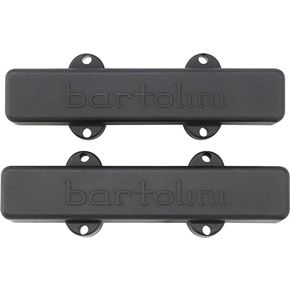
these are split P style pickups hidden in a J bass casing. Clear neck tone, deep bridge sound. Winning.
DV019_Jpg_Regular_H71938.jpg

Bartolini 9j1 set
 
Back
Top