Duncan/ESP Custom 14 and Alnico 2 Pro in an LTD EC-2025 -- How to improve further?

Thurisaz

Member
I have an LTD EC-2025 with a Custom 14/Alnico 2 Pro. I'm finding the pickups lacking, moreso the bridge pickup, and curious what options I have to make it more usable. I find the pickups to be bright, there is a frequency in the upper midrange/treble area that is unpleasant, and lacking in character. The way they interact with the gain is not to my licking.

Previously, I had them around 3/32" away from the strings when fretted at the last fret. In addition, I had the guitar tuned to E standard with 9-42 gauge strings. Currently, the pickups are now around 4/32" away from the strings and I have the guitar tuned to Eb standard. These changes have made the Alnico 2 Pro closer to where I want the sound in the neck, though I may need to back off the bass side to around 5/32". The bridge sounds I am getting have improved, but not to the extent of the neck pickup.

This has improved things some, the neck pickup moreso than the bridge, but I am curious what else I can try to improve things further. I would attempt to swap the magnet, which I think is a ceramic, for an Alnico 2, but the covers and wax potting would be a nuisance.

Any thoughts that'll keep me from having to replace pickups?
 
Ahh. In that case, I would put an A2 mag in bridge, making it a Custom Custom, which would better match the tone profile of the neck and soften the brightness. Cover would be a little troublesome, but the wax can be softened just with the heat of the hand, or a hair dryer (far enough away to not overdo it). The only other thing I could think of without changing the pickup would be some kind of EQ filter on the bridge, but that would add stuff into the wiring.
 
No, the Custom 14 is the ESP-exclusive version of the Custom. I don't know exactly what it is for certain, but I remember reading it's a Custom with a triple Ceramic magnet ala Invader/Black Winter.
 
Oh interesting, I actually didn't know that, but I am not up on a lot of ESP's stuff. I agree with the A2 suggestion. Having a triple ceramic magnet is going to be really bright. Even an A5 would knock the brightness down a bit.
 
How are we making recommendations when we know nothing about the amp and speakers this is being played through and what type of music is being played?
 
How are we making recommendations when we know nothing about the amp and speakers this is being played through and what type of music is being played?
I based it off this: "I find the pickups to be bright, there is a frequency in the upper midrange/treble area that is unpleasant, and lacking in character."
 
For the record, passive pickups have not a defined sound by themselves and many things can be done with resistive / capacitive loads (IOW: with pots and wiring/cables) before to go deeper with magnets, new pickups and so on...

Let's avoid a painful rambling by sharing a link. I don't agree with all this guy says (far from that) but on the basic principles at work, what he shares is what I'd explain as well.


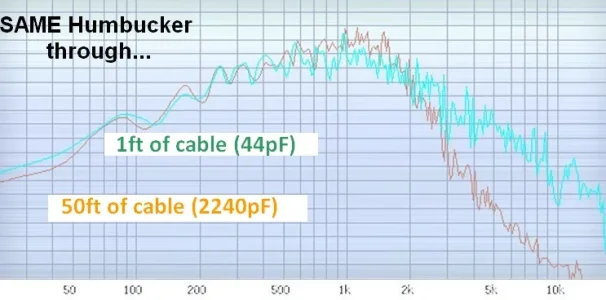
EDIT - And if ever the pickups mentioned by the OP are played through a wireless emitter without cable emulation... below is the response of a SAME bridge humbucker played in chords direct to the board, through 50ft vs 1ft of cable (1ft being the length of a generous patch cable to emitter). Should illustrate the first sentence of this post regarding passive PU's as having no defined inherent tone...

SameHB50fTvs1fTof Cable.webp
 
Last edited:
Ahh. In that case, I would put an A2 mag in bridge, making it a Custom Custom, which would better match the tone profile of the neck and soften the brightness. Cover would be a little troublesome, but the wax can be softened just with the heat of the hand, or a hair dryer (far enough away to not overdo it). The only other thing I could think of without changing the pickup would be some kind of EQ filter on the bridge, but that would add stuff into the wiring.
I would, but removing the pickup and repotting it are not something I'm able to do.

For the record, passive pickups have not a defined sound by themselves and many things can be done with resistive / capacitive loads (IOW: with pots and wiring/cables) before to go deeper with magnets, new pickups and so on...

Let's avoid a painful rambling by sharing a link. I don't agree with all this guy says (far from that) but on the basic principles at work, what he shares is what I'd explain as well.


EDIT - And if ever the pickups mentioned by the OP are played through a wireless emitter without cable emulation... below is the response of a SAME bridge humbucker played in chords direct to the board, through 50ft vs 1ft of cable (1ft being the length of a generous patch cable to emitter). Should illustrate the first sentence of this post regarding passive PU's as having no defined inherent tone...

View attachment 6326337
I understand this to some extent, but the specifics and how I'd implement it in the guitar are where I get lost. Adding a small amount of bass/low mids and a roll off of the high end would be a step in the right direction.

If I didn't find soldering in pickups to be a tedious pain, I might consider swapping the pickup as well, but the pickup covers aren't offered by Seymour Duncan, so I'd have to change both of them.
 
Adding a small amount of bass/low mids and a roll off of the high end would be a step in the right direction.

The resistive and capacitive loads that I evoked can do that to some extent. It requires to experiment with various pots and cable capacitance values...

Example of tonal variations with pots (whose action is to darken the sound by flattening the "resonant peaks" of pickups as their resistance gets lower):


Example of variations with cables (whose effect is to shift down the frequency of resonant peaks when their capacitance increases, knowing that treble freq. drop beyond these resonant peaks... so more capacitance = darker tone too, but not in the same way than with lower resistive load):


Changing the resistance of pots is the most often applied solution. But TBH, lowering a tone pot to obtain the required resistive load does largely the same thing than going through the hassle of changing pots... and for those who dislike to set their tone pots at exactly 6,363/10, it's always possible to change the value of existing pots just by adding cheap resistors to them (there are various ways to do that, I'll detail on request what I mean).

The effect of cable capacitance is often ignored but not to discard and can in fact be emulated with some small cheap cap(s) from hot to ground (of a pickup or of an output jack). Count +/- 40pF (picoFarad) per foot of average guitar cable to emulate.

Both solutions can be used altogether. I've often "tuned" instruments by pairing resistors and caps (and FWIW, PRS did the same directly on some of their pickups, like the single coils mounted in their "Silver Sky" guitars: each of these pups host sometimes a resistor in parallel with a cap from hot to ground connections).

FWIW.HTH.
 
That confirns that Im not nutz( or not as lol) in the fact that I use the same cables in the same positions( guitar to board and board to amp) on my rig all the time. Cause ive allways felt cables effect tone.
Even when I replace one I use the same length and brand.

To OP dont know your pedal chain but have you tried that guitar with just your amp and maybe just your main OD/ Drive pedal to rule out pedal loadings effect?
 
Last edited:
Has anyone ever tried Wago 221 connectors? I may end up deciding to replace the pickups, and if so, I don't want to screw around with soldering (I'm not great at it, and I find it to be a pain). I was thinking of leaving just enough wire (red/white, green/bare, and black), then using the Wago 221 connectors to splice the new pickup in.

Any thoughts?
 
Has anyone ever tried Wago 221 connectors? I may end up deciding to replace the pickups, and if so, I don't want to screw around with soldering (I'm not great at it, and I find it to be a pain). I was thinking of leaving just enough wire (red/white, green/bare, and black), then using the Wago 221 connectors to splice the new pickup in.

Any thoughts?
I dont trust anything solderless myself.
I would recomend. Go buy a Harbor Freight 30w iron they are 6.99. Grab sone small bits of wire and a junk pot and sit and practice.
Knowing how to solder can open up allot of posabilities for you and save money not having to pay someone for simple electrical repairs. Once you get it its easy.
Allot of times for pots/ ground ill scratch a circle on the back with a screw driver, heat the pot flow a pool of solder on. While its cooling ill tin the wire ill be soldering to the pot. Then ill just melt the tinned wire into the pool. Then get heat right off the pot. That usually keeps ya from overheating the pot and/or having an overheated cold joint.
 
Last edited:
Back
Top