Factory pickup heights

beaubrummels

Well-known member
Didn't know Seymour Duncan had recommended default pickup heights, but they revealed a couple in this article. Would like to see more recommendations, just as a starting place.
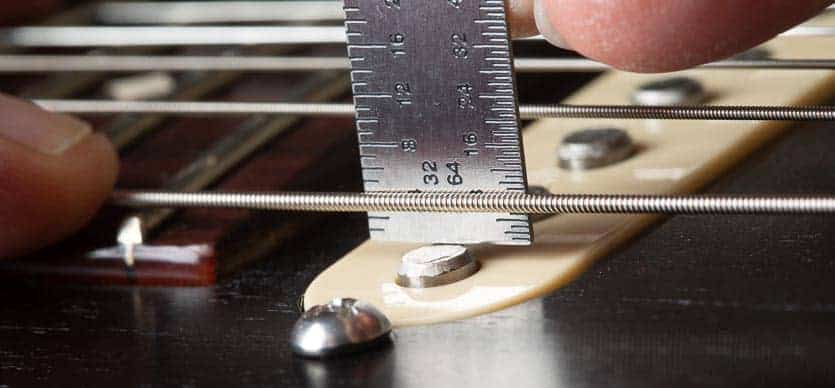

Just for some comparisons...
Per a Gibson QA employee, Gibson humbucker factory default heights are (with the high and low E fretted at the 22nd fret):
Bridge: 3/32" high E, 3/32" low E
Neck: 3/32" high E, 4/32" (1/8") low E

My 2012 Gibson Les Paul Studio (Burstbucker Pro pickups) came from the factory after Plek with:
Bridge: 9/64" high E, 9/64" low E
Neck: 9/64" high E, 5/32" low E

My 1994 Gibson Les Paul Standard (498/490) came from the factory with:
Bridge: 1/8" high E, 1/8" low E
Neck: 1/8" high E, 3/16" low E

With the latter 1994 LP, I've found that you can move the 498/490 set up and down and play with the screw pole height to get everything from scooped heavy metal sounds to vintage PAF chime sounds out of the same set of pickups, so numbers are just a starting place for me.

Maybe post some heights you've settled on, what the guitars (model, wood, neck, hardware) and amps/settings you are using, and what the resulting sound is like. Might help others get started.
 
I find the PRS recommendations for humbuckers are a good starting point for me and most of my guitars end up right there. sometimes a little closer, but rarely farther away. I adjust the poles so the wound strings follow the arc of the strings. The G and B strings are a bit lower, but each guitar is tweaked as I feel the need.

Fretted at the last fret for neck and bridge pickups;
High E = the string covering the 5/64" line on a ruler.
Low E = 3/32" covering the line on the ruler.

When my Strat and Tele used true single coils, Fender's starting points always sounded fine to me.

My Strat and Tele now have Kinmans. I don't know exactly where they are set, but they are pretty close to the recomended Kinman starting points, but a little farther away.
 
I'm not sure how much I trust Gibson measurements. I don't know if "trust" is the right word, but I feel like their measurements are pretty off compared to what I like. I feel like their stock action measurements, for example, are way too high for my liking. Especially since they're plek'd, it's very easy to get them lower without fret buzz.

I also set my bridge pickups closer to the strings that that. My starting point is usually as high as I can go without clicky sounds from the strings hitting the polepieces, the bobbins, or the covers. That's usually around 2.5 mm from the high E with the open string not fretting anything on the bridge pickup.
 
Last edited:
I use 1/8 " as a starting point for the bridge
Then volume balance the neck to match

The JB (mah favorite) likes 1/8 "
 
I deal with milimeters and meters at work. This helps me keep work stuff at work and home stuff at home. :D
Don't get me started. We were so close to switching to metric back in '79. It makes so much more sense.

As far as pickup heights, 15 minutes with a screwdriver will reveal a lot. I start with the bridge about 3/16" away (by sight). Then go up and down until it sounds right to me. It doesn't take long. I don't measure- I do it by ear.
 
I use the dime system, as in how many 10-cent pieces. 2 for bridge humbuckers, 3 for neck.

If I move back to Europe I'll need to do some currency smuggling.
 
I use drill bits to fix the height: I put them on the pole and when they touch the strings the height is ok, I use 3.0mm drill bit on bass side, 2.0mm on treble side, that's my go to distance for single coil

BTW imperial measures give me headache, how could you manage such a madness?
 
I use the pickup manufacturer's recommended start heights for all positions. If I hear the tones I want from that bridge pickup, then I adjust neck and middle pickup height for desired volumes, based on the E strings, relative to that bridge pickup. If I do not like any pickup's tone, then I tend to think have the wrong pickup in there.

It is rare that I adjust pole pieces. Again, if it reaches this point, do I have the wrong pickup in there? I did make a valiant effort adjusting pole pieces on my '59 neck in my LP, to no avail. It always seemed boomy or woofy compared to all the '59 clips I listened to, and I like bass. However, an A4 mag swap resolved that and I think the pole pieces are mostly flush again.

Aside: I always seem to learn something from beau's posts. I might have saved enough extra, instead of buying more guitars and pickups, that I would be retired from my day gig by now if he had posted this in 1983. 🤣🤣🤣

....

With the latter 1994 LP, I've found that you can move the 498/490 set up and down and play with the screw pole height to get everything from scooped heavy metal sounds to vintage PAF chime sounds out of the same set of pickups, ...
 
I use drill bits to fix the height: I put them on the pole and when they touch the strings the height is ok, I use 3.0mm drill bit on bass side, 2.0mm on treble side, that's my go to distance for single coil

BTW imperial measures give me headache, how could you manage such a madness?
You will measure things in terms of the big drill bit you have on your desk and the little drill bit you have on your desk but you scoff at the idea at a measuring system that's based around fractions instead of decimals?
 
You will measure things in terms of the big drill bit you have on your desk and the little drill bit you have on your desk but you scoff at the idea at a measuring system that's based around fractions instead of decimals?
I don't get the point, the diameter of the drills is metric, who need fractions?
 
I don't disagree with you on any of this in practice, but as someone's who's day job involves GD&T and many units of measurement, I have to say that you are not setting the height of your strings to 2mm and 3mm, you are setting them to the widths of your drill bit.

The big difference being that 2 and 3 mm are toleranceable numbers, whereas the width of the given drill bits you have would only be usable as a metric for a nontoleranced (ie "cut to fit") applications. One of these specs could be handed to a machininist, the other would be handed to a craftsman.

For strings and guitar pickups it doesn't matter, for high precision systems with moving parts it does. And since I'm fiddling with a guitar forum while at work, my work mind is bleeding into it
 
Back
Top