Fender Mustang Bass bridge foam?

dg27

New member
I've had a '69 Mustang since 1981. I used it a lot for several years and then moved away from it, mostly because I really don't like short scale basses. I'm working on a project for which it might be appropriate and am thinking of getting new strings and checking it out.

The original foam mute pieces on the bridge disintegrated years ago. I replaced them with a removable piece of foam at the time (I think it was actually some sort of rubbery insulation material). I used to think it dampened the strings too much. I removed it today and played it without any foam. It sounds a bit different: sustains a lot more but loses some of the flavor I'm looking for. FWIW I use black tapewound strings on this.

Should I try to find a more authentic replacement for the mutes? I've done quite a bit of searching and found nothing.
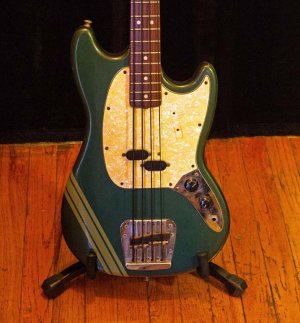
1969 Fender Mustang_4249.jpg

This picture shows the piece of foam I removed (not the original foam).
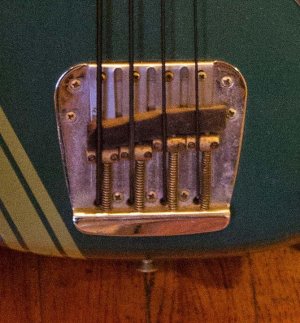
1969 Fender Mustang_4249_bridge.jpg
 
Re: Fender Mustang Bass bridge foam?

When you say "rubbery insulation material", do you mean self-adhesive draught excluder strip? That or the type of compressible rubbery foam found on the underside of some direct-mounted pickups would do the job. Just cut four short sections.

The advantage of the four individual blocks over a single continuous strip is that you should be able to adjust the degree of damping with the screws.
 
Re: Fender Mustang Bass bridge foam?

do you mean self-adhesive draught excluder strip?

If I asked for "self-adhesive draught excluder strip" material in New York, I'd certainly get nowhere, but yes--I think this is the same stuff. It's what you'd buy in a hardware store to put around the perimeter of a drafty window.

That or the type of compressible rubbery foam found on the underside of some direct-mounted pickups would do the job. Just cut four short sections.

Actually, I hadn't thought of that, but that seems to be the same type material (the same density).

The advantage of the four individual blocks over a single continuous strip is that you should be able to adjust the degree of damping with the screws.

Looking at the bridge, I see what you mean. And the stuff I used previously is about the same width as the metal pieces that run underneath {parallel} to the strings, where the screws are. How much string should they dampen, i.e., how long should these be? If my memory serves, the original pieces were less than 1 inch (25.4 mm).

Thanks for your help. When I took the foam off it lost the distinctive sound it had, but the foam I had used was just too much in terms of damping.
 
Re: Fender Mustang Bass bridge foam?

Yes. The draughty window stuff.

Just imagine. If you could pad print Rickenbacker on the stuff, you could sell it on for a 1000 per cent mark up. :fingersx:

Each mute pad needs to be no wider than the metal "spring" on which it sits. Lengthways, I would probably go with whatever width the strip comes in.

The theory is that the adjustment screws allow you to determine how firmly each pad presses against its respective string. They may require different pressures to achieve the same degree of attenuation.
 
Re: Fender Mustang Bass bridge foam?

Each mute pad needs to be no wider than the metal "spring" on which it sits. Lengthways, I would probably go with whatever width the strip comes in.

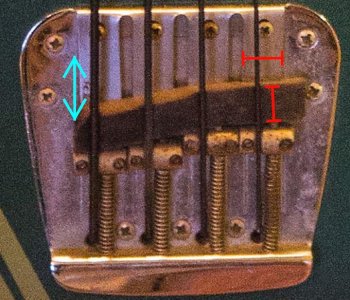
I think we are looking at what's the "length" and what's the "width" opposite of one another. If you look at the pic below, where this "draughty" stuff crosses underneath the string, the short dimension of the material is what I'd call the width. That's about the width of the individual metal pieces with the screws (imagine removing that piece and flipping it so it runs under the string). (The red lines below are about the same length.)

My question is how long it should be from the saddle (how far up the string it should go) and how far from the saddle it should be (The blue arrow.)

Capture.JPG

The theory is that the adjustment screws allow you to determine how firmly each pad presses against its respective string. They may require different pressures to achieve the same degree of attenuation.

Got it--thanks. I think I'll have to play around with it.
 
Re: Fender Mustang Bass bridge foam?

Thanks.

Yeah--sometimes I like the sound for certain applications, but I'm more a P/J player.
 
Back
Top