
You are using an out of date browser. It may not display this or other websites correctly.
You should upgrade or use an alternative browser.
You should upgrade or use an alternative browser.
Floyd's
- Thread starter JamesPaul
- Start date

nexion218
New member
Well its not any different when you adjust string action: you take out the springs and let the bridge sit completely loose. You just have to take out the completely detached bridge from the cavity. But I understand if someone likes a "cleaner" looking method - I'm just too lazy to find the "right sized block to use... And I bet that you cannot use the same block for all guitars as the cavity size and/or the sus block size will differ, calling for a differently sized block. Or can you?
And I bet that you cannot use the same block for all guitars as the cavity size and/or the sus block size will differ, calling for a differently sized block. Or can you?
Obsessive Compulsive
New member
Well its not any different when you adjust string action: you take out the springs and let the bridge sit completely loose. You just have to take out the completely detached bridge from the cavity. But I understand if someone likes a "cleaner" looking method - I'm just too lazy to find the "right sized block to use...
How do you adjust the action with the strings off? The strings have to stay onboard and strung to their regular tension otherwise there is no way to determine if you have reached the proper action.
Dude...do you even play guitar or just hang around?
P.S. Yes you can use the same block for nearly all guitars: A nine-volt battery should do it.
nexion218
New member
How do you adjust the action with the strings off? The strings have to stay onboard and strung to their regular tension otherwise there is no way to determine if you have reached the proper action.
Dude...do you even play guitar or just hang around?
P.S. Yes you can use the same block for nearly all guitars: A nine-volt battery should do it.
With that out of the way, I never said that I adjust action with strings off. For starters, we were talking about working on the frets and board of a Floyd equipped guitar and both dave74 and I have suggested that its easy, you just have to remove the bridge unit from the guitar, pull the strings aside and do your job on the board then reinstall the bridge. That way you avoid doing a whole setup from ground zero.
Mincer found this to be a messy solution, to which I replied that its not much different than setting up the action of a Floyded guitar, since to adjust the height adjustment screws of the unit, most people knowing what they're doing remove the springs to avoid blunting the baseplate knives by turning the height adjustment screws under full string tension. You remove the springs, adjust height and reinstall springs then check the action. Rinse, repeat until its where you want it to be. Yes, the Floyd has its iherent flaws, cumbersome setup being one if them.
But of course there are people who do it under full tension, then use their full force to tighten the string clamps and blocks and then run around internet forum whining about their sh!tty Floyd which wont stay in tune, return to zero or hold the string...
In case you still don't understand I suggest taking up reading classes instead of guitar.
Last edited by a moderator:

GuitarStv
Sock Market Trader
I use a small metal plate which is padded on the bottom. It is more like a ramp, really, and it fits between the saddle length adjustment screws and the body, keeping the bridge plate parallel to the body when you change strings.
I use a couple wedges of folder cardboard. Same kind of idea, they're ramp shaped. Takes a few tries to get the cardboard compressed enough to work well though.

ErikH
Well-known member
I have one of these that I use when changing strings. Can't recall when I got it but it was probably 25 or so years ago. Definitely after I purchased my Baretta.
Changing the strings isn't too bad for me. I don't playing a Floyd equipped guitar as my main one anyway. Though it is dive-only, I find this tool very helpful with getting to the string lock allen screws on the back. Once they are changed, remove the block, stretch them out, tune up, stretch, tune. Rinse and repeat until they are stable, lock the nut, fine tune if necessary.
https://www.shredneckstore.com/SearchResults.asp?Cat=46
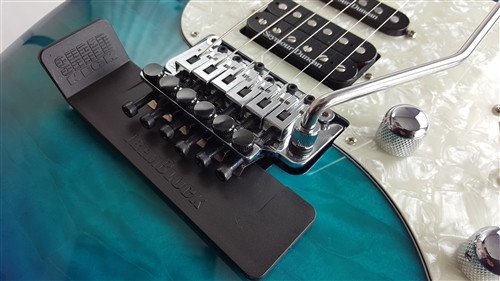
Changing the strings isn't too bad for me. I don't playing a Floyd equipped guitar as my main one anyway. Though it is dive-only, I find this tool very helpful with getting to the string lock allen screws on the back. Once they are changed, remove the block, stretch them out, tune up, stretch, tune. Rinse and repeat until they are stable, lock the nut, fine tune if necessary.
https://www.shredneckstore.com/SearchResults.asp?Cat=46

Guys, simmer down. Its a Floyd. No need to call each other names.
This is the same thing I use.
I have one of these that I use when changing strings. Can't recall when I got it but it was probably 25 or so years ago. Definitely after I purchased my Baretta.
Changing the strings isn't too bad for me. I don't playing a Floyd equipped guitar as my main one anyway. Though it is dive-only, I find this tool very helpful with getting to the string lock allen screws on the back. Once they are changed, remove the block, stretch them out, tune up, stretch, tune. Rinse and repeat until they are stable, lock the nut, fine tune if necessary.
https://www.shredneckstore.com/SearchResults.asp?Cat=46
This is the same thing I use.

Chris Pile
Well-known member
The first "name" player I ever heard of using a Floyd was Randy Hansen. His was made by Floyd himself, of unplated brass.
The second was Edward Van Halen - who is basically responsible for the acceptance of the Floyd into the market.
The second was Edward Van Halen - who is basically responsible for the acceptance of the Floyd into the market.
Chris Pile
Well-known member
Pretty sure the history of Floyd Rose stuff is not THAT.

JMP/HBE
Well-known member
The first 3 that come to my mind when I remember seeing Floyds are Eddie Van Halen, Neal Schon, and Brad Gillis. I believe they were the very first to use the system. Might be wrong but I seem to remember reading about those 3 getting the first ones.
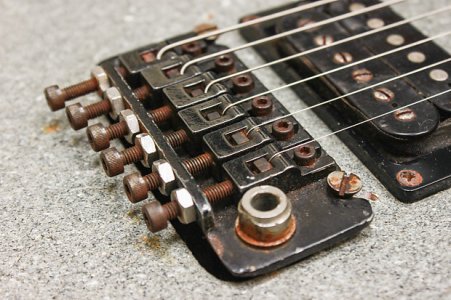
The first Floyds were very crude compared to these days & did not have fine tuners. Brad Gillis still uses that type now.

Here's a pic of my Schaller Trem-Meister.
Last edited:
ErikH
Well-known member
I remember seeing non-fine tuner Floyds. I wasn't playing then but when I started and started learning about parts and such I recall seeing them in older ads and magazines. Never used one personally though aside from the one that was done with Fender in the early 90's. That was a sweet bridge.
Last edited:


Demanic
PenultimateTone Member
I always preferred Kahlers.I fell in love with my Floyd once I put the Trem Block on it, until then I was wondering why everyone was so in love with them.
Sent from my SM-A115A using Tapatalk
Chris Pile
Well-known member
Me, too. You won't find any guitar repair guys who like Floyds.

JB_From_Hell
Jomo's Nimions
Maybe I’m doing something different, but I can change tunings and get the bridge floating at the proper height in less than 10 minutes.
Not implying that it’s a good system for frequent alternate tunings, but that it’s not the puzzle so many make it out to be. When I restring and stay tuned the same, I cut the end off a new string, loosen the nut clamps, remove a string, clamp the new one in, tune, etc... and again, we’re talking less than 10 minutes.
Not implying that it’s a good system for frequent alternate tunings, but that it’s not the puzzle so many make it out to be. When I restring and stay tuned the same, I cut the end off a new string, loosen the nut clamps, remove a string, clamp the new one in, tune, etc... and again, we’re talking less than 10 minutes.

beaubrummels
Well-known member
Sounds like you are changing one string at a time, which works pretty easy. It's when you need to replace the whole set and clean up the guitar (requiring all strings to be off at once) that it's more of a pain.


