Grain sealing

Sam SG

Active member
Just curious on this. But my 3rd SG is an Epiphone inspired by SG classic with P90s. Not a bad sounding axe. I use it fir open A tuning for a couple slide song.
Thing I dont like is the mahogany neck hasnt been seal. You feel the grain in your hand which deturs me from picking it up.
Is there a way to simply seal over the existing finish? Whats involved.
FYI my finishing/ refinishing skills are pretty much rattle can.
 
I'd also be interested in knowing this. My first instinct would be to French polish polyurethane onto it, but I don't know how that works over a finish
 
I just need to understand this better...
You said it hasn't been "sealed", but you want to know how to "seal over the existing finish" (which on an Epi is probably polyurethane or polyester).

If it has an existing finish then it most likely IS sealed. So I'm assuming that when you say "sealed" you really mean pore filled?

If that's the case you will need to sand the neck to bare wood (because nothing really sticks to cured poly), stain, apply a couple coats of sanding sealer, 2-3 coats of pore filler sanding smooth after each coat, then apply your desired final finish. I have really been loving the ease of application and the final feel of oil finish on the neck (like TruOil, Glancy's No. 1 Oil, or Tung oil).
 
how thick is the finish? i assume you could just sand whats there smooth if its thick enough
 
Some people just use powder on their palm while playing. I would just sand it to where it feels good to you- it won't take much. Sand to 2000 grit, and it will feel great.
 
It's called Scotchbrite. For decades I have had this complaint from clients and I simply scuff the neck with maroon Scotchbrite until the gloss gets cut down a bit. Good to go, and no finish removal. No charge, either.
 
I don't think I 've understood the type of finish you have, I have a les paul special faded which is practically bare wood with a thin thin coat that could be oil, I can feel the pores too but you seem to describe something different, could you please post a pic ?
 
I don't think I 've understood the type of finish you have, I have a les paul special faded which is practically bare wood with a thin thin coat that could be oil, I can feel the pores too but you seem to describe something different, could you please post a pic ?
Gibson does NOT use oil finishes.
 
mmh, ok, so something that seems smilar, opaque and very thin with pores visible and touchable, maybe you know what finish the faded series had?
 
Gibson usually uses acrylic lacquer, but since it's an Epi you can bet it's some kind of poly. Basically plastic, which is not normally regarded as musical.
 
Gibson usually uses acrylic lacquer, but since it's an Epi you can bet it's some kind of poly. Basically plastic, which is not normally regarded as musical.
I will not accept poly slander. Thick polyfinishes are bad and "not musical", but they can be applied thinly
 
If you don't want to sand back and grain fill, you could spray lacquer until you buid up quite a heavy coat, then see if it will sand flat.

It will eventually 'sink' into the pores a bit, but that's the nature of the beast-Gibson's do it as well.

Larry
 
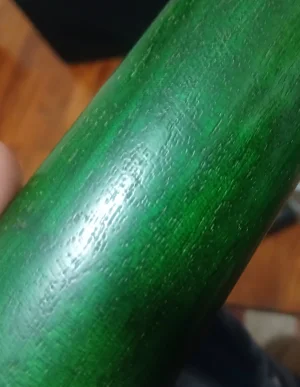
Ok anyways I finally remembered to snap a pic. It was very dificult to capture the open grain on photo. But here is what I mean the mahogany neck was never grain filled.
It is an Epi Inspired SG classic in Green. Finish is definetly not nitro. Its a matte poly.
 

Attachments

  • 20260326_004756.webp
    20260326_004756.webp
    202.9 KB · Views: 2
Right now all my guitars and basses feature "unfinished" necks from Warmoth. I love feeling the grain while I play on the wenge and bubinga necks. The unfinished roasted maple and Indian rosewood necks are smooth.

Orpheo put a thin finish on my bass that he built but it has an unfinished feel to it. He does incredible work. I wish everyone on the forum could try an Orpheo guitar or bass.
 
Last edited:
Back
Top