
You are using an out of date browser. It may not display this or other websites correctly.
You should upgrade or use an alternative browser.
You should upgrade or use an alternative browser.
Guitar input jacks..
- Thread starter BloodRose
- Start date

dystrust
Well-known member
Re: Guitar input jacks..
I'm glad that we're on the same page. Just out of curiosity, where is your shop located? If you're anywhere near the Twin Cities metro I'd love to stop by and check it out sometime.
Indeed I did, and I agree with you. However, it's not exactly the same as a standard guitar output jack. I deal with guitar customers nearly everyday and it's not a stretch of the imagination to envision someone purchasing this jack and then wondering how to hook it up, given that it is not identical to what they are replacing. That's all I was getting at.
In my shop I use Nuetrik & Switchcraft brands for cable ends and jacks. I agree with others about the quality of the Switchcraft pars and use them anytime I am replacing an output jack.
I'm glad that we're on the same page. Just out of curiosity, where is your shop located? If you're anywhere near the Twin Cities metro I'd love to stop by and check it out sometime.
F
Funkfingers
Guest
Re: Guitar input jacks..
This technology dates back to military field radios. Imagine, if you will, that your life could depend on this li'l metal effer. Which one would you choose?
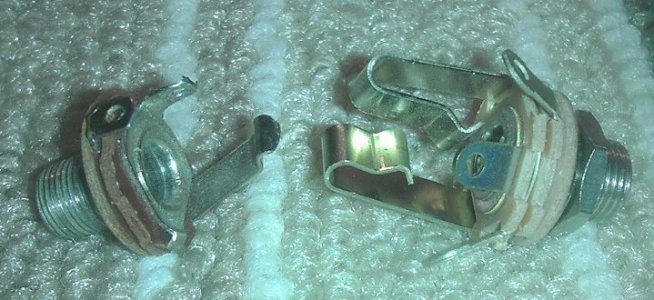
This seems like a good time for a pic: (Switchcraft vs import)
View attachment 64478
Hopefully, the difference is obvious.
This technology dates back to military field radios. Imagine, if you will, that your life could depend on this li'l metal effer. Which one would you choose?
Re: Guitar input jacks..
Yep, funny isnt it? all the technology, this is still bout the best. I do kinda like the neutric locking jack my one Les Paul had on it. was kinda ugly though, but it was solid. plus, if you step on the chord, it wouldnt pull out either..
This technology dates back to military field radios. Imagine, if you will, that your life could depend on this li'l metal effer. Which one would you choose?
Yep, funny isnt it? all the technology, this is still bout the best. I do kinda like the neutric locking jack my one Les Paul had on it. was kinda ugly though, but it was solid. plus, if you step on the chord, it wouldnt pull out either..
F
Funkfingers
Guest
Re: Guitar input jacks..
Neutrik three-pin XLR plugs and sockets make sense for active instruments running on external power.
Neutrik three-pin XLR plugs and sockets make sense for active instruments running on external power.

GilmourD
Burritotoneologist
Re: Guitar input jacks..
For standard guitar applications you want this one, not the TRS jack you linked in your OP.
http://www.onlinecomponents.com/neutrik-nys229.html?p=11967850
For standard guitar applications you want this one, not the TRS jack you linked in your OP.
http://www.onlinecomponents.com/neutrik-nys229.html?p=11967850

Artie
Peaveyologist
Re: Guitar input jacks..
I was trying to figure out how you can slam a chord so hard, that you knock the cord out.
Then I realized it was probably a typo.
. . . plus, if you step on the chord, it wouldnt pull out either..
I was trying to figure out how you can slam a chord so hard, that you knock the cord out.
Then I realized it was probably a typo.

ehdwuld
A Ficus
Re: Guitar input jacks..
done slapped the Copper out of that one, he did
I was trying to figure out how you can slam a chord so hard, that you knock the cord out.
Then I realized it was probably a typo.
done slapped the Copper out of that one, he did
Re: Guitar input jacks..
No! Don't know where you're getting that. They are just fine. But get the ones DreX linked to in his post and save a bunch of $$. They are just fine.
If you buy that Neutrik jack, you'll be back on here asking which wire goes where...it's the wrong jack for your application. The dimarzio one is what you need.
No! Don't know where you're getting that. They are just fine. But get the ones DreX linked to in his post and save a bunch of $$. They are just fine.
Re: Guitar input jacks..
I totally agree.
The Switchcraft jacks are supposedly made in the USA, I'm always skeptical of the claim given the economics of making such things in the US, but beyond that, it's hard to say. The most common point of failure for jacks seems to be grime or oxidation at the tip, and both designs seem to be equal in terms how they make contact with the male end of the plug. The other issue would be how quickly the metal arm loses it's "spring" after repeated uses, and some might say the USA made one must be better because everything made in the USA is magically somehow better, but without proof, I'd assume they are equal in that regard to. We don't know what metals or metallic alloys they're using in either case, and if we did, how many could speak to the functional elasticity of each? Seeing as how they have similar problem points, and are known to fail rather often, I'd rather retain a bunch of them regardless.
With this and a lot of other guitar parts that cost ten times more for being US made, but still only cost $10 or less, such as PIO caps or pots or switches, people say, to paraphrase "maybe I am getting robbed, but it's only $10, and I feel better about buying American." In general, I start out cheap and then go expensive as the need presents itself. I have so called "high quality" stuff break on me all the time, so that promise alone doesn't mean much to me.
I totally agree.

DreX
New member
Re: Guitar input jacks..
I don't understand why the jacks are designed to have a single arm. Why not two, or even three tip contacts?
I hope every loops their guitar cable through their strap / strap button thusly:
RIGHT (be sure there's some slack in the cable)

WRONG

If you don't do this, then you're submitting the input jack to unnecessary tension torquing the input jack every which way as you move around, and possible damaging the jack or the guitar when you eventually trip on the cable. The better you treat the input jack, the less necessary it is to go looking for military grade hardware.
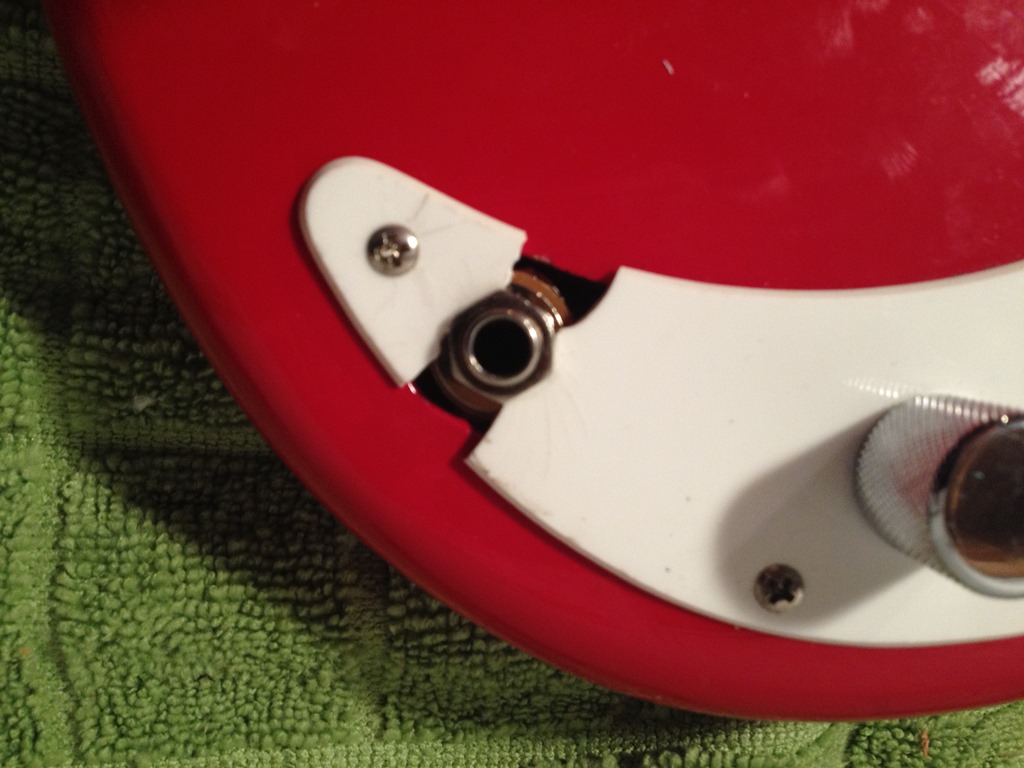
Rather common situation:
Yep, funny isnt it? all the technology, this is still bout the best.
I don't understand why the jacks are designed to have a single arm. Why not two, or even three tip contacts?
if you step on the chord, it wouldnt pull out either..
I hope every loops their guitar cable through their strap / strap button thusly:
RIGHT (be sure there's some slack in the cable)
WRONG
If you don't do this, then you're submitting the input jack to unnecessary tension torquing the input jack every which way as you move around, and possible damaging the jack or the guitar when you eventually trip on the cable. The better you treat the input jack, the less necessary it is to go looking for military grade hardware.
Rather common situation:
Boogie Bill
New member
Re: Guitar input jacks..
I like to use a loop of string or rawhide through one of the strap holes, and feed the cable through the loop. That's a better way than just looping the cable between strap and guitar. If you do that, the cable will eventually damage the guitar's finish.
Drex makes a good point...securing your cable protects the jack, and the cable.
Bill
I like to use a loop of string or rawhide through one of the strap holes, and feed the cable through the loop. That's a better way than just looping the cable between strap and guitar. If you do that, the cable will eventually damage the guitar's finish.
Drex makes a good point...securing your cable protects the jack, and the cable.
Bill
Re: Guitar input jacks..
Yep, sorry... so used to talking about chords (in a playing sense..)
I was trying to figure out how you can slam a chord so hard, that you knock the cord out.
Then I realized it was probably a typo.
Yep, sorry... so used to talking about chords (in a playing sense..)
Re: Guitar input jacks..
Yeah, I usually do like photo 2, tween the strap and body. Especially on my USA Charvel cuz it has the upside down jack on back edge of body.. Ironically, this is the one that seems to be giving me the most noise..
Great Idea! I resisted doing the tween the body and strap thing for years out of worry about this..
I don't understand why the jacks are designed to have a single arm. Why not two, or even three tip contacts?
I hope every loops their guitar cable through their strap / strap button thusly:
RIGHT (be sure there's some slack in the cable)
WRONG
If you don't do this, then you're submitting the input jack to unnecessary tension torquing the input jack every which way as you move around, and possible damaging the jack or the guitar when you eventually trip on the cable. The better you treat the input jack, the less necessary it is to go looking for military grade hardware.
Rather common situation:
Yeah, I usually do like photo 2, tween the strap and body. Especially on my USA Charvel cuz it has the upside down jack on back edge of body.. Ironically, this is the one that seems to be giving me the most noise..
I like to use a loop of string or rawhide through one of the strap holes, and feed the cable through the loop. That's a better way than just looping the cable between strap and guitar. If you do that, the cable will eventually damage the guitar's finish.
Drex makes a good point...securing your cable protects the jack, and the cable.
Bill
Great Idea! I resisted doing the tween the body and strap thing for years out of worry about this..
Similar threads


- Replies
- 24
- Views
- 1K

