
You are using an out of date browser. It may not display this or other websites correctly.
You should upgrade or use an alternative browser.
You should upgrade or use an alternative browser.
Guitar Tuning
- Thread starter Wayne27
- Start date

JB_From_Hell
Jomo's Nimions
Re: Guitar Tuning
If you're asking if you can adapt an alternate tuned song to be played on a standard tuned guitar, sure. It probably won't sound the same as the original, but it's the same 12 notes no matter how the strings are tuned.
For instance, "Rusty Cage" by Soundgarden is in standard with the low E tuned down to B. Any of the low notes could be played two frets higher on the A string, but it's obviously not gonna be the same low octave as if it's tuned down.
If you're asking if you can adapt an alternate tuned song to be played on a standard tuned guitar, sure. It probably won't sound the same as the original, but it's the same 12 notes no matter how the strings are tuned.
For instance, "Rusty Cage" by Soundgarden is in standard with the low E tuned down to B. Any of the low notes could be played two frets higher on the A string, but it's obviously not gonna be the same low octave as if it's tuned down.
Last edited:

dystrust
Well-known member
Re: Guitar Tuning
The notes may be the same, but it may not be possible to play the same chords in standard tuning. A good example is Kashmir by Led Zeppelin; it's somewhat possible to play in standard tuning, but it sounds goofy because you can't really play the same chords.
If you're asking if you can adapt an alternate tuned song to be played on a standard tuned guitar, sure. It probably won't sound the same as the original, but it's the same 12 notes no matter how the strings are tuned.
For instance, "Rusty Cage" by Soundgarden is in standard with the low E tuned down to B. Any of the low notes could be played two frets higher on the A string, but it's obviously not gonna be the same low octave as if it's tuned down.
The notes may be the same, but it may not be possible to play the same chords in standard tuning. A good example is Kashmir by Led Zeppelin; it's somewhat possible to play in standard tuning, but it sounds goofy because you can't really play the same chords.

Gtrjunior
Well-known member
Re: Guitar Tuning
Exactly...and if a riff uses open strings to complete the voicing you’re gonna run into some issues too.
The notes may be the same, but it may not be possible to play the same chords in standard tuning. A good example is Kashmir by Led Zeppelin; it's somewhat possible to play in standard tuning, but it sounds goofy because you can't really play the same chords.
Exactly...and if a riff uses open strings to complete the voicing you’re gonna run into some issues too.

NegativeEase
New member
Re: Guitar Tuning
In short yes -that's the beauty of a guitar and advantage over most other instruments -almost infinite permutations of voicings to interpret any song with -and simple tuning changing to move between tunings and their possible voicings in only moments.
The catch is it will not be the exact tonality or likely voicing if a different tuning is used -you may have to invert a chord voicing or arpeggio sequence to achieve the same notes in a different tuning -but that's the fun of a guitar.
In short yes -that's the beauty of a guitar and advantage over most other instruments -almost infinite permutations of voicings to interpret any song with -and simple tuning changing to move between tunings and their possible voicings in only moments.
The catch is it will not be the exact tonality or likely voicing if a different tuning is used -you may have to invert a chord voicing or arpeggio sequence to achieve the same notes in a different tuning -but that's the fun of a guitar.
Re: Guitar Tuning
The great thing about alternate standard tuning is that you can either play a tune in a different key and make it your "cover version," or just go with a capo at the fret that brings it back to E standard.
Or how about this, "21 Guns" by Green Day is a bugger for a beginner, and an AWESOME song to practice "efficient barre chord changing" when going from that A#maj to the Fmaj and such. In "A Standard" tuning (seven semitones lower), the Dm is now an Am shape, and the song is a breeze...that is if you're okay with just the Fmaj barre chord shape.
The only issue at that point is that the song is a noticeably deeper, which you may or may not like; and if you just play it normal, it's in a different key...AND deeper.
But for playing lead guitar, alternate tuning is almost a non-factor in how songs get played, as far as I'm concerned.
The great thing about alternate standard tuning is that you can either play a tune in a different key and make it your "cover version," or just go with a capo at the fret that brings it back to E standard.
Or how about this, "21 Guns" by Green Day is a bugger for a beginner, and an AWESOME song to practice "efficient barre chord changing" when going from that A#maj to the Fmaj and such. In "A Standard" tuning (seven semitones lower), the Dm is now an Am shape, and the song is a breeze...that is if you're okay with just the Fmaj barre chord shape.
The only issue at that point is that the song is a noticeably deeper, which you may or may not like; and if you just play it normal, it's in a different key...AND deeper.
But for playing lead guitar, alternate tuning is almost a non-factor in how songs get played, as far as I'm concerned.
Re: Guitar Tuning
Yes, and sort or, and no
YES: If the lowest note is an open low E string or higher, and the highest note is the highest fret on the high E or lower, it can be
SORT OF: lower tunings in Estandard or DropD patterns can be ignored at will if you play alone, or if your bandmates tune same as you... just play a DropA song with the same fingerings in DropD, for example
NO: your fretboard doesn't have the required range of notes... ex: 7 string Drop A song with high E solos up to 24th fret AND lowA chugs --- on a 21-22 fret 6 string.
Can you turn any song that uses alternative tuning into one that uses standard tuning?
Yes, and sort or, and no
YES: If the lowest note is an open low E string or higher, and the highest note is the highest fret on the high E or lower, it can be
SORT OF: lower tunings in Estandard or DropD patterns can be ignored at will if you play alone, or if your bandmates tune same as you... just play a DropA song with the same fingerings in DropD, for example
NO: your fretboard doesn't have the required range of notes... ex: 7 string Drop A song with high E solos up to 24th fret AND lowA chugs --- on a 21-22 fret 6 string.
Re: Guitar Tuning
That's pretty much the only thing that holds a player back when playing lead on an alternate tuned guitar; you lose some of the high notes.
But I'll argue that when playing lead in a band, and those last few frets on the high E string get ignored (or CAN get ignored / replaced), then it doesn't matter if the rhythm guitar player is in the same tuning. Power trios have their choice: bass playing lead, or bass playing rhythm. Alternate tuning with a lead guitar is more like "bass playing lead," except that it's "baritone" instead.
NO: your fretboard doesn't have the required range of notes... ex: 7 string Drop A song with high E solos up to 24th fret AND lowA chugs --- on a 21-22 fret 6 string.
That's pretty much the only thing that holds a player back when playing lead on an alternate tuned guitar; you lose some of the high notes.
But I'll argue that when playing lead in a band, and those last few frets on the high E string get ignored (or CAN get ignored / replaced), then it doesn't matter if the rhythm guitar player is in the same tuning. Power trios have their choice: bass playing lead, or bass playing rhythm. Alternate tuning with a lead guitar is more like "bass playing lead," except that it's "baritone" instead.

GuitarStv
Sock Market Trader
Re: Guitar Tuning
Sure.
Heck, you can play any song from any instrument on guitar . . . but you will have to get handy at rearranging things so that they're possible to play efficiently, and they may not always sound quite the same.
If notes are too low, you might transpose the piece up an octave (or two), if notes are too high you might transpose it down an octave. Chords often need to be fingered differently. Riffs that use open strings need to be carefully planned around too. But anything is possible if you want it enough and are willing to put in the work to figure it out.
Can you turn any song that uses alternative tuning into one that uses standard tuning?
Sure.
Heck, you can play any song from any instrument on guitar . . . but you will have to get handy at rearranging things so that they're possible to play efficiently, and they may not always sound quite the same.
If notes are too low, you might transpose the piece up an octave (or two), if notes are too high you might transpose it down an octave. Chords often need to be fingered differently. Riffs that use open strings need to be carefully planned around too. But anything is possible if you want it enough and are willing to put in the work to figure it out.
Chistopher
malapterurus electricus tonewood instigator
Re: Guitar Tuning
Here's a mish mash of a whole bunch of screenshots I took displaying how to play an A chord. For your own experimentation, play all of them on a clean channel just to see how different some of them can sound, even though they are all technically A chords.
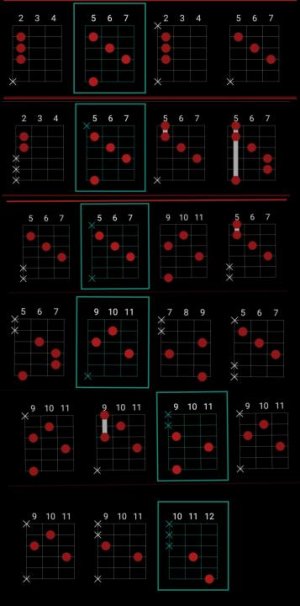
Here's a mish mash of a whole bunch of screenshots I took displaying how to play an A chord. For your own experimentation, play all of them on a clean channel just to see how different some of them can sound, even though they are all technically A chords.
NegativeEase
New member
Re: Guitar Tuning
OP, this is a great representation of what I am referring to my previous comment when using the word "voicings" and the many examples of an A chord shown here by Christopher is only showing one standard tuning, without a capo or partial capo, without using both hands or even dare I say a pitch modulation or harmonization of a guitar by downstream pedals. The Guitars is kind of infinite when it comes to interpretations of voicings of songs and also the ability to change complete tunings quickly or on the fly -even mid song in some cases (EVH I talking about you!)
Here's a mish mash of a whole bunch of screenshots I took displaying how to play an A chord. For your own experimentation, play all of them on a clean channel just to see how different some of them can sound, even though they are all technically A chords.
View attachment 95748
OP, this is a great representation of what I am referring to my previous comment when using the word "voicings" and the many examples of an A chord shown here by Christopher is only showing one standard tuning, without a capo or partial capo, without using both hands or even dare I say a pitch modulation or harmonization of a guitar by downstream pedals. The Guitars is kind of infinite when it comes to interpretations of voicings of songs and also the ability to change complete tunings quickly or on the fly -even mid song in some cases (EVH I talking about you!)
JB_From_Hell
Jomo's Nimions
Re: Guitar Tuning
Transpose it to E and all of those problems go away. "Kashmir" is in DADGAD, but take it up a whole step and all those lowered pitches become the guitar's normal tuning, and all the fretted notes just get played 2 frets higher. I bet $20 if you performed it that way, no one would notice.
For whatever reason, in the rock world, if a song was originally played in E, then that becomes the "right" way to play it. Blues, jazz, and bluegrass (and I'm sure others, this is just what I'm familiar with), all transpose songs all over the place to suit the vocalist, or in this case, eliminate the need or a one-off oddball tuning.
The notes may be the same, but it may not be possible to play the same chords in standard tuning. A good example is Kashmir by Led Zeppelin; it's somewhat possible to play in standard tuning, but it sounds goofy because you can't really play the same chords.
Transpose it to E and all of those problems go away. "Kashmir" is in DADGAD, but take it up a whole step and all those lowered pitches become the guitar's normal tuning, and all the fretted notes just get played 2 frets higher. I bet $20 if you performed it that way, no one would notice.
For whatever reason, in the rock world, if a song was originally played in E, then that becomes the "right" way to play it. Blues, jazz, and bluegrass (and I'm sure others, this is just what I'm familiar with), all transpose songs all over the place to suit the vocalist, or in this case, eliminate the need or a one-off oddball tuning.
Re: Guitar Tuning
Two issues that I can think of using a capo on an alternate tuned guitar...
(1): You're right about the voicings of the chords and how a capo can fix that, but it totally changes the tone of the guitar. There's a difference in the "ring" of a open Cmaj and a Cmaj barre at the 3rd fret. They voice out somewhat close, but that barre chord doesn't have the same ring to it.
B Standard is pretty common for extended scale guitars. That puts a capo at the fifth to bring it back to E Standard, and the further you get from the nut, the more ring you lose. Some songs, to me, just don't quite sound right on an extended scale guitar with a capo. They loose that "sweet" sound you get from fretting notes closer to the nut.
(2): Fretting chords past the seventh gets a bit too tight for my liking. My fingers start getting jammed up because the frets are closer together. I can think of a couple of songs that I play almost almost daily at this time that I wouldn't be playing on my B Standard tuned guitar with a capo due to that issue alone.
I play more rhythm than lead, and I personally have a love/hate relationship with alternate tuning. Man, that's how a guitar is supposed to be tuned! And then I start running into trouble...
Two issues that I can think of using a capo on an alternate tuned guitar...
(1): You're right about the voicings of the chords and how a capo can fix that, but it totally changes the tone of the guitar. There's a difference in the "ring" of a open Cmaj and a Cmaj barre at the 3rd fret. They voice out somewhat close, but that barre chord doesn't have the same ring to it.
B Standard is pretty common for extended scale guitars. That puts a capo at the fifth to bring it back to E Standard, and the further you get from the nut, the more ring you lose. Some songs, to me, just don't quite sound right on an extended scale guitar with a capo. They loose that "sweet" sound you get from fretting notes closer to the nut.
(2): Fretting chords past the seventh gets a bit too tight for my liking. My fingers start getting jammed up because the frets are closer together. I can think of a couple of songs that I play almost almost daily at this time that I wouldn't be playing on my B Standard tuned guitar with a capo due to that issue alone.
I play more rhythm than lead, and I personally have a love/hate relationship with alternate tuning. Man, that's how a guitar is supposed to be tuned! And then I start running into trouble...

Obsessive Compulsive
New member
Re: Guitar Tuning
That's actually the weakness of the guitar. People can alter the tunings as they wish to suit whatever the fk their music requires. It leads to more headaches than alternate musical dimension.
In short yes -that's the beauty of a guitar and advantage over most other instruments -almost infinite permutations of voicings to interpret any song with -and simple tuning changing to move between tunings and their possible voicings in only moments.
The catch is it will not be the exact tonality or likely voicing if a different tuning is used -you may have to invert a chord voicing or arpeggio sequence to achieve the same notes in a different tuning -but that's the fun of a guitar.
That's actually the weakness of the guitar. People can alter the tunings as they wish to suit whatever the fk their music requires. It leads to more headaches than alternate musical dimension.
JB_From_Hell
Jomo's Nimions
Re: Guitar Tuning
What headaches? Not being able to figure out a Sonic Youth song?
That's actually the weakness of the guitar. People can alter the tunings as they wish to suit whatever the fk their music requires. It leads to more headaches than alternate musical dimension.
What headaches? Not being able to figure out a Sonic Youth song?

beaubrummels
Well-known member
Re: Guitar Tuning
What’s interesting is if you detune a guitar, somehow it’s still a guitar. If you tune it completely different, it’s still a guitar.
But if you detune a violin, it’s a viola. And if you tune it completely different, it’s just out of tune and can’t be played.
What’s interesting is if you detune a guitar, somehow it’s still a guitar. If you tune it completely different, it’s still a guitar.
But if you detune a violin, it’s a viola. And if you tune it completely different, it’s just out of tune and can’t be played.
Re: Guitar Tuning
Following that metaphor - which is spot on, by the way - I've actually turned a violin into a viola, and then tuned it completely different, and then it couldn't be played.
One day I realized that on a 7 string with an extended scale length, I can go to A Standard with a low E string...and now it's all the way down to low E on a bass (and yep, I used a bass string!), and all of the open chords are legit open chords...none of them are a sharp or a flat! And the tuning was weird: E-A-D-G-C-E-A...so drop the "C" string a half-step, and I've got an odd way to make a 7 string bass guitar that starts at 4 string bass low E...thus I'd be able to essentially play two different tunings: A Standard with a low E, or E Standard bass with high B-E-A strings. And I'm only giving up 7 frets at the top of standard high E...!!!
PERFECT!!!
Yeah, it doesn't work that way. All that I did was create a mud slut. If what you're looking for is pure mud at the bottom end from about maybe A under standard low E, then this is the exact recipe for THAT disaster! I was all the way up to a .90 that I mean JUST BARELY fit in that guitar (and actually kinda didn't), so I was at about 25 pounds of tension on my strings, and it was a MUD SLUT on the bottom end. The pickups AND the amp are just not tuned to that set of frequencies.
That was my first extended scale length guitar (27"), AND my first 7 string. I've since learned that A Standard is at or maybe just beyond the threshold for a guitar, and that B Standard on a 6 string is often a bit muddier than the low B note (same note, same octave) on a standard-tuned 7 string. The pickups on a 7 string were designed to deal with low B and can even handle a low A pretty nicely; while the pickups on a 6 string are done around C, and B is starting to be a reach for them. Low A becomes highly questionable.
And then we get to argue if B Standard actually does turn your violin into a viola, because now it's technically a baritone! They play like a guitar, and that's all that matters! And that's why I said that you're spot on, because in the end, it's still a guitar running guitar pickups through a guitar amp. But yeah, if you go too low, you'll hate it.
What’s interesting is if you detune a guitar, somehow it’s still a guitar. If you tune it completely different, it’s still a guitar.
But if you detune a violin, it’s a viola. And if you tune it completely different, it’s just out of tune and can’t be played.
Following that metaphor - which is spot on, by the way - I've actually turned a violin into a viola, and then tuned it completely different, and then it couldn't be played.
One day I realized that on a 7 string with an extended scale length, I can go to A Standard with a low E string...and now it's all the way down to low E on a bass (and yep, I used a bass string!), and all of the open chords are legit open chords...none of them are a sharp or a flat! And the tuning was weird: E-A-D-G-C-E-A...so drop the "C" string a half-step, and I've got an odd way to make a 7 string bass guitar that starts at 4 string bass low E...thus I'd be able to essentially play two different tunings: A Standard with a low E, or E Standard bass with high B-E-A strings. And I'm only giving up 7 frets at the top of standard high E...!!!
PERFECT!!!
Yeah, it doesn't work that way. All that I did was create a mud slut. If what you're looking for is pure mud at the bottom end from about maybe A under standard low E, then this is the exact recipe for THAT disaster! I was all the way up to a .90 that I mean JUST BARELY fit in that guitar (and actually kinda didn't), so I was at about 25 pounds of tension on my strings, and it was a MUD SLUT on the bottom end. The pickups AND the amp are just not tuned to that set of frequencies.
That was my first extended scale length guitar (27"), AND my first 7 string. I've since learned that A Standard is at or maybe just beyond the threshold for a guitar, and that B Standard on a 6 string is often a bit muddier than the low B note (same note, same octave) on a standard-tuned 7 string. The pickups on a 7 string were designed to deal with low B and can even handle a low A pretty nicely; while the pickups on a 6 string are done around C, and B is starting to be a reach for them. Low A becomes highly questionable.
And then we get to argue if B Standard actually does turn your violin into a viola, because now it's technically a baritone! They play like a guitar, and that's all that matters! And that's why I said that you're spot on, because in the end, it's still a guitar running guitar pickups through a guitar amp. But yeah, if you go too low, you'll hate it.
JB_From_Hell
Jomo's Nimions
Re: Guitar Tuning
A viola is bigger than a violin with a longer scale. Not the same thing.
But if you detune a violin, it’s a viola. And if you tune it completely different, it’s just out of tune and can’t be played.
A viola is bigger than a violin with a longer scale. Not the same thing.
Re: Guitar Tuning
That's too confusing
7 string exists for one thing and one thing only:
DropA7 (A+EADGBE)
... best of most worlds at the expense of a narrow neck
Following that metaphor - which is spot on, by the way - I've actually turned a violin into a viola, and then tuned it completely different, and then it couldn't be played.
One day I realized that on a 7 string with an extended scale length, I can go to A Standard with a low E string...and now it's all the way down to low E on a bass (and yep, I used a bass string!), and all of the open chords are legit open chords...none of them are a sharp or a flat! And the tuning was weird: E-A-D-G-C-E-A...so drop the "C" string a half-step, and I've got an odd way to make a 7 string bass guitar that starts at 4 string bass low E...thus I'd be able to essentially play two different tunings: A Standard with a low E, or E Standard bass with high B-E-A strings. And I'm only giving up 7 frets at the top of standard high E...!!!
PERFECT!!!
Yeah, it doesn't work that way. All that I did was create a mud slut. If what you're looking for is pure mud at the bottom end from about maybe A under standard low E, then this is the exact recipe for THAT disaster! I was all the way up to a .90 that I mean JUST BARELY fit in that guitar (and actually kinda didn't), so I was at about 25 pounds of tension on my strings, and it was a MUD SLUT on the bottom end. The pickups AND the amp are just not tuned to that set of frequencies.
That was my first extended scale length guitar (27"), AND my first 7 string. I've since learned that A Standard is at or maybe just beyond the threshold for a guitar, and that B Standard on a 6 string is often a bit muddier than the low B note (same note, same octave) on a standard-tuned 7 string. The pickups on a 7 string were designed to deal with low B and can even handle a low A pretty nicely; while the pickups on a 6 string are done around C, and B is starting to be a reach for them. Low A becomes highly questionable.
And then we get to argue if B Standard actually does turn your violin into a viola, because now it's technically a baritone! They play like a guitar, and that's all that matters! And that's why I said that you're spot on, because in the end, it's still a guitar running guitar pickups through a guitar amp. But yeah, if you go too low, you'll hate it.
That's too confusing
7 string exists for one thing and one thing only:
DropA7 (A+EADGBE)
... best of most worlds at the expense of a narrow neck
Last edited:


