Hanging guitars on walls

Re: Hanging guitars on walls

I have a couple of dozen instruments hanging in my house all using Off the Wall hangers. Some are into drywall. Some into studs. I like those hangers, especially in an earthquake prone area like Southern Cal. The reason is that if the house starts to sway, the guitars will sway too. Plus, they use three anchors. And they look cool.


thnx for the heads up Evan. I have the same problem-space-. at the guitar store I used to work at we noticed the cheaper hangers left ugly marks on the neck were it hung. I was worried long term which brand worked well without leaveing those ugly marks.
:beerchug:
 
Re: Hanging guitars on walls

i've used the off-the-wall ones for years straight into the drywall with no problem. and 2 of the guitars are heavier ones: les paul, fender p bass.

one thing you should note is something that has been brought up before about hanging certain guitars. the finish on the headstock where the guitar hangs can get blemished. i never noticed this with mine until a few months ago. so i took a black t-shirt and sacrificed it by cutting some thin strips of cloth from it and wrapping the cloth around the wall hanger arms. now my guitar's headstock is resting on cloth instead of the black hanger arms.
 
Re: Hanging guitars on walls

Living in the UK means that we have more brick walls to mount such things onto.
I use assorted different hangers as they come my way.
The one you can't quite see is screwed directly into the wood of the bookcase with wood screws.

6827_155993985833_712650833_3172819_3388112_n.jpg
 
Re: Hanging guitars on walls

String Swing®
DeckMate®
Reisser®
Simpson Strong-Tie®
Fender®
Custom Shop Telecaster®
The Fabulous Fifty Million Dollar Trinaural Stratocaster™
Seymour Duncan®
Lipstick Tube for Strat®
Little 59™
Surf Whammys™
The Fabulous Cooters™
The Amazing Lollipops™
iPod®
SONY®.

What the F?!
 
Re: Hanging guitars on walls

There are several types of drywall anchors, and some of them are very strong, so the general idea is to use the strongest drywall anchors if you cannot locate the mounting bracket so that there is a wall stud underneath the drywall and you have no choice but to use a drywall anchor . . .

[NOTE: Drywall also is called "gypsum board", "sheetrock", and "wallboard", but there is another type of wall material which is called "plaster", so there are lots of types of wall that generally can be called "drywall", which is confusing, but so what . . . ]

p119_full.jpg

Expanding Drywall Anchor (UCAN Fasteners)

Another solution is to use toggle bolt, which is for hollow walls, and they are installed by drilling a larger diameter hole in the wall which is just large enough for the toggle head or "wing" before it has been unexpanded, since once the folded "wing" goes through the hole in the drywall, it expands and looks like the photograph, and the strength comes from the weight of the guitar on the bracket being spread over a larger area of the drywall . . .

p124_full.jpg

Toggle Bolt (UCAN Fasteners)

These types of anchors and toggle bolts usually have a load or weight rating on the package, which states the safe upper limit of the load or weight that the drywall anchor or toggle bolt will support . . .

And the String Swing® metal brackets have two holes spaced approximately 3" apart (vertically), so instead of using the screws and plastic sleeves that come with the String Swing metal brackets, you will use the screws that come with the drywall anchor, or you will use the toggle-bolt unit . . .

These drywall anchors and toggle bolts spread the load over a larger section of drywall, with the Expanding Drywall Anchor being excellent, since the outer sleeve fits tightly in the larger diameter hole, and there are cleats on the lip . . .

And there are other types of drywall anchors, so the best strategy is to visit a hardware store that has a wide selection of these types of drywall anchors and toggle bolts, which is fabulous . . .

Fabulous!

P. S. There are thousands of different types and styles of these things, and they are designed for a variety of wall materials, as well . . .

So, if the wall is drywall, there are drywall anchors and toggle bolts, but if the wall is brick or concrete, then there are special anchors for brick and concrete, and so forth and so on . . .

And while a large hardware store might have a few hundred different types and styles, there are catalogs that have more types and styles that can be ordered . . .

P. P. S. Another useful bit of information is that electrical wiring and plumbing pipes (water, natural gas, and anything that is piped) often are routed through the centers of wall studs (more or less, depending on the skill of the electricians and plumbers), so drilling or screwing something into a wall stud travels with a bit of danger, so the more you know about the way a house is wired and plumbed, the better . . .

If you do not know exactly where the electrical wires and various pipes are run, then you will want to drill holes in small steps, checking along the way to ensure that you have not started to drill into an electrical wire or pipe, and you certainly want to use an electric drill with an insulated plastic handle, for sure . . .

For sure!

In other words, drill perhaps 1/8" and stop; remove the drill bit and examine the hole; then drill another 1/8" and stop; and so forth and so on . . .

This takes a bit longer, but it is safer, which is fabulous . . .

Fabulous!
 
Last edited:
Re: Hanging guitars on walls

He's a copyright attorney.

Thanks for the kind words! :)

I am not an attorney, but I like to be as precise as possible . . .

If I were a copyright attorney then I would not need to continue pondering which of these is correct:

(a) The Fabulous Fifty Million Dollar Trinaural Stratocaster™

OR

(b) The Fabulous Fifty Million Dollar Trinaural™ Stratocaster®

I like (a) better, but the fact of the matter is that Stratocaster is a registered trademark, and registered trademarks are supposed to have the registered trademark symbol in the first usage, although I think that putting the notice in a footnote works just as well . . .

And this introduces a third possibility:

(c) The Fabulous Fifty Million Dollar Trinaural Stratocaster™

[NOTE: Stratocaster® is the registered trademark of its owner . . . ]

Of course the smarter solution might be to avoid using "Stratocaster", but perhaps not, which is fabulous . . .

Fabulous!

However, perhaps it makes sense to do it the way Seymour Duncan® solves the problem in the name for the Lipstick Tube for Strat®, which is pretty smart, and creates a fifth possibility, really . . .

(e) The Fabulous Fifty Million Dollar Trinaural Stratocaster®

Really!

P. S. As you can hear on the latest mix of "Really Big Knob™" (The Surf Whammys), where I play all the instruments and do all the singing, from a drumming perspective I have no problems doing essentially same thing over and over and over, which is fabulous . . .

"Really Big Knob" (The Surf Whammys) -- MP3 (48-kHz, 272-kbps [VBR], 7.8MB)

Fabulous!

In fact, when I was in college, I worked in a warehouse putting price stickers on individual tubes of Crest® toothpaste, and as best as I can guess, I probably put price stickers on several tubes of Crest toothpase, one at a time, which among other things is the way I learned to sleep standing-up, since I was so fast that I finished the work very quickly and would take a nap standing-up so that I looked like I was working, which was pretty strange, really . . .

Really!

P. P. S. All I can do is make an educated guess on this, but it might be that one of the prerequisites to being able (a) to compose a song, (b) to play all the instruments, (c) to do all the singing, and (d) to do everything including the composing in real-time on the fly, which is the way it was done for "Really Big Knob", is being a bit eccentric with respect to attention to minutiae . . .

P. P. P. S. One of the recording engineers who worked on "R.A.M" (Wings) told me that Paul McCartney did all the vocals in one take, which I thought was so cool that I decided to try it, and while it is a bit strange at first, after a while you get pretty good at it, which is fabulous . . .

Fabulous! :)

I only do the bass guitar, keyboards, and lead guitar stuff one time, because I never can remember what I did, so there is no way to do it a second time . . .

The only thing I tend to prepare in advance is the rhythm guitar chord pattern, which is the first thing I record . . .

Then, most of the time I do the drumkit part a time or two, since I have never actually heard the song, so how can I be expected to play the drumkit part?

I have no idea . . .

Then I usually do the lead guitar solo, by playing a lead guitar solo for the entire length of the song, since at that point I have no idea where the lead guitar solo actually is supposed to be played, since there is no melody for the singing, so how could I know?

I have no idea . . .

And once that is done, I have heard the song enough times to start singing along with it, and pretty soon there is a melody, and then I can add bells and whistles, whcih is fabulous . . .

Fabulous!

Actually, I know the entire song once I get the rhythm guitar chord pattern and lyrics, but I only know it unconsciously, but so what . . .

So what!

It works for me, and I like it! :)
 
Re: Hanging guitars on walls

Is someone else talking back to you when you type "Fabulous!" and "Really!," like a voice in your head or an imaginary friend?
 
Re: Hanging guitars on walls

I don't know who you are, Surf Whammy, but I applaud you for being thorough, and want you to know that I get a kick out of you.

Welcome!
 
Re: Hanging guitars on walls

Is someone else talking back to you when you type "Fabulous!" and "Really!," like a voice in your head or an imaginary friend?

In a way, yes . . . :)

I do all my writing and music stuff in the sound isolation studio--which is 7' by 12' by 7' (width, length, height)--and, since I do everything myself, I find it to be both entertaining and enlightening to create a virtual festival of pretend personalities, which is fabulous . . .

Fabulous!

And one of the pretend personalities is a radio announcer who is a bit like Pretend Ed McMahon in a Bunny Suit™ but with a higher pitch voice and a much smaller overall vocabulary, for sure . . .

For sure!

Basically that personality likes to repeat the last phrase of certain sentences, which is pretty cool . . .

Pretty cool!

However, the real reason is that I decided to start writing dialogue sometime in the late-1980s, which I discovered was not such an easy thing to do, so I thought about it for a while and decided that it is easier to write dialogue (screenplays, movie scripts, and whatever) if you actually take the time (a) to create characters in your mind and (b) to discover how to get them to have conversations among themselves, which is patently strange but FUN, really . . .

Really!

When you think about it for a while, it is no different from hearing music in your mind, especially when you discover how to play a lot of instruments in your mind simultaneously . . .

Stated another way, if you already have an orchestra in your mind, then having a bit of FUN with dialogue is just a matter of discovering how to get the folks in the orchestra to talk to each other, which is fabulous . . .

Fabulous!

It also helps if you are what I call a "hearing reader", which as best as I have been able to determine over the years by asking various neurologists and other folks is something that perhaps only 10 percent of the people on your planet do . . .

In other words, when you read, if you actually hear the words spoken in your mind, then you are what I call a "hearing reader", for sure . . .

For sure!

How do folks learn to write screenplays for motion pictures, television shows, and so forth and so on?

I have no idea . . .

Yet, I think that they must be able to imagine everything very realistically in their minds--all the actors and actresses, scenes, and whatever--at least to the level of detail required to do scripting, storyboarding, and so forth and so on . . .

So how do you teach yourself to do that?

Great question!

I think that you do it the same way that a composer writes music for an orchestra, marching band, Rock and Roll group, or whatever . . .

Bach, Beethoven, Mozart, and all those folks probably heard music in their minds, so if they were able to do it, then other people should be able to do it, albeit with a bit of work and whatever . . .

And I think that the best way to get good at it is to do it a LOT, for sure . . .

For sure!

So, I certainly have a bit of dialogue happening most of the time, and nearly all of it is intentional in the sense of being something I do consciously as a goal-directed activity . . .

Yet, occasionally, Pretend Richard Nixon on LSD™ appears and makes a few observations to the group, but everybody likes him, which is fabulous . . .

Fabulous! :)

P. S. I will be the first to admit that creating a virtual festival of pretend personalities in my mind and allowing them to have conversations might be a bit strange, but it is not so much stranger than deciding to design and to build a sound isolation studio--which incidentally has triple walls, with each wall being insulated and having an air space between it and the other walls, along with assorted Helmholtz resonating panels and whatever, with the triple ceiling also done this way, as is the floor, except that the floor is floated on (a) thick mats made from ground truck tires and (b) two layers of 30 lbs. tar paper--which has interior walls that are painted Cosmic Blue and an interior ceiling which is painted Deep Space Blue . . .

How strange is that?

Pretty strange!

P. P. S. And while focusing on strange activities, another thing I like to do is to memorize all the items in the local Walmart® Supercenter, which is something I started doing with non-food items when I was putting price stickers on several million tubes of Crest® toothpaste and was a lot more focused on the non-food aspects of grocery business, which is fabulous . . .

Fabulous! :)
 
Last edited:
Re: Hanging guitars on walls

I don't know who you are, Surf Whammy, but I applaud you for being thorough, and want you to know that I get a kick out of you.

Welcome!

Glad you enjoy it! :)

I like to write and to drink a lot of very strong coffee, and I would write a bit more, but I am pretty zoned-out at the moment, which is fabulous . . .

Fabulous! :)
 
Re: Hanging guitars on walls

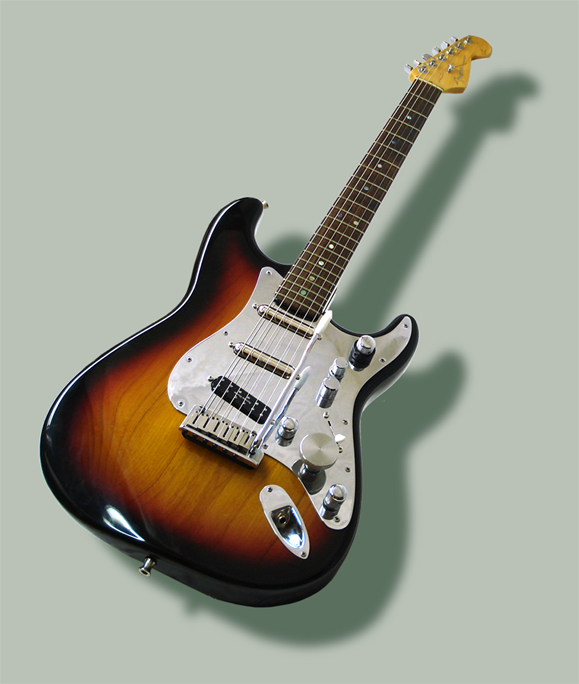
I use a vertical String Swing wall mount for The Fabulous Fifty Million Dollar Trinaural Stratocaster™, which has Seymour Duncan® pickups (Lipstick Tube for Strat® and Little 59™) and is heard on this Surf Whammys™ song, featuring Ravi "Reveb" Ole™ on lead guitar and The Fabulous Cooters™ and The Amazing Lollipops™ on backup vocals, which is as fabulous as it is mixed expressly for listening with iPod® earphones or studio-quality headphones like the SONY® MDR-7506 . . .

"It Don't Add Up" (The Surf Whammys) -- MP3

TheFabulousFiftyMillionDollarTrinauralStratocaster.png

The Fabulous Fifty Million Dollar Trinaural Stratocaster

Fabulous!
That has got the biggest f-ing tone knob I've ever seen in my life. What do the remaining 3 1/2 (one is appears to be a concentric knob) do?
 
Re: Hanging guitars on walls

That has got the biggest f-ing tone knob I've ever seen in my life. What do the remaining 3 1/2 (one is appears to be a concentric knob) do?

The Fabulous Fifty Million Dollar Trinaural Stratocaster® has two separate and independent circuits (L, R) that feed a TRS stereo output jack, which I connect to a TRS guitar cord that splits into two monaural guitar cords at the other end, with each monaural output feeding a separate set of effects pedals that have stereo outputs, with the overall result that it produces four tracks of guitar in real-time, which I call the "Wall of Guitars™", which is fabulous . . .

Fabulous!

The left-channel is a Seymour Duncan® Little 59™ in the bridge position and a Seymour Duncan Lipstick Tube for Strat® in the neck position, with this channel being controlled by the three knobs in the standard location of the Fender® American Deluxe Stratocaster knobs, where the top knob is the master volume control; the Really Big Knob™ is a Rothstein™ "mid-scoop" Varitone-style 6-position rotary TONE control switch; and the bottom knob is a Rothstein "mid-scoop" push-pull TONE control. The selector switch is a Megaswitch™ E-Model, and the little knob at the top of the Megaswitch E-Model selector switch currently is a blend control that works the two coils of the Seymour Duncan Little 59 humbucker, although it does not do anything I can identify, so I am going to replace it with a Rothstein "mid-scoop" TONE control, so that there will be a separate TONE control for each coil of the Little 59, since the Really Big Knob works the "A" coil of the Little 59 and the bottom knob works the Lipstick Tube for Strat in the neck position . . .

The right channel, which is the Seymour Duncan Lipstick Tube for Strat single coil pickup in the middle position, has a single Rothstein "mid-scoop" center-detent TONE control and a Fender American Vintage '62 Jazz Bass® style dual-concentric stacked pair of potentiometers, with the inside knob being the master volume and the outside knob working a Black Ice™ passive overdrive device, which is fabulous . . .

Fabulous!

All the pickups are "bridge output", since I like hot pickups and with there actually being two channels, it makes a bit of sense to have hot outputs for both channels (L, R) . . .

You can hear a bit of the guitar in this recent mix of "Really Big Knob" performed by my pretend Rock and Roll band, The Surf Whammys™, which was composed and played on the fly in real-time, one instrument at a time, since I do all the composing, playing, and singing and generally make an effort to do everything only one time, which is a bit strange but is a lot of FUN once you learn how to do it, which is as fabulous as it is mixed expressly for listening with iPod® earphones and studio-quality headphones like the SONY® MDR-7506 . . .

"Really Big Knob" (The Surf Whammys) -- MP3 (48-kHz, 272-kbps [VBR], 7.8MB)

Fabulous!

The current plan is to upgrade the guitar to six Seymour Duncan pickups (Little 59™, JB Jr.™, Duckbuckers™, Hot Rails™, and two Lipstick Tube for Strat®) for a total of five separate channels, with one channel being the current bridge position and neck position pickups, although this will require a bit of guitar body routing and a new custom-made chrome metal pickguard, along with replacing all the knobs--except the Really Big Knob--with miniature dual-concentric stacked potentiometers and adding perhaps 10 or so 4P3T (4-Pole Triple-Throw) mini-toggle switches for having a bit of FUN with series, parallel, phasing, coils splits, and whatever, which is fabulous . . .

Fabulous!

I already have all the Seymour Duncan pickups, but I need to get the mini-toggle switches and the miniature dual-concentric stacked potentiometers, but other than ordering some parts, I think that I have the circuits correctly designed, and I am confident that the extra guitar body routing required to make room for the three additional pickups will fine, since the guitar body was routed at the factory for H-S-H, and all I need to do is to remove four wood "islands", thereby making it what the Warmoth folks call a "universal" pickup routing . . .

The already routed lower-front section should provide enough space for the new sets of controls, and I am planning to use Switchcraft® TINI Q-G® Miniature Connectors with a 5-conductor shielded cable which will split into 5 separate monaural outputs (one for each of the 5 channels) via a splitter box, which will map to the guitar having just one cable that will look pretty much like a regular guitar cord, which is fabulous . . .

Fabulous! :)
 
Last edited:
Re: Hanging guitars on walls

In a way, yes . . . :)

I do all my writing and music stuff in the sound isolation studio--which is 7' by 12' by 7' (width, length, height)--and, since I do everything myself, I find it to be both entertaining and enlightening to create a virtual festival of pretend personalities, which is fabulous . . .

Fabulous!

And one of the pretend personalities is a radio announcer who is a bit like Pretend Ed McMahon in a Bunny Suit™ but with a higher pitch voice and a much smaller overall vocabulary, for sure . . .

For sure!

Basically that personality likes to repeat the last phrase of certain sentences, which is pretty cool . . .

Pretty cool!

However, the real reason is that I decided to start writing dialogue sometime in the late-1980s, which I discovered was not such an easy thing to do, so I thought about it for a while and decided that it is easier to write dialogue (screenplays, movie scripts, and whatever) if you actually take the time (a) to create characters in your mind and (b) to discover how to get them to have conversations among themselves, which is patently strange but FUN, really . . .

Really!

When you think about it for a while, it is no different from hearing music in your mind, especially when you discover how to play a lot of instruments in your mind simultaneously . . .

Stated another way, if you already have an orchestra in your mind, then having a bit of FUN with dialogue is just a matter of discovering how to get the folks in the orchestra to talk to each other, which is fabulous . . .

Fabulous!

It also helps if you are what I call a "hearing reader", which as best as I have been able to determine over the years by asking various neurologists and other folks is something that perhaps only 10 percent of the people on your planet do . . .

In other words, when you read, if you actually hear the words spoken in your mind, then you are what I call a "hearing reader", for sure . . .

For sure!

How do folks learn to write screenplays for motion pictures, television shows, and so forth and so on?

I have no idea . . .

Yet, I think that they must be able to imagine everything very realistically in their minds--all the actors and actresses, scenes, and whatever--at least to the level of detail required to do scripting, storyboarding, and so forth and so on . . .

So how do you teach yourself to do that?

Great question!

I think that you do it the same way that a composer writes music for an orchestra, marching band, Rock and Roll group, or whatever . . .

Bach, Beethoven, Mozart, and all those folks probably heard music in their minds, so if they were able to do it, then other people should be able to do it, albeit with a bit of work and whatever . . .

And I think that the best way to get good at it is to do it a LOT, for sure . . .

For sure!

So, I certainly have a bit of dialogue happening most of the time, and nearly all of it is intentional in the sense of being something I do consciously as a goal-directed activity . . .

Yet, occasionally, Pretend Richard Nixon on LSD™ appears and makes a few observations to the group, but everybody likes him, which is fabulous . . .

Fabulous! :)

P. S. I will be the first to admit that creating a virtual festival of pretend personalities in my mind and allowing them to have conversations might be a bit strange, but it is not so much stranger than deciding to design and to build a sound isolation studio--which incidentally has triple walls, with each wall being insulated and having an air space between it and the other walls, along with assorted Helmholtz resonating panels and whatever, with the triple ceiling also done this way, as is the floor, except that the floor is floated on (a) thick mats made from ground truck tires and (b) two layers of 30 lbs. tar paper--which has interior walls that are painted Cosmic Blue and an interior ceiling which is painted Deep Space Blue . . .

How strange is that?

Pretty strange!

P. P. S. And while focusing on strange activities, another thing I like to do is to memorize all the items in the local Walmart® Supercenter, which is something I started doing with non-food items when I was putting price stickers on several million tubes of Crest® toothpaste and was a lot more focused on the non-food aspects of grocery business, which is fabulous . . .

Fabulous! :)


D00D! You've created one of the most interestingly unique forum persona's ever. Between you and Frankly, I am highly amused and greatly entertained. I love it!
 
Re: Hanging guitars on walls

D00D! You've created one of the most interestingly unique forum persona's ever. Between you and Frankly, I am highly amused and greatly entertained. I love it!

Glad you enjoy it! :)

I like to write, and I really like to touch-type, since I like the way the keys feel on the new Apple® keyboard almost as much as I like ladies who wear Manolo Blahnik® high-heel slippers with open toes and cute ankle straps, which sometime last year inspired me to have a bit of FUN with the most parodied song in the known universe, "Twinkle, Twinkle, Little Star", which first was parodied in in the late-18th century by Wolfgang Amadeus Mozart in his now classic "Twelve Variations on 'Ah vous dirai-je, Maman'"; then was parodied in the late-19th century by Lewis Carroll in his "Twinkle, Twinkle, Little Bat"; and more recently in the 1940s was parodied by Walt Disney® ("When You Wish Upon A Star"); and in the early-1960s was parodied by the Beatles ("This Boy") and the Beach Boys ("Surfer Girl"); but was parodied most recently by my pretend band, The Surf Whammys, in their fabulous song, "Slipper Girl", which is as fabulous as it is mixed expressly for listening with iPod® earphones and studio-quality headphones like the SONY® MDR-7506 . . .

"Slipper Girl" (The Surf Whammys) -- MP3 (44.1-kHz, 256-kbps, 6.7MB)

Fabulous!

There are more songs at the Surf Whammys website, since I like to provide links to songs when I am working on an album, with the website songs being experimental mixes, because among other things I am discovering how to do mixing and mastering, which is a lot more difficult in the digital universe than it was in the analog vacuum-tube and magnetic tape universe, for sure . . .

The Surf Whammys™ (website)

For sure!

And one of the most recent discoveries I have made is something I call the "Spherical Sonic Landscape™", which is a more geometrically focused way of representing the binaural sonic space that occurs when one listens to music with iPod earphones and studio quality headphones like the SONY MDR-7506, noting that "binaural" is just a way to say "two ears", which is fabulous . . .

SphericalSonicLandscape-1.png

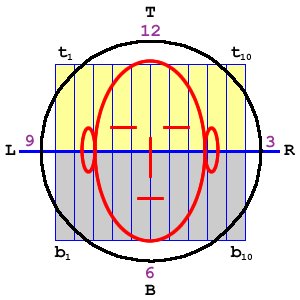
Spherical Sonic Landscape ~ ({x, y} perspective, looking forward)

Fabulous!

In other words, this particular perspective of the Spherical Sonic Landscape is what you would see if you were sitting in a chair at the back of your mind looking forward, and it is the vertical plane that runs from ear to ear, which is pretty strange, but so what . . .

So what!

Most folks who listen to headphone mixes, or "Beatles Mixes" as they sometimes are called, are familiar with the circular arc that is the top half of a clock face, where far-left is 9; top-center is 12; and far-right is 3, but I like to include the bottom half of the clock face, since occasionally it decides to donne a pair of fine ladies footwear, although mostly in the evening, which in a curious way makes a bit of sense, really . . .

Really!

The key addition is the two rows of vertical bars, which in the diagram (see above) are labeled t1 to t10 on the top row and b1 to b10 on the bottom row, which among other things provides a well-defined way to identify the locations of sounds very precisely, which then makes it a tiny bit easier to discover how to locate sounds inside the listener's mind, literally, which is pretty strange . . .

Pretty strange!

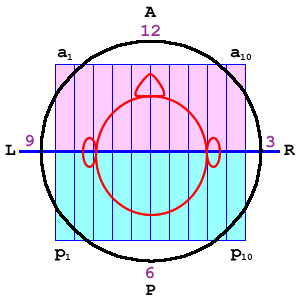
And for the top-down folks, this is the perspective that you might see while riding around the top of your mind in a mini-helicopter looking downward at the center of your mind, which is way out there . . .

SphericalSonicLandscape-2.png

Spherical Sonic Landscape ~ ({x, z} perspective, looking downward from a mini-helicopter)

[NOTE: The rounded triangle shape is supposed to be a nose--not a Jack-in-the-Box wearing a silly party hat . . . ]

In this view, the plane runs horizontally, and there are two rows of bars, a1 to a10 and p1 to p10, where "a" and "A" map to "anterior" and "p" and "P" map to "posterior . . .

Left and right continue to be left and right, and there is second clock face which is a bit like a Hula Hoop®, where the key locations generally are {Left, Right, Front, Back} or {9, 3, 12, 6}, respectively, although I sometimes like to put the drumkit and cymbals in what I call the "Dr. Pepper®" position (10, 2, 4), which is fabulous . . .

Fabulous!

But the truly fascinating aspect of all this stuff is that even though it is beyond silly, it actually makes a bit sense when you think about it for a while, which is one of the more fascinating aspects of science fiction and certainly is a lot of FUN, for sure . . .

For sure! :)
 
Last edited:
Back
Top