Hey Guitar builder guys ... Multi-piece bodies

Darg1911

New member
This is probably a dumb question but I'll ask anyway. You see threads often about multi-piece bodies in all types of guitars, from imports to Gibsons (below custom shop models anyway). Most posters seem to suggest that they use multiple, small pieces of wood. Here's the dumb question ... say, for example, for a 5 piece LP style body. Wouldn't it be more feasible that the body started out as a 3 piece blank? Depending on how wide the pieces are, when the body shape is routed, you could be cutting past the "wings" and into the center piece, on both sides, which would expose the glue seams. So, a 3 piece blank could end up as a 5 piece ...? Or, for my 5 piece example, do they actually pre-plan the cuts accordingly and puzzle together 5 smaller pieces to accommodate (makes less sense, to me). I'm just using 5 pieces as an example. For a 3 piece, I could see two pieces of wood used for the blank, although that would probably mean one wide piece and one narrower piece.

At any rate, I'm just curious as to which way it's really done.
 
Re: Hey Guitar builder guys ... Multi-piece bodies

When laying out the spread sections for a five piece solid body, yes, an asymmetric outline such as a Stratocaster would involve longer pieces for the upper horn than for the lower one.

The classic formula for a Gibson Les Paul IS three pieces. One slab of mahogany plus two book-matched pieces of maple to form the cap.
 
Re: Hey Guitar builder guys ... Multi-piece bodies

Glue seams?!?

I don't think any guitar maker would be so clumsy as to make such a crap joint as for the glue to be visible......just look at every non solid colour Gibson ever made......can you spot the 'glue seam' on the top???.....I mean its carved so there a long expanse of the glued joint visible.....WAY longer than any multipiece body would have no matter how you oriented the bits.

And a pancake body LP from the late 60's/early 70's........a joint all the way around the body (see pic). Spotting any glue there???.....or just wood in intimate contact like every good quality glue joint gives you.
 

Attachments

  • pancake.jpg
    pancake.jpg
    29.4 KB · Views: 0
Re: Hey Guitar builder guys ... Multi-piece bodies

Glue seams?!?

I don't think any guitar maker would be so clumsy as to make such a crap joint as for the glue to be visible......just look at every non solid colour Gibson ever made......can you spot the 'glue seam' on the top???.....I mean its carved so there a long expanse of the glued joint visible.....WAY longer than any multipiece body would have no matter how you oriented the bits.

And a pancake body LP from the late 60's/early 70's........a joint all the way around the body (see pic). Spotting any glue there???.....or just wood in intimate contact like every good quality glue joint gives you.

Sorry Alex. I didn't actually mean visible glue. I meant the seam where two pieces of wood would be joined. Maybe seam is the wrong word? Maybe it should be the joint ... The visible line where two pieces of wood are joined.
 
Last edited:
Re: Hey Guitar builder guys ... Multi-piece bodies

When laying out the spread sections for a five piece solid body, yes, an asymmetric outline such as a Stratocaster would involve longer pieces for the upper horn than for the lower one.

The classic formula for a Gibson Les Paul IS three pieces. One slab of mahogany plus two book-matched pieces of maple to form the cap.

I understand about the cap, I wasn't including the cap. I'm talking about the lines that you can see on the sides of a guitar, where it's obvious that different pieces of wood were joined. Since I'm obviously not expressing myself very well in writing here, I think I'll give up. I appreciate your input all the same. Thanks.
 
Re: Hey Guitar builder guys ... Multi-piece bodies

Okay, when manufacturers specify a 3-piece body, typically that's done with all pieces the same width, somewhere between 4 to 5 inches wide. So cutting or carving inward on the sides isn't going to hit the center slab at all unless you have some really crazy body design. The only places you are going to see the seams is on the lower bout and in the cutaways.
 
Re: Hey Guitar builder guys ... Multi-piece bodies

Some burst finishes are used to make a multiple piece body look like a one piece :)

As much as I would like to think a one piece body is superior to a multiple piece body...from my experience its purely aesthetics as my one piece bodies were never vastly superior in tone the ones I've had with multiple pieces.
 
Re: Hey Guitar builder guys ... Multi-piece bodies

Okay, when manufacturers specify a 3-piece body, typically that's done with all pieces the same width, somewhere between 4 to 5 inches wide. So cutting or carving inward on the sides isn't going to hit the center slab at all unless you have some really crazy body design. The only places you are going to see the seams is on the lower bout and in the cutaways.

I think were on the same page here. For a specific example, I have a cheap import single cut in which I can count 5 pieces, looking at the sides. So, if I understand what you're saying, that body would have most likely started out as 5 pieces of wood, glued together. It would just seem to make more sense that it would be less labor intensive to join less pieces and then just cut through them. But on the other hand, it's more wood intensive. Quite obviously, I don't build guitars. :-)

Thanks
 
Re: Hey Guitar builder guys ... Multi-piece bodies

At the same time, multi-piece necks are considered superior. Isn't this a contradiction?
 
Re: Hey Guitar builder guys ... Multi-piece bodies

Some burst finishes are used to make a multiple piece body look like a one piece :)

As much as I would like to think a one piece body is superior to a multiple piece body...from my experience its purely aesthetics as my one piece bodies were never vastly superior in tone the ones I've had with multiple pieces.

I'm not sure it matters much either. But, if one were to spend a couple grand or more, I can understand it being important to the buyer. Psychologically anyway. I know that Gibson lists their $2K+ non-custom shop LP's as one or two piece. Personally, I'd still buy based on tone, playability and feel, not whether it was 1 or 2 pieces. But I can see it being important to someone.
 
Re: Hey Guitar builder guys ... Multi-piece bodies

At the same time, multi-piece necks are considered superior. Isn't this a contradiction?

Aren't multi-piece necks supposed to be stronger and less prone to twist/warp? I think that would be less of an issue with a single slab used for the body. You don't hear much about bodies twisting, warping, or breaks.
 
Re: Hey Guitar builder guys ... Multi-piece bodies

At the same time, multi-piece necks are considered superior. Isn't this a contradiction?

Well, I love a 1 piece Maple Neck...just do. But a multi-piece neck is much stronger and highly unlikely to warp...like seriously you have to try and force them to warp. I would like to build a Tele with a 1 piece Quartersawn Roasted Maple Neck but that is more for looks (I don't like inconsistent look in a Maple neck plus a Maple board) as Hendrix had great tone and used a Maple neck plus Maple board. :)
 
Re: Hey Guitar builder guys ... Multi-piece bodies

Aren't multi-piece necks supposed to be stronger and less prone to twist/warp? I think that would be less of an issue with a single slab used for the body. You don't hear much about bodies twisting, warping, or breaks.
You missed my point. I don't question the superiority of laminated necks. I am asking about the perceived superiority/higher cost of one piece bodies.
 
Re: Hey Guitar builder guys ... Multi-piece bodies

At the same time, multi-piece necks are considered superior. Isn't this a contradiction?

Multipiece necks are considered superior due to their stability.
One piece bodies are thought to be superior due to the tonal qualities.

Can't see any contradiction there.

And Darg, there are plenty of guitars about where you can see the joins front and centre. But unless you're getting to a lot of bits then you only see the cuts around the perimeter on endgrain. Typical luthier body blanks are only generally up to 3 piece. But often you can get commercial guitars with solid or dark see-through finishes (like wine red or oxblood) with many more. You could then see a wing or horn with
A lot of MIM bodies go higher.....5, 6, 7. They tend to be made from the offcuts from the larger slabs used in making typical MIA 3 piece bodies.

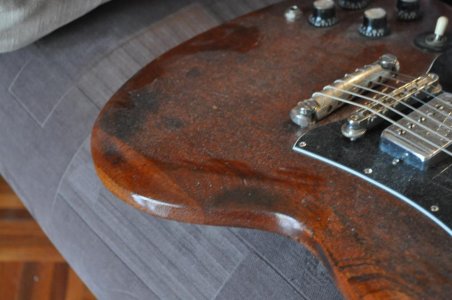
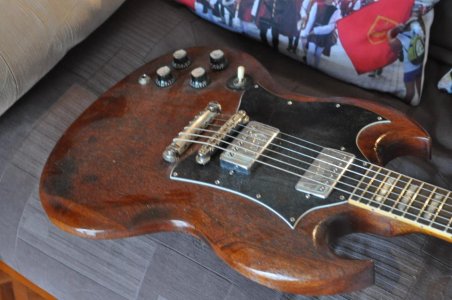
A pic of my SG
 

Attachments

  • DSC_0424.jpg
    DSC_0424.jpg
    67.7 KB · Views: 0
  • DSC_0425.jpg
    DSC_0425.jpg
    81.4 KB · Views: 0
Re: Hey Guitar builder guys ... Multi-piece bodies

Both of these Strats are Basswood...the Model 3A has at least 3 pieces glued together (I've refinished several Model 3s and found they are generally 3 piece bodies) while the Fender style headstock one is one piece. I really like the idea behind having one solid piece; however, tonally (besides different pickups) one is not better than the other...I really really wanted a one piece body with nitro finish to be better but both sustain very well and both are awesome guitars.

View attachment 69342
View attachment 69343
 
Re: Hey Guitar builder guys ... Multi-piece bodies

Multipiece necks are considered superior due to their stability.
One piece bodies are thought to be superior due to the tonal qualities.

Can't see any contradiction there.

when you have 90%+ of the tone coming from the neck (that's a fact) I don't see any logic in this. You make more stable (presumably losing tone from) the part where the tone comes from while you make more "tonal" (maybe also losing stability from) the part that contributes less to the tone.
 
Re: Hey Guitar builder guys ... Multi-piece bodies

^ 90%....LOL

A guitar is a sum of parts......and as all are different there is NO fact whatsoever to any consistent % contributed by a certain part. Not to mention that you can't measure tone of a guitar without a neck to do any comparison......you really need to back up this 'plucking a figure out of the air' bit with some testing/science for it to be more than pure fantasy.
I'm also calling you on this other fantasy of 'more stable neck = losing tone'.
1. Tone is not quantative
2. Tone is not absolute - you can't say 'x' tone is worse, as it might be just what someone else wants
3. Stability is required for the neck's ability to deal with string tension, and with climatic conditions. Who is to say that on one bit of wood that more than the absolute bare minimum to deal with these aspects is worse. You don't need QS maple to make necks, but do for mahogany generally. QS maple is more stable and strong, like a laminate/multipiece. It will impart a different tone than flatsawn in general.....but is it automatically worse??? You in particular don't have the wisdom to decide that for anybody else.

When it comes to multipiece bodies it is not certain that 1 piece is superior. As I said in my post it is thought to be by many......but this is not proof one way or the other. Unless you can do testing with the same piece made into various option it is neither provable nor disprovable. It is certain from empirical evidence that not all guitars are equal......even with identical hardware. What makes 2 guitars with the only difference being wood so different.....well it has the be the way the wood combines. Whether its a dud bit in there, or several bits that otherwise would be good if not combined together who knows. In a multipiece body (or neck) of course there is no way to tell. Additionally, with a really good body/neck that is multipiece why couldn't it equally be 2 'bad' bits that manage to compensate for each other?? Its like the infinite monkeys and infinite typewriters scenario.
So what you have with a 1-piece body is a lower statistical likelihood of being attached to another bit which could be incompatible. And the increased cost is due to fewer trees being big enough. Scarcity drives the price higher like with very highly figured maple.

So whilst multiple pieces in a neck will certainly help stability over 1 (this is the only provable part), pretty much everything else is not only dependant on the wood, but also not quantifiable.
 
Last edited:
Re: Hey Guitar builder guys ... Multi-piece bodies

One thing is for sure. Sourcing larger pieces of tone wood costs more. Manufacturers simply pass those costs on. Hence, the need to justify the prices in the product description.

Taking things to their illogical extreme, if glue sounded that good, the entire guitar would be made from it.
 
Re: Hey Guitar builder guys ... Multi-piece bodies

^ 90%....LOL

A guitar is a sum of parts......and as all are different there is NO fact whatsoever to any consistent % contributed by a certain part. Not to mention that you can't measure tone of a guitar without a neck to do any comparison......you really need to back up this 'plucking a figure out of the air' bit with some testing/science for it to be more than pure fantasy.
I'm also calling you on this other fantasy of 'more stable neck = losing tone'.
Your (guitar's) neck is mostly responsible for the majority of the characteristics of the waveform that constitutes your sound (sum of harmonics of every note plucked). 90% was an underestimation. Unless you play on the higher 1-2 frets, the neck contributes more to the sound than 90%, in relation of course to the body.
Happy reading : https://www.unibw.de/lrt4/mechanik/mitarbeiter/ehem-mitarbeiter/hfleischer/deadspots-en
http://www.frudua.com/sound_of_electric_guitar_wood.htm
http://www.frudua.com/neck_influence_in_guitar_tone.htm <- frudua says this is 30%/70% but this is very simplistic. Fact is that *ALL* luthiers agree that neck is more important than the body. The 90% figure i wrote was based on the first paper and personal experience.
I'm also calling you on this other fantasy of 'more stable neck = losing tone'.
I was trying to use the perceived assumption to show the oxymoron. You got confused.
 
Back
Top