I want to build a Pickup Test Bed guitar

This is my testbed guitar. Since it is top routed all I need to do is loosen the strings and slip in the pickups which are mounted in pickup rings. Then run the wires through the wiring channels to alligator clips in the control cavity where I can clip them onto the 5-way switch. I can switch out pickups in less than five minutes. If I wanted to I could also route the neck for a humbucker so I could test nearly any pickup combination. I might put a screw terminal strip in the pickup cavity to eliminate the alligator clips.

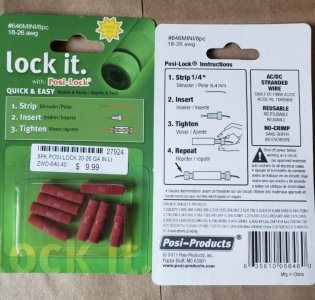
These are another option to alligator clips and screw terminals. Whats nice is you can loosen and tighten by hand, no screwdriver or other tool is needed.
 

Attachments

  • photo99260.jpg
    photo99260.jpg
    91.9 KB · Views: 0
Didnt Gibson have a rearmounted guitar for stores to showcase the Gibson pickups? I'd image that's the fastest and cleanest way. Or someone posted on here not too long ago that guitar with a roulette wheel for pickups or something to that effect.. That looked like fun... :D
 
Already got one. LP Special Humbucker that I picked up off the classifieds here for 400 bucks a few years back. It was a project guitar, without pickups, and had already been refinished, so it was a good candidate. Routed the pickup cavities through to the back. Enlarged the control cavity and installed Duncan Liberator volume pots. Pickups go in through the back and hook up to the Liberators quickly. I don't even have a back door on the guitar (though I do plan on making one if I ever plan on using it for practicing or gigging.

It's good to have, but not as cool as you'd think, to those already familiar with what the various offerings from Duncan, DiMarzio, et al sound like. It's great benefit, aside from the obvious one of speed, is that it eliminates some variables that go along with pickup swaps, e.g. slacking and then retuning your strings, or changing them out completely – and any unintentional setup tweaks that go along with string changes. It'd be useful to a professional gear blogger, but to you or me? Probably nowhere near as useful as it might sound in our heads. Cool? Yes. Of much real world use? Probably not.
 
Last edited:
I like the Tele Idea....

I know who I need to talk to about this! Can't believe I didn't think of this guy sooner....
 
I am sure Ben can sort it out. He probably has designed something like that in the past.
 

The opposite of a Relic Guitar -instead of beating the sh*t out of it to fake the wear, lock it up and hide it because the guitar and pickups options are pricey enough that you don't want to nick it.

Remember, Once you buy a Relish, you are only halfway there -in order to make them worth their whole point -you will want to buy lots of pickups in their mounting system -so add 500-2000 on to that price tag for 3-4 sets of pickups to swap around in the system.
 
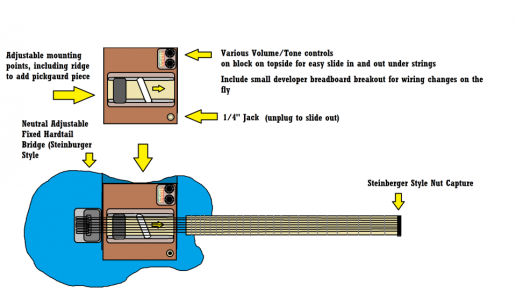
Since a test bed for pickups is about listening to the pickups for their qualities without compounding variables -I would suggest building a block type jig with a pickguard option where you can move pickups back and forth and change the angles to - that isolates and slides in from the top side of the guitar and sits mounted but which some isolation from the resonant loop of the bridge, body, neck, tuners, and nut. Also avoid mounting from the bottomside or back -it's fr*gging annoying as hell and creates loading and unloading by moving the guitar around and doing prep work to play it between pickups. Top side (shown) means you can slide in from a seated position, jack in the 1/4 and strum away with not manipulation -but keep the 1/4" one the bottomside -otherwise it's in the way for strumming and working. Make sure you break out tine and volume serial, parralel arrangements to a breadboard on the top side.

Also pick a direct tension adjustable intonation hardtail bridge -which impart the least personality -Avoid any tremelo systems and fulcrum based systems like a tuneomatic -as string resonance imparts personality. I guess a Steinberger style nut capture with an adjustable hardtail would give you the most honest pickup evaluation. Also pick more neutral woods and a bolt on neck

I drew out what I would do (disclaimer -I drew this in 3 minutes)

Test Jig - Copy.png - Click image for larger version  Name:	Test Jig - Copy.png Views:	0 Size:	266.2 KB ID:	6035552
 
Last edited:
A key is getting pickups in without removing the strings. OR completely removing the bridge or neck constantly.
 
The opposite of a Relic Guitar -instead of beating the sh*t out of it to fake the wear, lock it up and hide it because the guitar and pickups options are pricey enough that you don't want to nick it.

Remember, Once you buy a Relish, you are only halfway there -in order to make them worth their whole point -you will want to buy lots of pickups in their mounting system -so add 500-2000 on to that price tag for 3-4 sets of pickups to swap around in the system.

My guess is that the people who buy a Relish guitar are not concerned with price.
 
of course, but someone concerned with pickup tone swapping for empirical reasons isn't going to waste money on this system.

No, they wouldn't. I think your system is really the way to go. Especially if these kinds of tests were part of your job...or you like to design and build your own pickups.
 
Rear-mounted pickups have been A Thing for decades and several 'parts' companies will make you a body for it, and there are lots on eBay. Grab one HH body and one SSS body, buy identical necks and use Liberator pots (probably best to have a set of active pots on hand, too) and you're good to go. No need to change strings, height or shift the bridge at all when changing pickups.

That said, personally I'd get busy and totally remove the middle block of a body and use pickguard blanks to cut humbucker, Strat, Tele (both neck and bridge) and minibucker mounts which could then be swapped around in any configuration, from behind. Not sure how you could work in soapbar P-90s, but you'd have most combinations to hand.

The bigger problem I see with making one 'test' guitar is just that there can be such a difference between how a pickup feels in set neck mahogany vs bolt-on alder vs neck-through maple that there isn't really one construction and material combination that is truly neutral and universal. Maybe a 2-ply body made of a limba/korina back layer and an ash top layer, then an all-bubinga neck & fretboard that is set in but with a very short tenon, like in a Les Paul DC Special... but then how'd you test pickups in a way that is relevant for hollow bodies?

FWIW I have two test guitars: a Les Paul Vixen, which is a slightly thinner and lighter LP, for testing humbuckers; and a Squier Mustang with a couple of pickguards cut for Strat-style and Tele-style pickups (one SSS, one TB-TN, one TB-TB) that I can just about swap with only slacking off the strings and not having to actually touch the bridge. The Squier's very 'dead' body (some kind of multi-ply basswood) and the Vixen's intonation-unfriendly wraparound bridge do not make them ideal, but they get the basics done better than any one single guitar can.
 
The bigger problem I see with making one 'test' guitar is just that there can be such a difference between how a pickup feels in set neck mahogany vs bolt-on alder vs neck-through maple that there isn't really one construction and material combination that is truly neutral and universal. Maybe a 2-ply body made of a limba/korina back layer and an ash top layer, then an all-bubinga neck & fretboard that is set in but with a very short tenon, like in a Les Paul DC Special... but then how'd you test pickups in a way that is relevant for hollow bodies?

.

This is why a pickup test guitar needs to be as neutral as possible -understand the differences between pickups with as few variables as possible. Then apply that knowledge further as it relates to specific guitars styles, makes, woods etc.

Otherwise you'd have to build 6-7 test guitars to cover the basics.
 
A key is getting pickups in without removing the strings. OR completely removing the bridge or neck constantly.

with my little test bed guitar you can swap pups in less than a minute. no slacking of strings or anything. disconnect the wires, slide the old pup out. zip the two screws holding the pup to the block, put the new pup on the block, slide it in, connect the wires and play
 
This is why a pickup test guitar needs to be as neutral as possible -understand the differences between pickups with as few variables as possible. Then apply that knowledge further as it relates to specific guitars styles, makes, woods etc.

Otherwise you'd have to build 6-7 test guitars to cover the basics.

I agree that it can't be done completely - in the sense of all possible combos - with one guitar. But, since I'm looking at a JB....bolt on it is.
 
Threaded inserts....that might be an easy ticket!

Tele + Threaded Inserts + Locking tuners. Neck on/off all day long!
 
Back
Top