Improving the functionality of the Avg Strat trem...

Re: Improving the functionality of the Avg Strat trem...

On a vintage trem you have 6 screw but 4 if the 6 are backed if a bit so the two screw work like a fulcrum keeping tension on the bridge is the key

I understand that. And yeah it works sort of like a fulcrum. but the problem is that a traditional strat trem has a very large pivot area on the baseplate, pivoting against the large vertical area of a pivot screw. There's really nothing to lock the pivot point in at 1 location like there is for many other fulcrum tremolos like the floyd rose, gotoh/wilkinson vs100, etc. which have knife edges on the baseplate and a groove on the pivot screw to keep the knife edge pivoting on one place only instead of potentially sliding all over the place.

The other thing I don't like about vintage strat trems and basically any 6-screw system is that the pivot screws have those rounded heads with the flat bases. So when you push down on the bar, the plate tries to pivot on the shaft of the screw, then hits the head of the screw and tries to pivot on that. It's a bit of a mess. That's what the wudtone tremolo seeks to solve, by making a recess on the plate, instead of modifying the screws.
 
Re: Improving the functionality of the Avg Strat trem...

It would be a pain, but maybe something like a fishing shop might have a small cone weight that fits in the counterbores, with enough play to allow free movement - would only need 2 - And I think brass might be OK for the purpose. You would have to drill it out to the mounting screw diameter.
 
Re: Improving the functionality of the Avg Strat trem...

The pivot post screws that the OFR uses (the wood screw type) are quite a bit lager than the the screws that a 6 point uses. The inner thread dia of the OFR is larger the the largest dia of the 6 point screws. Other than that....good idea. At one time (30 years ago) I had thought about having a bridge plate that had a knife edge on the entire front edge of it that would rest and pivot in a bar with a V groove in its edge. It would be mounted to the top using multiple screws and the side play would be controlled by the width of the V groove being only a few thousandths of an inch wider than the front of the bridge plate that would rest in it. So much easier to have 2 pivot posts, although it would be interesting to see what the tone would be like seeing that the contact point would be so much larger/longer.
 
Re: Improving the functionality of the Avg Strat trem...

Not sure I follow...

Actually a better idea, but you have to find the right one...

cone%20washer%20aisin.JPG


on the outside screws. Those are cone washers... You're basically making a ledge for the holes to bear against.
 
Last edited:
Re: Improving the functionality of the Avg Strat trem...

The pivot post screws that the OFR uses (the wood screw type) are quite a bit lager than the the screws that a 6 point uses. The inner thread dia of the OFR is larger the the largest dia of the 6 point screws. Other than that....good idea. At one time (30 years ago) I had thought about having a bridge plate that had a knife edge on the entire front edge of it that would rest and pivot in a bar with a V groove in its edge. It would be mounted to the top using multiple screws and the side play would be controlled by the width of the V groove being only a few thousandths of an inch wider than the front of the bridge plate that would rest in it. So much easier to have 2 pivot posts, although it would be interesting to see what the tone would be like seeing that the contact point would be so much larger/longer.


ahhhhh right you are. I didn't realize they were that much bigger. I made some measurements and it looks like they wouldn't fit an ordinary strat bridge plate without modifying the mounting holes.

hmmmmmmmmm. Plan B. design a rig to accurately create grooves in strat pivot screws. I think I have something in mind that could work.


Actually a better idea, but you have to find the right one...

cone%20washer%20aisin.JPG


on the outside screws. Those are cone washers... You're basically making a ledge for the holes to bear against.

oh, that's interesting... hmm. got some thinking/engineering to do.
 
Last edited:
Re: Improving the functionality of the Avg Strat trem...

One thing I can tell ya is that those old style Floyd screw in studs are much larger on diameter than what is used on a Fender 6-screw trem. The holes would need to be enlarged and I don't think there's even enough metal to get them to where they'd need to be.

In any case, there's plenty of solutions available. Nothing wrong with a good 2-point trem.
 
Re: Improving the functionality of the Avg Strat trem...

I went to Floyd Rose's site and got the info about the screw diameter of the unthreaded shaft portion. it is thicker than a strat screw, but not a whole helluva lot. I made measurements on my strat and floyd screw would be a bit too big to fit in a standard strat screw hole on the baseplate, but only JUUUUUUUUUUUUUUUST. It's really a tiny bit.

I'm not sure how large the screw holes (hee hee, I said screw holes) are on the wilkinson baseplate, but I don't think I'd want to risk screwing up the baseplate just so I can test out this theory of mine about the floyd screws. It makes a lot more sense to get an extra set of regular screws and modify those.

I thought about a 2-point system but then I'd have to drill for bushings etc, and like I said, I'd prefer to not modify the guitar itself.
 
Re: Improving the functionality of the Avg Strat trem...

What I meant about that statement was that I hate the feel and sound of a floyd.
Also I think floyds are ugly, though I don't mind as much the low profile redesigns that have shorter string-lock bolts sticking out the back.

Now i see what you mean. The problem with floyds is that its harder to have that bell/piano sound as with a simpler trem or bridge. Sitar-sounding floyds are very common, and if it is the nut's fault then the fix might not be so straight forward, if it is the bridge's fault again the fix might be even trickier.
But once it sings, it sings much better and with so much more sustain than the standard vintage trem. See natural harmonics on G.
About looks, it surely looks "industrial", but that's what the first classic guitarists might have thought when they saw the first solid body electric.
 
Re: Improving the functionality of the Avg Strat trem...

Now i see what you mean. The problem with floyds is that its harder to have that bell/piano sound as with a simpler trem or bridge. Sitar-sounding floyds are very common, and if it is the nut's fault then the fix might not be so straight forward, if it is the bridge's fault again the fix might be even trickier.
But once it sings, it sings much better and with so much more sustain than the standard vintage trem. See natural harmonics on G.
About looks, it surely looks "industrial", but that's what the first classic guitarists might have thought when they saw the first solid body electric.

agreed, and maybe a bigass brass block might also be the key to getting a floyd sounding big and beefy. But if I opted for a floyd for this guitar, I'd have to make some serious modifications to the body, which I don't want to do :)
 
Re: Improving the functionality of the Avg Strat trem...

Wonder if I can chuck up the Floyd screw posts on a lathe and make some of those washers I mantioned? Cut them off and drill a hole in it.

Its been a LONG time since I worked a lathe - but I know where there is one. It might be too big for the job.
 
Re: Improving the functionality of the Avg Strat trem...

Hooray!!!

I'ma going to get me some!!!!! :D
 
Re: Improving the functionality of the Avg Strat trem...

Scratch that - $25 for 6 screws???/

Like I said - I have access to a lathe.
 
Re: Improving the functionality of the Avg Strat trem...

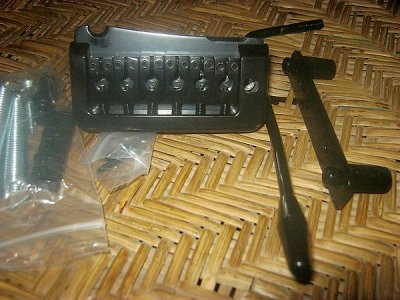
I bought this a while ago when I was working on my old Ibby DT250. The original bridge had broken & I was looking to replace it with something else. Ended up getting a Floyd Special for it..

But this thing mounts with two screw-in studs just like a Floyd (Spacing is different/narrower though). Looks sturdy & they're available in Chrome as well...if I'm not mistaken they're Wilkinson (or clones of Wilkinson) bridges..

StratTrem.jpg


Or you could just try Big Bends nut sauce with your existing bridge ...that stuff is good...
 
Re: Improving the functionality of the Avg Strat trem...

The original Strat trem does have a knife edge, it's the part of the counter-bored hole in the bridge plate that the screws rest against. On a properly set-up Strat, when you move the trem, the front of the plate moves downward, and the plate rises up on the mounting screws (when you push down on the trem). It's actually ingenious. You just have to know some tricks, which I have learned in years of playing Strats:

Lubricate all contact points with guitar lube.
Only screw the outer two mounting screws down so the head just hits the top of the plate when the plate is flat against the top of the guitar, the other 4 should be unscrewed just a little bit above the plate.
It's designed to be floating, I set mine so the back of the plate is around 1/8" above the guitar top, or so it will get you about one whole step if you bend "up" on the bar instead of down. This way the fulcrum part of the plate is in the correct position for it to work correctly.
Always stretch your strings well when installing them.
Make sure your nut is correctly cut and polished so the strings don't bind in the slots.

These tricks work great for me, I can do pretty hard whammy stuff and it still is in tune. I think the original Strat trem unit was well-thought out, the only downside is when you break a string it goes out of tune, so I change the plain strings often on my Strats.

Al


The average vintage strat bridge doesn't really have a sharp/hardened knife edge on the baseplate, and it doesn't have a pivot point designed on the pivot screws either. The baseplate just rides up and down the shaft of the screw, and it's anyone's guess where the bridge ends up after some aggressive tremolo use.

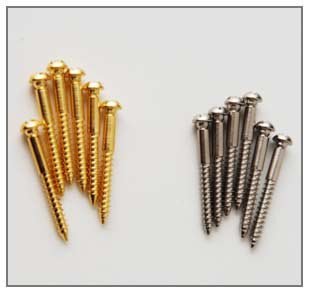
But I wonder if using 6 of the pivot screws from the old floyds which didn't have bushings, if that would help to improve the functionality and "return to pitch" accuracy of your average 6-screw trem.

Or....

A lot of aftermarket 6-screw trems have improved edges on the baseplate but use the same kind of screws as a strat, which renders that edge kinda useless. They might also benefit from using the floyd screws.


These are the ones I'm talking about.

View attachment 54497

I'm guessing it'd forcibly move the whole bridge whatever fraction of an inch it'd be between the edge of the old screw shafts and the edge of the pivot point of the floyd screws, but as long as there's enough travel left in the saddles, that shouldn't impact intonation ability any significant amount.

Thoughts?
 
Re: Improving the functionality of the Avg Strat trem...

agreed, and maybe a bigass brass block might also be the key to getting a floyd sounding big and beefy. But if I opted for a floyd for this guitar, I'd have to make some serious modifications to the body, which I don't want to do :)

if the guitar sings, there is absolutely no reason to ruin it with mods!
 
Back
Top