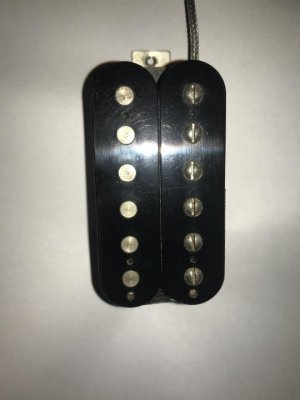
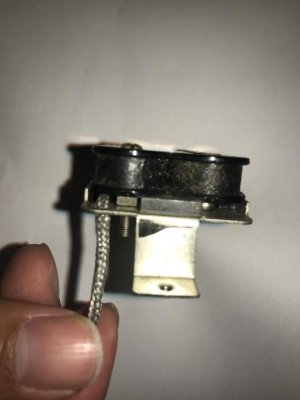
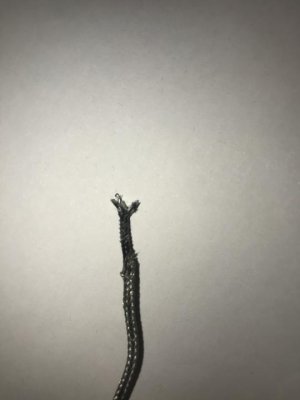
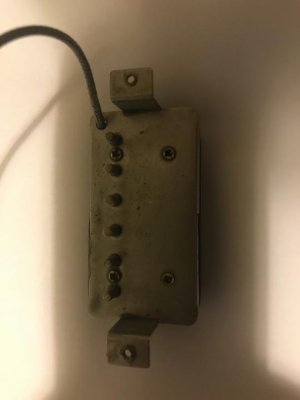
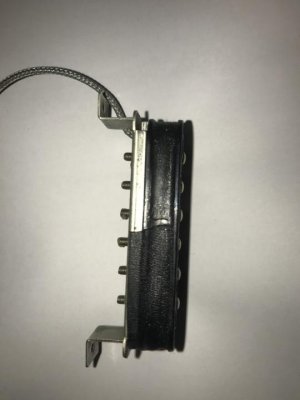
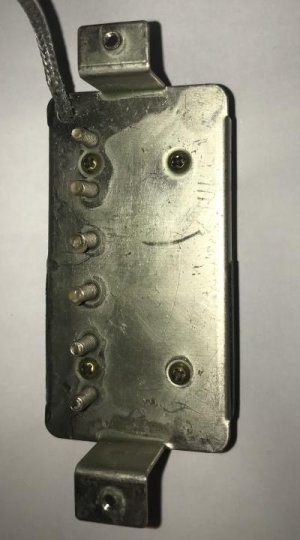
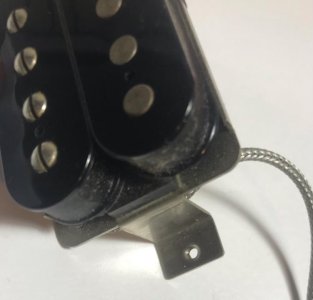
Is this a genuine 80’s 59 sd pickup

Tally_Ho

New member
Told it’s an old 59 with the label missing

resistance is 7.74 ohms, feels like a proper metal baseplate with a wax feel, has a shielded braided wire with black live wire, brought as a set which came with another sd pickup with label
 

Attachments

  • photo98227.jpg
    photo98227.jpg
    27.7 KB · Views: 0
  • photo98228.jpg
    photo98228.jpg
    25.2 KB · Views: 0
  • photo98229.jpg
    photo98229.jpg
    19.6 KB · Views: 0
  • photo98230.jpg
    photo98230.jpg
    19.2 KB · Views: 0
  • photo98231.jpg
    photo98231.jpg
    26.1 KB · Views: 0
  • C024B7EB-8217-4000-8CF6-120FF7D12586.jpeg
    C024B7EB-8217-4000-8CF6-120FF7D12586.jpeg
    34.4 KB · Views: 0
Told it’s an old 59 with the label missing

resistance is 7.74 ohms, feels like a proper metal baseplate with a wax feel, has a shielded braided wire with black live wire, brought as a set which came with another sd pickup with label

What I can see looks largely like my early SH1's (one of them being partly pictured in my avatar). I have one measuring 7.8k, BTW. Cosmetically, really old ones had an oval sticker and/or a mere paper sticker so the Duncan label was easy to remove... The only obvious difference that I see here with my early 59's is the "black live wire" (with yellow dots in mine) but it's a detail, as is the presence of wax - very first ones weren't potted and if this one has been vaguely potted after its purchase, it can explain why the sticker(s) is/are missing .

So, yes, it looks like an authentic early SH1 to me...
 
Typically, the bobbin tape wraps onto the baseplate on 59s, if it never had a cover. What does the label on the other one look like?
 
the other pickup has a white sticker with 59B in red, that one does have bobbin tape wrapped in the baseplate

is there anything internally one can inspect to verify, i.e spacer material used
 
I have some 59's from the 1980's that Mj wound. They look like yours. Looking at one right now. The spacer is brown. Looks like plastic. The four brass screws in yours appear recessed but it might just be the way the photograph looks. Mine are not recessed. I don't want to take them apart. The neck measures 7.4K in one set and 7.66K in the other set.
 
Last edited:
I have some 59's from the 1980's that Mj wound. They look like yours. Looking at one right now. The spacer is brown. Looks like plastic. The four brass screws in yours appear recessed but it might just be the way the photograph looks. Mine are not recessed. I don't want to take them apart. The neck measures 7.4K in one set and 7.66K in the other set.

its the photo, the screws are not recessed, can see the spacer by shining a light through and looks like it black plastic.
are your pickups wax potted as well?
 
Hard to be 100% sure, but I'm leaning toward "not a Duncan" on this one. The crimping marks on the mounting legs don't match up to any of the vintage Duncan's I have owned or currently have on hand, which is a lot.

Just to double check, are the 4 baseplate screws brass? Also, is the magnet somewhat shiny and silver or is it duller and graphite-looking?
 
Hard to be 100% sure, but I'm leaning toward "not a Duncan" on this one. The crimping marks on the mounting legs don't match up to any of the vintage Duncan's I have owned or currently have on hand, which is a lot.

Just to double check, are the 4 baseplate screws brass? Also, is the magnet somewhat shiny and silver or is it duller and graphite-looking?

the 4 baseplate screws look like brass, and the magnet from looking at the outside is graphite looking and looks smooth and shiny...
 
I've uploaded additonal photos which might help

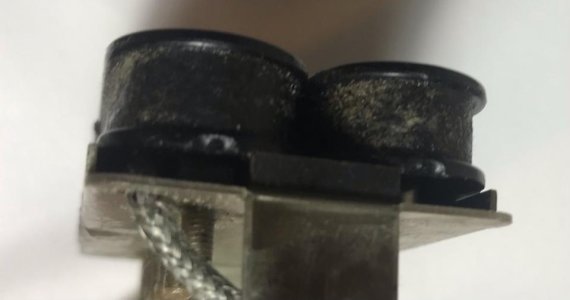
1) there appear to be a notch in the bottom of the plastic bobbin in the side
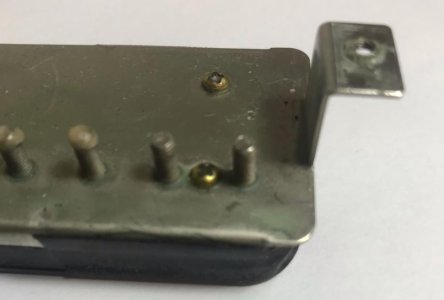
2) close up of brass screws, can see wax residue
3) close up of magnet, graphite colour, and looks like a smooth bar
 

Attachments

  • photo98245.jpg
    photo98245.jpg
    27.2 KB · Views: 0
  • photo98246.jpg
    photo98246.jpg
    32 KB · Views: 0
  • photo98247.jpg
    photo98247.jpg
    30.8 KB · Views: 0
on further inspection, its looks like the length sides and bottom of the magnet is shiny silver.....

thanks guys for your help it has certainly been very helpful lesson....
 
on further inspection, its looks like the length sides and bottom of the magnet is shiny silver.....

thanks guys for your help it has certainly been very helpful lesson....

Have you removed the magnet? I think it's just an old 59N. Looks just like mine. Should have an alnico 5 magnet. Might be polished or roughcast. Either way the edges will be smooth and polished even if the 1/2" x 2 1/2" surfaces are roughcast. Old 59's (some wound by Mj!) could have either version of the alnico 5 magnet in them. Just stick it in your guitar and enjoy it! Should be a very good sounding pickup.
 
"What I can see" with my tired 57 years old eyes is not much on the bad small screen of my old obsolete PC, so my testimonial is obviously to take with a grain of salt

That said:

-I'll inspect the mounting legs of my own remaining vintage 59's (they are currently all mounted in various guitars) but the threaded baseplate and other parts in the pics still look familiar to me ;

-the color of the mag is not really meaningful with vintage SH1's IMHO/IME. All of mine include RC A5 mags whose main tint is a dark blueish grey.

Now, there is an extremely simple way to check if the mag is ceramic or not: take a multimeter, put one of its probes on one side of the magnet and the other probe on the other side (without touching anything else). If the DMM gives no resistance reading (if it shows an infinite resistance), it's a ceramic mag.If it gives a DCR reading, it's not ceramic.

Last but not least, the uneven look of the baseplate with its "tides" made me think to a kind of flash wax potting done after purchase (and possibly on the baseplate alone, in order to fasten the bottom of the mag on it). It would be understandable knowing how some early unpotted SH1's tended to squeal and it might explain some missing label(s) / paper wrap.

Each of these statements is pure conjecture. Any serious diagnosis would presuppose to have the pickup in hand IMHO.

Footnotes:

-one of my vintage SH1's had a RC mag GLUED on its baseplate. My friend luthier had kept it on a shelf during 3 to 4 decades and didn't remember to have done such a thing. I'm still wondering if this unusual operation had been done in the factory or not... strange things happened back in the days so I wouldn't necessarily expect consistency from old products. :-))

-I've dissected/repaired some vintage SH1's and wouldn't recommend to open any of them if it works: IME, they are frail and prone to develop intermittent contacts if their bobbins are handled repetitively. :-/

FWIW : conjectures and subjective testimonial + feelings, like any post in such cases... :-)
 
Last edited:
Wow, I learned something today!

Now, there is an extremely simple way to check if the mag is ceramic or not: take a multimeter, put one of its probes on one side of the magnet and the other probe on the other side (without touching anything else). If the DMM gives no resistance reading (if it shows an infinite resistance), it's a ceramic mag.If it gives a DCR reading, it's not ceramic.
 
Wow, I learned something today!

Always glad to share, even if I had already posted that here. :-)

That said, the devil is in the details so let's add a nuance: if a DMM reads a resistance in a ceramic mag, it should be a VERY high resistive value (in the MegaOhm's range vs virtually no resistance with an AlNiCo bar). My "no resistance reading / infinite resistance" scenario was implicitely based on the use of a DMM set to read a relatively low DCR (like when one measures a guitar pickup)...
 
would this test apply with the magnet taken out? its good to know, and thanks for sharing

shame i put the pickups in one of my guitars, still working fine after all tinkering :)
 
would this test apply with the magnet taken out? its good to know, and thanks for sharing

shame i put the pickups in one of my guitars, still working fine after all tinkering :)

Metali is a conductor, ceramic is typically an insulator, so the test would hold regardless of the magnet in or out of the pickup.
 
Back
Top