It's weird you don't see more of these...

Chistopher

malapterurus electricus tonewood instigator
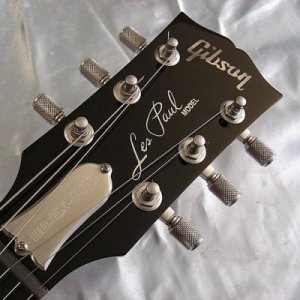
68575-4802f6bb47be2233bcd3c4e13961fca2 (1).jpg

Round grippy tuning keys.

They cost the same as any other tuning key shape to produce, but they offer much more comfort and precision than the industry standard flat, wide, smooth shape.

Even if you're not trying to appeal to the traditionalist, you think these things would be on every uber modern overengineered guitar on the market.

I just bought like 3 dozen of these things to put on my guitars as soon as I realized how great they feel. Seriously, if you try them you won't go back.
 
Re: It's weird you don't see more of these...

Those do look like interesting. How's the price?

Sent from my Alcatel_5044C using Tapatalk
 
Re: It's weird you don't see more of these...

It's a little over $30 after shipping for a set of 6, which isn't bad for Hipshot.
 
Re: It's weird you don't see more of these...

If they have the identical gear ratio, the regular machine heads can be dialed in more accurately than those new round ones you are posting. mechanical advantage makes this certainty, and thats why traditional machine heads use a paddle style tuner button.

Not saying they aren't great tuners though.

Do they have a different gearing system?
 
Last edited:
Re: It's weird you don't see more of these...

They remind me of the LSR tuners that for example Mustaine used on some is KVs. Are they locking?
 
Re: It's weird you don't see more of these...

They remind me of the LSR tuners that for example Mustaine used on some is KVs. Are they locking?

Hipshot offers them in a locking and non locking variety.

@NegativeEase: no, same ratio as regular Hipshots.

I tried them but didn't care much for them. My string winder couldn't get a hold of that and that bugged me to no avail.
 
Re: It's weird you don't see more of these...

I tried them but didn't care much for them. My string winder couldn't get a hold of that and that bugged me to no avail.

You don't much need a string winder with these. They're round, so you can easily twist the knob almost three full rotations before you have to reset your fingers. With locking tuners, you can easily tune each string to pitch without ever taking your fingers off the knob.

Also the pressure you exert is consistent the entire rotation, so you're less likely to overshoot the note you're tuning to.
 
Re: It's weird you don't see more of these...

They look interesting. Though good point with mechanical limitations NegativeEase.

I'm going to admit something here... I've never even learned to use string winder.

I've had two of them, got from somewhere, but I haven't figured out how they should be used?
 
Re: It's weird you don't see more of these...

LSR made them 15-20 years ago, and they had something like a 40:1 ratio. I know these are just the knobs that are replaced, but I think they started the barrel-knob thing years ago. I am all for redesigns of tuners- tuning machines are positively archaic compared to bridge and pickup design these days.
 
Re: It's weird you don't see more of these...

View attachment 102828
they offer much more comfort and precision than the industry standard flat, wide, smooth shape.

No.
Absolutely not!
In fact, not even close.
Mathematically and mechanically impossible if you are referring to the tuning HEADS. If you're talking about the gears inside the tuners, well that may be different.
 
Last edited:
Re: It's weird you don't see more of these...

I don't think they would be more precise either.

Your ability to precisely control the position of the tuner is related to the distance of the farthest edge of the edge of the tuning peg from the center of rotation. Think about it. If you had a tuning peg with a 1 ft wide tuning peg on it, you could much more precisely set the tuning because it would be easier to make small adjustments. If the tuning peg was only 1/8th of an inch wide you would have trouble making fine adjustments.

In the pic, it looks like the tuning pegs are a little closer in that traditional ones . . . which would result in slightly less precision.
 
Re: It's weird you don't see more of these...

No.
Absolutely not!
In fact, not even close.
Mathematically and mechanically impossible if you are referring to the tuning HEADS. If you're talking about the gears inside the tuners, well that may be different.

The shape of the head can affect tuning precision. As I mentioned earlier, with a flat knob you are more likely to overshoot the desired note.

If you want to get into mathematic and mechanical speak, they back me up as well. Longer levers from the center of rotation require less torque to rotate a given distance, with non-circular heads this distance changes as you roll the knob through your fingers. Mathematically, when you start to turn the tuners, you have your fingers on the outside applying force perpendicular to the flat surface, giving as near as makes no difference to 100% of the force from your fingers. As you rotate the key you start to push more parallel to it, making it closer and closer to 0% efficiency. The fraction of force you put into rotation the tuning key is equivalent to sin(x), where x is the angle of force against the flat surface of the tuning key.

With the circular knob, both these figures remain constant, where on a flat knob they change depending on hand placement, leading to more required effort to tune to the same precision.
 
Re: It's weird you don't see more of these...

I don't think they would be more precise either.

Your ability to precisely control the position of the tuner is related to the distance of the farthest edge of the edge of the tuning peg from the center of rotation. Think about it. If you had a tuning peg with a 1 ft wide tuning peg on it, you could much more precisely set the tuning because it would be easier to make small adjustments. If the tuning peg was only 1/8th of an inch wide you would have trouble making fine adjustments.

In the pic, it looks like the tuning pegs are a little closer in that traditional ones . . . which would result in slightly less precision.

If you're tuners work smoothly, this shouldn't be a problem for either model.
 
Re: It's weird you don't see more of these...

I'd love to try actual LSR machines. But they rarely come up for sale these days.
 
Re: It's weird you don't see more of these...

The shape of the head can affect tuning precision. As I mentioned earlier, with a flat knob you are more likely to overshoot the desired note.

If you want to get into mathematic and mechanical speak, they back me up as well. Longer levers from the center of rotation require less torque to rotate a given distance, with non-circular heads this distance changes as you roll the knob through your fingers. Mathematically, when you start to turn the tuners, you have your fingers on the outside applying force perpendicular to the flat surface, giving as near as makes no difference to 100% of the force from your fingers. As you rotate the key you start to push more parallel to it, making it closer and closer to 0% efficiency. The fraction of force you put into rotation the tuning key is equivalent to sin(x), where x is the angle of force against the flat surface of the tuning key.

With the circular knob, both these figures remain constant, where on a flat knob they change depending on hand placement, leading to more required effort to tune to the same precision.

OMG!

You are sooo far off and contradict yourself so badly that there is no need to even comment. But I will anyway.

You are absolutely correct that..."Longer levers from the center of rotation require less torque to rotate a given distance". But that distance doesn't change as you rotate flat type tuners. You are constantly applying the force toward the outside of the tuner and in a circular direction. Everything else you say or imply is incorrect and only would apply if you didn't rotate your hand while rotating the tuner (applying the force in a constant direction/vector). But by rotating your hand as you rotate the knob you are keeping that same moment arm, the direction of the force/vector is constantly changing in a circular direction, the amount of force required to rotate the knob remains the same, and that force (depending on how large your flat tuners are) is considerably LESS than those tiny round knobs, which gives you considerably GREATER control.

You'd better repeat your math and physics classes. You can quote the principles but you don't have a clue as to their practical application.

Hey, it's ok if you like these round tuners. There is absolutely no problem with that. I'm glad you do. To each his own. And your opinion is valid. But don't try to tell us that they are more precise by virtue of them being small round cylinders. That is just untrue.
 
Last edited:
Re: It's weird you don't see more of these...

Okay, sure. Why not. For people that rotate their hand through the wrist to tune, that is correct. I do not, as that puts my wrist in an awkward position.

That does not mean what I said was wrong, just that it does not apply to your method of rotating the head. No need to be unreasonable about it.
 
Re: It's weird you don't see more of these...

If you're tuners work smoothly, this shouldn't be a problem for either model.

It's not a matter of smoothness. It's a matter of the distance from the center of rotation to the edge of the tuning peg. A greater difference allows for more precise control because you actually have to move it further to get the same tuning effect. You have to move the edge of the round peg less distance than the regular (flat) tuning peg to make a change - which is bound to be less precise. Whether or not this precision matters in the real world I have no idea though.
 
Back
Top