Kramer Striker bass

Inflames626

New member
Hi all,
So I finished my latest project build--an import dual P BC Rich Warlock that I refitted with 250k CTS pots, .1uf orange drop caps, and Fender 62 reissue pickups. It's everything good about a P but more articulate. I'm not sure why the dual P design isn't more popular or tried, but in my experience it works well. I like it a lot better than the active stock stuff that was in there.

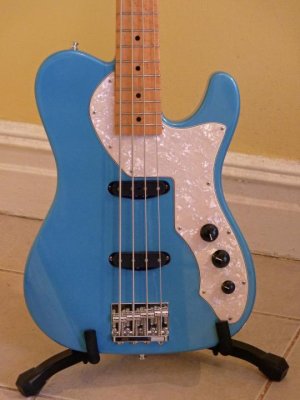
Now I'm moving on to trying a PJ. I'm seeing some Kramer Strikers, which are cheap. I like them because they have a body similar to the old 80s Jackson/Charvel/Fender Japan models but with standard and not reversed P coils (don't like the sound of reverse P's).

The only problem is they have a toggle switch, which looks a bit hokey on a bass. They have 3 control knobs. I assume these are Jazz bass style, but independent volume knobs on a bass with a toggle wouldn't be necessary, would they? Any clue what the controls might be?

Thanks.
 
Re: Kramer Striker bass

They have 3 control knobs. I assume these are Jazz bass style, but independent volume knobs on a bass with a toggle wouldn't be necessary, would they? Any clue what the controls might be?


Where have you been? Independent volume controls and a 3-way toggle are on most Gibson guitars. Let's you instantly change volumes and/or tones back-and-forth with the flip of a switch. It'd work the same way for bass.
 
Re: Kramer Striker bass

Where have you been? Independent volume controls and a 3-way toggle are on most Gibson guitars. Let's you instantly change volumes and/or tones back-and-forth with the flip of a switch. It'd work the same way for bass.

Right, except the context is a little different because on bass you usually use both pickups while on guitar you usually use one pickup (at least, I don't know many people who use the toggle in the middle position for long periods of time--if they do, some folks seem to prefer a mega bucker approach with both pickups in series.)

Independent volume knobs on bass are used to establish tonal balance, while this isn't as true on guitar, where one pickup is usually favored over another.

Using independent volume knobs on a passive bass to balance pickup volume is problematic relative to a blend pot. I remember uOpt saying something about not liking passive PJ basses because he felt the P overwhelmed the J. If I remembered correctly, he preferred an active blend pot to independent passive volume pots.

Using that line of thinking, I thought, "If independent volume knobs are used to set the balance between the neck and bridge pickup, why is a toggle even there?" It was then that I thought that perhaps a toggle was seen as a better solution to achieving volume balance on a PJ bass relative to independent volume pots, which, based on uOpt's experience, tend to be problematic.

In short, independent volume knobs and a toggle on a bass seem redundant when both pickups will most likely be used all the time. Having both pots cranked would be the same as the having the toggle in the middle. At best, the toggle could be turned to the middle to create a parallel sound and the unwanted pickup turned all the way down in order to isolate the pickup you want in parallel mode.

This is exactly how I use independent volumes on my guitars. In my case, on my guitars the volume controls are independent in order to isolate pickups when the toggle is in middle/parallel, creating a parallel type sound from one pickup. It also allows me to get a parallel sound from a split humbucker. This gives me a way to have split and parallel type sounds without needing a parallel/split/series 3 way toggle (although there will be tonal differences between two pickups in parallel and the coils of a single pickup in parallel, I'm sure, due to differing locations on the string).

So, I don't use independent volume controls on a bass (pickup volume balance) the same way I would use them on a guitar (pickup isolation).
 
Re: Kramer Striker bass

The Fender Jazz Bass Special which the Duff McKagan signature is based on has V/V/T with a 3-way toggle. I believe the JP-90 did as well, and I've also seen a few Jackson Concert Basses with that set up. The Charvel Model 2Bs & 3Bs initially had that configuration before switching to Vol / Blend / Tone in mid/late 1986.
 
Re: Kramer Striker bass

The Fender Jazz Bass Special which the Duff McKagan signature is based on has V/V/T with a 3-way toggle.

The original JBS had V/V/TBX. This is what mine had until I removed the TBX. I hate switches so I went with a vol/blend/tone.
 
Re: Kramer Striker bass

I see the point of a toggle if you want to change tones quickly (probably not very useful with rock bass). I just think they look cheesy on a bass.
 
Re: Kramer Striker bass

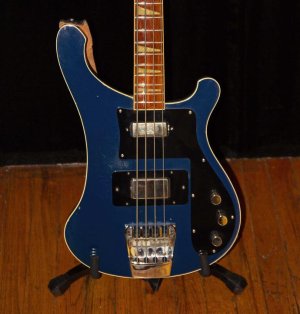
I found the toggles on both my JBS and my Rick 4001 completely annoying. I used to accidentally hit them at times and really had no use for them whatsoever.

Went Vol/Blend/tone on both and never regretted it.

1984 Fender Jazz Bass Special_4209.jpg

1976 Rickenbacker 4001S_4283.jpg

Heresy to some, I'm sure, but I bought both new and will never sell them.
 
Re: Kramer Striker bass

Do you guys find a difference between independent volume knobs and a blend pot?

My concern is how useful all of this is if a person does not like on instrument tone controls or boosting EQ via on instrument tone controls.

Since I'm a guitar player, I don't particularly care for dialing in a lot of complex tones on an instrument. I'd rather do it on an amp or via software presets that I can later recall, which is more precise than using instrument settings.

I know a lot of people prefer active controls on a bass, but I subscribe to the EQ rule that says you'll hear cuts more than boosts. When I used active EQ on my guitars (EMG 81/85 with concentric BTC in 18 volts), it sounded false and brittle past a certain point. So I've rarely found use in boosting via onboard controls. If I do need to boost, I prefer boosting active EQ's on amps, which I know I'll be on, say, 6 or 6 1/2, versus an approximation that I would have to find by ear if I used active tone boosts on a bass.

I suppose my only concern would be the number of pots in a passive circuit that the wiring "sees" and whether this degrades tone relative to more sophisticated alternatives like a blend pot. I don't know enough about all this stuff to decide, but it's something I've thought about.
 
Re: Kramer Striker bass

At the time I thought the blend was a good alternative to the existing toggle switch on the JBS and the Rick; not sure I'd do it again though.

I did both of these mods several years ago; since that time I've opted opted for vol/vol + a DPDT push-pull for series-parallel on the tone. I've really grown attached to that configuration.

I also don't do much complex dialing in on the instrument. I know where I like the tone knob on all my basses and generally don't make changes there except for the push-pull on the DPDT.
 
Re: Kramer Striker bass

Sounds like we're of the same mind dg27. I prefer my guitars active for metal, so I like the warmth of a passive bass to offset the traditionally compressed sound of actives.

Your setup also sounds like what I have in mind once I build a bass with the SD NYC soapbars, which look great.

My guess is the NYC part is an allusion to Sadowsky basses.
 
Re: Kramer Striker bass

My Squier Jazz was the first one in which I tried the vol/vol/DPDT. Then last year I built a Warmoth with two SDSC P stacks and the same setup (the Custom Shop provided a wiring diagram: PM me if you'd like it).

Right now I'm putting together a MIM Fender Jazz with the same config and noiseless passive Jazz pickups.
 
Re: Kramer Striker bass

How do you find the stacks and noiseless pups?

A lot of people say they can't tell the difference, but in my guitars I feel like vertical stack pups dampen the highs and dynamics a bit (this being a STKS1 Classic Stack noiseless relative to a true single coil like an SSL 1).

I could see the point as far as keeping things quiet under lights in a live situation, but with recording, where the only thing I really have to fear is noise coming from a computer monitor and cellphone, I'm a bit skeptical of noiseless designs.
 
Re: Kramer Striker bass

The stacks I have in my Warmoth were custom wound and are a matched set.

No hum whatsoever, but I was surprised at how bright and powerful they are--there could be a lot of factors involved including placement of the neck pickup.

I'm undecided what pickups I'll put in the Jazz, but I'm looking for more warmth.
 

Attachments

  • 2014_0518_Custom_T_P1000161.jpg
    2014_0518_Custom_T_P1000161.jpg
    43 KB · Views: 0
Re: Kramer Striker bass

I prefer my guitars active for metal, so I like the warmth of a passive bass to offset the traditionally compressed sound of actives.

I'm coming from pretty much the opposite direction. I like the warmth of passive guitar pups, but the articulation, clarity, and precision of active bass pickups. I'm not entirely shocked that you didn't like the EMG-BTC in your guitar; longcat has one in her Spector and it works great there but doesn't seem like it'd be all that useful in a guitar. Regarding blend vs. dual volumes, longcat and I find it much easier and more convenient to get a specific balance between the pickups with a blend than two volume knobs.

How do you find the stacks and noiseless pups?

I haven't tried the latest generation of guitar stacks (STK-S4 & etc), but I always found STK-S1s lacking compared to an SSL-1 or SSL-2. OTOH, I have a STK-T2 Hot Stack in my Tele and I've used both Classic and Hot Stack for Jazz Bass and they're great. The Tele Hot Stack doesn't really sound like any single I've ever heard, but the Classic Stack for Jazz Bass sounds pretty much identical to a single coil Jazz Bass pickup minus the hum.
 
Back
Top