Locking a trem down like a hard tail

  • Thread starter Thread starter WickedCoach
  • Start date Start date
W

WickedCoach

Guest
So I have a sterling jp 60 which is a really nice guitar. Nice neck, very comfortable, sounds great even with the stock pickups, but I have a Fred paf pro combo I'm going to put in there. I don't play the guitar a whole lot, but I still really am happy with it. However, the trem serves no purpose to me. One, its obv non locking so it doesn't stay in tune great with heavy trem work, and I already have 4 guitars with real floyd to serve that purpose. So my thought was to maybe have a set up done where the bridge is totally locked down and can't move in either direction. My question is how do they do this, and does anyone else do this? Does the tone or anything else get affected?
Thanks
 
Re: Locking a trem down like a hard tail

You can buy $20 tremblocker devices that are adjustable.

or you shove a piece of wood between block and body and tighten down the strings.
 
Re: Locking a trem down like a hard tail

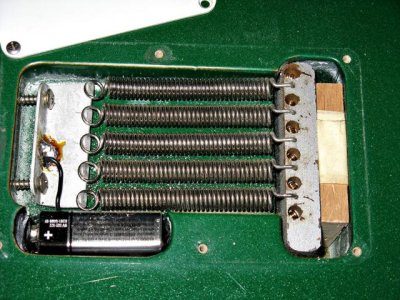
A simple block of wood – any wood – will do the trick. However, for best results it should be cut very precisely to size. It should go between the rear wall of the spring cavity and the vibrato block. If you're unsure of what I mean, here is a pic of how it is done on the Clapton Signature Strats:

claptoninnards.jpg

It should cram in there tightly enough so that the bridge plate is forced to lie flush with the top of the body.

Be sure to keep at least one spring in, though. You will want it to provide a path from the ground wire to the vibrato block. You could also run the ground wire straight to the block, if you insisted on removing the claw and springs entirely. However, IME blocks are difficult (if not impossible) to solder to; smashing the wire between the vibrato block and the block of wood works better. That said, I still think leaving the claw and one spring in is the easiest way to go.

Or you could just go the ghetto route, and screw in your claw screws until the claw is held against the body. You will probably want four or five springs for this. The advantages are that all you need is a screwdriver and an extra spring or two. Also, if you really wanted to, you could still lean hard on the vibrato arm and get it to dive, even though it would be decked normally.
 
Last edited:
Re: Locking a trem down like a hard tail

I do it like the photo above. ^^^^^^^ But I don't use tape. I fit the actual piece of wood tight by starting off with a piece that's to thick and then sand it until it fits in - but tightly.

My Fender Strats have vintage style vibratos so I tighten the six screws on top so that the bridge is parallel to the body and not tilted. Tighten them to much and the rear of the bridge will tilt up since the leading edge is beveled on the bottom.

Then I go around to the back and shape and sand a block of wood that fits snugly between the steel block of the vibrato and the rout in the body of the Strat for the vibrato assembly.

I also tighten the 5 springs a bit.

That's pretty much how Eric Clapton's Strats are set up too.
 
Last edited:
Re: Locking a trem down like a hard tail

If you want to have a hardtail just block it but with a good set up, a well made nut and good tuners that tremolo will work quite well despite not being a locking tremolo.

I know a lot of guys deck their tremolos but to me that is just the biggest waste of a tremolo...they are much more musical and expressive if you can go over and under the intended notes with the vibrato bar.
 
Re: Locking a trem down like a hard tail

If you want to have a hardtail just block it but with a good set up, a well made nut and good tuners that tremolo will work quite well despite not being a locking tremolo.

I know a lot of guys deck their tremolos but to me that is just the biggest waste of a tremolo...they are much more musical and expressive if you can go over and under the intended notes with the vibrato bar.

Clapton prefers the sound of Strat's with a vibrato over hard tail Strats without a vibrato, but since he never uses it, he blocks it.

Blocking it let's me bend notes more easily, and play pedal steel licks and bends without the other strings in the "chord" going flat.
 
Re: Locking a trem down like a hard tail

I have no idea if it will work with that guitar but you should look into a Tremlo-no. They're about $30 on e-bay. It's simple to install and easy to use. You can lock the trem down totally, put it in dive only mode or free floating. I have them on two guitars and they're great.
 
Re: Locking a trem down like a hard tail

Clapton prefers the sound of Strat's with a vibrato over hard tail Strats without a vibrato, but since he never uses it, he blocks it.

Blocking it let's me bend notes more easily, and play pedal steel licks and bends without the other strings in the "chord" going flat.

Clapton never uses the trem, has the blocked with a block of wood...no use of a vibrato bar for anything.

I like guys that use the vibrato for a real musical, human voice like vibrato like David Gilmour and Jeff Beck...all those guys float the bar like Leo intended so you can get that up and down vibrato around the now as opposed to a Van Halen style down only.

I get the double stop, pedal steel licks and such but I use a Telecaster for that type of playing so not having it available on a Strat is no big loss for me plus if you work at it you can get them on a Strat with a floating bar it just requires bending more than one string at a time and often bending them in different amounts to get the right pitch.
 
Last edited:
Re: Locking a trem down like a hard tail

Clapton never uses the trem, has the blocked with a block of wood...no use of a vibrato bar for anything.

I like guys that use the vibrato for a real musical, human voice like vibrato like David Gilmour and Jeff Beck...all those guys float the bar like Leo intended so you can get that up and down vibrato around the now as opposed to a Van Halen style down only.

I get the double stop, pedal steel licks and such but I use a Telecaster for that type of playing so not having it available on a Strat is no big loss for me plus if you work at it you can get them on a Strat with a floating bar it just requires bending more than one string at a time and often bending them in different amounts to get the right pitch.

You know I love Jeff Beck! :) He's been my favorite rock guitarist for something like 45 years. But I don't play much like him. Besides, I like to rest my palm near the bridge and sometimes right on it and if it's raised it goes out of tune.
 
Last edited:
Re: Locking a trem down like a hard tail

The last trem equiped guitar I had I didn't use the trem much but I used 4 springs and a trem-setter so I could pull up one step and it worked well. I could bend strings without the others going out of tune. It took a little time to get it adjusted right but it didn't go out of tune.
 
Re: Locking a trem down like a hard tail

A simple block of wood – any wood – will do the trick. However, for best results it should be cut very precisely to size. It should go between the rear wall of the spring cavity and the vibrato block. If you're unsure of what I mean, here is a pic of how it is done on the Clapton Signature Strats:

View attachment 35163

It should cram in there tightly enough so that the bridge plate is forced to lie flush with the top of the body.

Be sure to keep at least one spring in, though. You will want it to provide a path from the ground wire to the vibrato block. You could also run the ground wire straight to the block, if you insisted on removing the claw and springs entirely. However, IME blocks are difficult (if not impossible) to solder to; smashing the wire between the vibrato block and the block of wood works better. That said, I still think leaving the claw and one spring in is the easiest way to go.

Or you could just go the ghetto route, and screw in your claw screws until the claw is held against the body. You will probably want four or five springs for this. The advantages are that all you need is a screwdriver and an extra spring or two. Also, if you really wanted to, you could still lean hard on the vibrato arm and get it to dive, even though it would be decked normally.

I've always gone the "Ghetto route" myself and have been happy, but often wonder if blocking the trem off with a block of wood would have any advantages over screwing down the claw and using five springs.
 
Re: Locking a trem down like a hard tail

I've always gone the "Ghetto route" myself and have been happy, but often wonder if blocking the trem off with a block of wood would have any advantages over screwing down the claw and using five springs.

It's possible that using the block of wood might transfer the string vibrations to the body of the guitar more completely. It's also possible that one type of wood might be better than another for making that block too. One thing I'm certain of is that my Strat sounds "better" to me when I block the vibrato in the way shown above.
 
Last edited:
Re: Locking a trem down like a hard tail

I use a Tremol-no on one of my Strats and it works great.

I have another trem guitar that I just mounted the plate right on the body, put on four springs and tightened the claw (the "Ghetto route"). Works great, still allows me to bend all I want without affecting the pitch of the other strings, stays in tune, and keeps the typical trem tone (blocking with a wood block does change the tone). Plus, IF I want to put the bar on and use the trem for lowering the pitch, I still can. It has a very stiff action with the bar, but it still works just fine and is easy to get used to.
 
Re: Locking a trem down like a hard tail

A simple block of wood – any wood – will do the trick. However, for best results it should be cut very precisely to size. It should go between the rear wall of the spring cavity and the vibrato block. If you're unsure of what I mean, here is a pic of how it is done on the Clapton Signature Strats:

View attachment 35163

It should cram in there tightly enough so that the bridge plate is forced to lie flush with the top of the body.

I put the wood on the other side and use maximum spring.
 
Re: Locking a trem down like a hard tail

Try to fit with a nice piece of brass or aluminum to block the trem for more sustain and better response of bridge and body.
 
Re: Locking a trem down like a hard tail

I blocked my tremolo with a wedge. My block is tapered and there was no chance I could get an exact fit in the front, so I installed an aluminium piece on towards the neck, I use four springs tight against that piece of aluminium and works fine.
Before that I just had it tight to the body but didn't work out for me, somehow there's a slight difference if the trem is flush with the body or floating and it probably depends on how the saddles are slanted. Gap by Fender specs + a block works for me.

Altough I'm now completely sold on the tremol-no. :D
 
Back
Top