Lower end guitars losing resonance over time

Re: Lower end guitars losing resonance over time

Several of my guitars, cheapos and expensive ones, sound significantly better In high humidity. Throw a humidifier in your room. They are cheap enough that its worth the experiment.
 
Re: Lower end guitars losing resonance over time

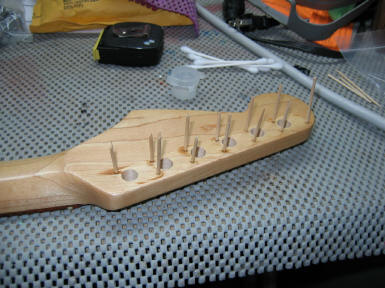
this problem is also know as the "stripped screw holes effects" the dumb-proof way to fix this is with tooth-picks and glue (form white glue to anything that can bond wood) this happens reagulary to bolt on neck guitars, and very rare to tom bridges studs, also happens to the tuners.

headstick.JPG


don't completly loose the strings, just enough to can quit the bidge, get the studs off, apply glue, procedure to just cover the inner "wall" of the studs holes (completly filling them is useless), let then dry, cut the exces of tooth pick with a wire cutter (or the most gutsfull scissors like tool you had) carefully introduce the studs on the tighted holes, mount the bridge again, strung your guitar, tune it to perfection and enjoy a "renowed" guitar
 
Last edited:
Re: Lower end guitars losing resonance over time

Personally, I think its more of an issue of honeymooning mixed with the fact that after playing for longer and probably playing other's guitars...your ear is just getting better and your realizing the differences in guitars and what you want to hear out of your guitar.

I wouldn't be super worried about what an SG sounds like unplugged, especially overtime... I go through phases with all my guitars as to which give me a better vibe and when. both unplugged and plugged.

Just my two cents.
 
Re: Lower end guitars losing resonance over time

All Guitars change over time. Wood dries out,.especially modern guitars that go through a quick and artificial quick drying process. Less espensive softer metals fatigue... bridges, tailpiecew, studs, tuners,.frets, etc.. things start to wear, over time and with lots of play.
 
Re: Lower end guitars losing resonance over time

the more you play a guitar (especially unplugged), the more you learn its abilities and its imperfections. sometimes its quite subtle.
 
Re: Lower end guitars losing resonance over time

Did you by a chance record it?

I find that ever since I upped the gearslutting game my standards are higher.

As for real effects, glue might be a factor.
 
Re: Lower end guitars losing resonance over time

I don't know man, I've kinda just decided lower end guitars aren't for me. The last 2 times I've bought a sub-$400 guitar I have not gelled with it. I just keep coming back to my PRS SE Torero. It's kinda funny, this guitar is insanely nice for the price, and I say that having owned a cheaper PRS SE which I ended up selling. I've played a grand total of 4 other guitars that compete with it in terms of resonance, finish, and playability. 3 of those retailed for over $1200.
 
Re: Lower end guitars losing resonance over time

I don't know man, I've kinda just decided lower end guitars aren't for me. The last 2 times I've bought a sub-$400 guitar I have not gelled with it. I just keep coming back to my PRS SE Torero. It's kinda funny, this guitar is insanely nice for the price, and I say that having owned a cheaper PRS SE which I ended up selling. I've played a grand total of 4 other guitars that compete with it in terms of resonance, finish, and playability. 3 of those retailed for over $1200.

When your playing gets really advanced, you may actually want less resonance in some frequencies. For the same reason that you don't put every control on your amp to '10'. Some of the biggest sounding guitars unplugged, have the muddiest and least focused lead tones. Probably why they dont use 335s for gainy lead playing. But for low-wattage class-A pentatonic wanking and play-acting orgasmic faces on stage, you cant beat that big "expensive" sound.

Stratocaster would have never survived if resonance and sustain were criteria for good sound.

Platitudes and price tags, I've got no use for em.
 
Last edited:
Re: Lower end guitars losing resonance over time

When your playing gets really advanced, you may actually want less resonance in some frequencies. For the same reason that you don't put every control on your amp to '10'. Some of the biggest sounding guitars unplugged, have the muddiest and least focused lead tones. Probably why they dont use 335s for gainy lead playing. But for low-wattage class-A pentatonic wanking and play-acting orgasmic faces on stage, you cant beat that big "expensive" sound.

Stratocaster would have never survived if resonance and sustain were criteria for good sound.

No offense dude but it's a helluva lot easier to dial a certain amount of frequency out than in, IME.
 
Re: Lower end guitars losing resonance over time

When your playing gets really advanced, you may actually want less resonance in some frequencies. For the same reason that you don't put every control on your amp to '10'. Some of the biggest sounding guitars unplugged, have the muddiest and least focused lead tones. Probably why they dont use 335s for gainy lead playing. But for low-wattage class-A pentatonic wanking and play-acting orgasmic faces on stage, you cant beat that big "expensive" sound.

Stratocaster would have never survived if resonance and sustain were criteria for good sound.

Platitudes and price tags, I've got no use for em.
http://en.wikipedia.org/wiki/Platitude
A platitude is a trite, meaningless, or prosaic statement, generally directed at quelling social, emotional, or cognitive unease. The word derives from plat, French word for "flat." Platitudes are geared towards presenting a shallow, unifying wisdom over a difficult topic. However, they are too overused and general to be anything more than undirected statements with ultimately little meaningful contribution towards a solution.
 
Re: Lower end guitars losing resonance over time

When your playing gets really advanced, you may actually want less resonance in some frequencies. For the same reason that you don't put every control on your amp to '10'. Some of the biggest sounding guitars unplugged, have the muddiest and least focused lead tones. Probably why they dont use 335s for gainy lead playing. But for low-wattage class-A pentatonic wanking and play-acting orgasmic faces on stage, you cant beat that big "expensive" sound.

Stratocaster would have never survived if resonance and sustain were criteria for good sound.

Platitudes and price tags, I've got no use for em.

Or the 335's could have been hell with feedback.

And you might want to tone it down a bit with the generalisations. You'll get slaughtered here.
 
Re: Lower end guitars losing resonance over time

You just thought it sounded better than it really does. I'll bet if you were to compare now and then recordings, they'd sound identical.
 
Re: Lower end guitars losing resonance over time

On the topic of humidity. How much is bad. Overall We have a hot an humid climate here in Mumbai for most of the year. It is a coastal region. Winter is for just 3-4 months. It has started warming up. So do I need to put a humidifier. I have seen some guys use silica gel packs.
 
Re: Lower end guitars losing resonance over time

On the topic of humidity. How much is bad. Overall We have a hot an humid climate here in Mumbai for most of the year. It is a coastal region. Winter is for just 3-4 months. It has started warming up. So do I need to put a humidifier. I have seen some guys use silica gel packs.

treat your guitar like a person. this goes for hot and cold climates. if you would not be comfortable being stored in a certain place for a long time (ie, the boot of a car in the sun or overnight, in a wooden case in swampy damp room in the tropical heat, or naked in an unheated house for the duration of a Canadian winter) then neither would your axe. Treat them the way you would treat a person and all will be fine.
 
Last edited:
Re: Lower end guitars losing resonance over time

I've been noticing something about my Epi SG.

I've had it almost a year and a half now, and have been playing it regularly. But I've noticed something lately that reminds me of what happened to my old Hamer/Slammer explorer copy aeons ago. After owning it for some time, the guitar seemed to lose the tight/resonant feeling and sound that it had when I bought it. Same thing is happening to my SG now. Sustain seems to have dropped off a bit, and the guitar seems to be fighting me. I just recently restrung and set it up. Also, shortly after I got it, I replaced the cheap plastic nut with a nice Graphtech Tusq nut, and gutted the electronics and replaced all of it.

I'm not sure what's causing it. Anyone else experience anything like this? Could it be just a simple matter of tightening up all the hardware? I almost feel like I might need to give the bridge/tailpiece studs a good hammering to make sure they're properly seated in the wood and aren't coming loose, but I'm equally concerned that the neck joint just isn't tight in terms of maximum wood-to-wood contact, which I can't really do anything about at this point.

Try changing the strings more than once a year. :D
 
Re: Lower end guitars losing resonance over time

FWIW, I generally perceive guitars as improving over time.

I also have recordings that proof that the sound changes quite a bit or a few of them in the first weeks after I receive them. This is for real. I think there is probably a mundane reason for that such as that after shipping and/or climate changes they need to re-settle into their truss rod or something like that.

This also has to do with my preference on what "good sound" actually means. I like medium length sustain where something is happening, overtones don't just decay, different overtones last different long and the spectrum changes in more interesting ways than just "less treble over time". For the most part I get this sound out of guitars that have pretty floppy necks wood-wise and balance the strings against the truss rod. It is important that there truss rod isn't hulk class (just a simple little rod please) and that the total mass of wood is just right, either a thick neck of less dense wood or a thinner neck from denser wood.

Anyway, you can easily see how that could dramatically change over time if the wood is moving around and then settles.
 
Back
Top