Mounting ring (vintage, non-standard size): Hole - Melt or Drill?

Adieu

New member
At my disposal - Bosch drill, 130w soldering iron (pistol grip, variety of attachments, "turbo" button, labelled as specifically made for melting through ****).

What I need a screw hole in: non-standard (wider, bigger) pickup ring from a vintage MIJ, which is unfortunately made with 2 screws to one side, 1 on the other... need a 1:1 config. Kinda zero room for error, cause I don't know where to source another one of these things.

So - melt or drill? What's safer?
 
Re: Mounting ring (vintage, non-standard size): Hole - Melt or Drill?

I'm assuming it's a metal pickup ring?

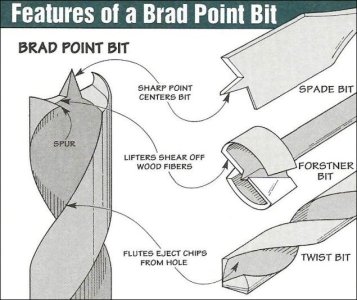
I'd go with drill. slowly, using a metal-compatible drill bit. be careful and start really small as metal drill bits aren't like brad-point bits and have a tendency to wander when used with a hand drill. Ideally, it should be done with a drill press, if you have zero room for error.

If it's a plastic ring, then use an awl to mark a perfectly centered drill location, and use a brad-point bit.

Melting through either metal or plastic is too unpredictable.
 
Re: Mounting ring (vintage, non-standard size): Hole - Melt or Drill?

Naw, plastic of course. I'm just wondering if a drill won't crack it or tear it to shreds.

What's a brad-point? And why would it be safer than poking it with a superheated tip of a soldering iron? Power should be plentiful, it's harsh enough to write burn-line script on wood. What's unpredictable there?
 
Re: Mounting ring (vintage, non-standard size): Hole - Melt or Drill?

hole size, for one.

a brad point bit looks like this:
Features+of+a+brad+point+bit.jpg

If you are gentle and let the bit do the work instead of forcing it through, then it will leave you with a clean, neat, perfectly sized hole.

It's not necessarily safer than a soldering iron, but you will get a better result because you can control what size bit you use, vs the soldering iron where you stick the hot tip in the plastic and hope you get the right diameter. And then you have to worry about whether it will cool down fast enough to give you a good hole without warping the surrounding plastic and ruining your pickup ring.

It doesn't take all that much heat to melt plastic, believe it or not. Even a 40W iron will do it with ease. 130W is way overkill.

Safety isn't so much an issue here, but how good a result you get is.
 
Re: Mounting ring (vintage, non-standard size): Hole - Melt or Drill?

+1 to CTN's reasoning. Control and exactness is the name of the game.
 
Re: Mounting ring (vintage, non-standard size): Hole - Melt or Drill?

Melting worked perfectly.

Not a contrarian just didn't see the new replies. Btw, my soldering iron CAN control hole size, because the tip is tapered to a "/\" point (and there are a variety of tip attachments to use). Used 130 watts cuz that's what I have, and I have it cuz 15-30 watt "pencils" suck for soldering pots, and this is what Fry's had for <$20 with >100watts.
 
Re: Mounting ring (vintage, non-standard size): Hole - Melt or Drill?

Glad it worked out for ya. I agree with what you say about the lower wattage irons. I personally feel that there is no use for them. I use a 50 watt large pencil tip which works fine for all my guitar soldering (works great on pots).
 
Re: Mounting ring (vintage, non-standard size): Hole - Melt or Drill?

Anyone know of anywhere that sells wider-than-standard archtop mounting rings? Just for future reference?
 
Re: Mounting ring (vintage, non-standard size): Hole - Melt or Drill?

Define "standard".

If we take the inventors to be the standard, that means Gibson dimensions. The Seymour Duncan Trembucker surround is the same width but longer to accommodate the longer bobbins. Many import guitars use a metric humbucker surround that is longer and wider than Gibson. Their screw holes come nowhere near to lining up with the American designs. These are readily available. Vendor descriptions usually include keywords like fits Epiphone, Cort, Hamer XT et cetera.
 
Re: Mounting ring (vintage, non-standard size): Hole - Melt or Drill?

Don't mean to cause a stir, but a coil soldering gun as the OP described in his initial post, isn't something you want to mess with around the pups, because it might demagnetize it. If I'm not mistaken, there's a word or two on that issue in SD's Q&A too.
 
Back
Top