Re: New Bass Questions
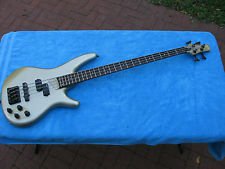
My son picked up a used bass and I have a few questions. The bass is an Ibanez Soundgear SR-590. It looks like this...
View attachment 50306
1 - How do the controls work? I can't quite figure it out.
2 - The E and A strings are much louder than the D and G string. How do I address this? I pretty comfortable performing basic set-ups but I've not set-up a bass before.
3 - The pick-ups (P/J configuration) seem to be some kind of active knock-offs. Which SD pick-ups would be the choice for replacing these?
Thanks in advance for your help.
1 - This bass should have two single pots, and two concentric stacked pots. The two single pots are the volume and pickup blend or "panpot". The volume control should have a smooth action all the way through its range of motion, while the panpot will have a "detent" at the center point of its rotation indicating an even blend between the P pickup toward the neck and the J pickup near the bridge. As per the diagram I found, the single knob closer to the bridge is the panpot and the other is the volume.
The two sets of stacked knobs are the three-band parametric EQ. The knob set closer to the bridge is the midrange EQ; the smaller knob on top sets the midrange frequency, while the larger bottom knob sets the amount of boost or cut at that frequency. The other knob stack are the treble and bass "shelving" controls; the inner knob is the treble, the outer is the bass. All of these knobs should have a center detent position indicating "flat" (there
may not be a detent on the mid frequency control).
2 - First, use the guide for (1) to make sure the bass's EQ is set totally flat. Also make sure the amp settings are flat. With that done, see if the E and A are still louder than the D and G. If so, you need to perform a setup of the bass, and you should probably do it anyway.
A full setup involves doing the following things in order: (1) Setting the amount of relief curvature in the neck (too little and the lower frets will buzz when played; too much and the strings will be very high off the fretboard and hard to play), (2) setting the saddle height (too low and the bass will buzz all over, and especially around the octave; too high and the strings will again be far off the fretboard and hard to play), (3) setting string intonation (the 12th fret needs to be in tune exactly an octave above the open string; if it's sharp the saddle need to move back; if it's flat the saddle needs to come forward), and finally (4) setting pickup height (the standard recommended by most manufacturers is, with the string pressed down at the last fret, the bottom of the string should be about 3-4mm from the top of the pickup cover for the E string, and about 2-3mm from the G string. The exact method for setting neck relief and saddle height varies by manufacturer, but they will all get you to about the same place, and there are literally thousands of tutorials for doing this online; just type "bass guitar setup tutorial" into any search engine and you'll get pages of good results. Here's Fender's:
http://www.fender.com/support/articles/bass-guitar-setup-guide/.
3 - I've said it many times, I'll say it again; an "active" bass very rarely has active pickups. Truly active pickups, with an op-amp built in to boost the signal from an "underwound" pickup, do exist, with EMG being the biggest supplier. However, 9 times out of 10 a bass labelled "active" has traditional passive pickups, and what's active is the on-board preamp providing the multi-band boost/cut EQ. Most likely, the pickups currently on the bass are the stock ones, though they may have been swapped out by the previous owner. You should be able to replace them with pretty much anything under the sun, SD or otherwise.
As far as SD's selection, I've always been partial to the Quarter-Pounder P pickup. It's slightly hotter than a "vintage" Fender Precision pickup, with oversized polepieces making it more sensitive to string vibration, but it's not as midrangey as a traditional "hot" overwound pickup would be (in fact, compared to SD's vintage P-bass it's a bit scooped). They make the QP in a Jazz size as well, but that gives an extremely scooped tone, not much mids to speak of, and to me the bridge J pickup is all about that jazzy "burp" that's 90% mids. The QP for Jazz is also a single-coil pickup, which can be noisy when soloed (the P pickup, though technically not a humbucker, has two halves that are wound and polarized like the two coils of a humbucking guitar pickup to reject EMI noise). I would recommend a Classic Stack for the bridge position. It's got the output to match the QP, but keeps more of the midrangey goodness and gives you a wide tonal palette. And it's a hum-cancelling pickup so you can solo it with no buzz.



 Right on Brothers & Sisters....


