
You are using an out of date browser. It may not display this or other websites correctly.
You should upgrade or use an alternative browser.
You should upgrade or use an alternative browser.
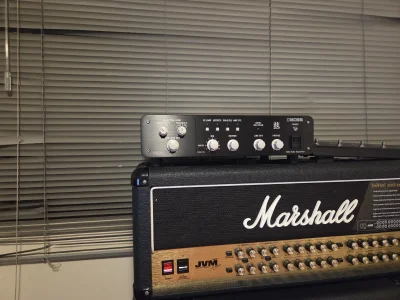
NGD, finally a reactive attenuator
- Thread starter Archer250
- Start date


Archer250
Well-known member
Yeah. I was warned about the resonance knob, so I have it turned off. Otherwise? This is a very good sounding unitAlways wondered how those sounded, but too expensive new to try myself. It is awesome that it works so well!
I know the 70s Altair resistor type attenuator. They could heat up and blow out. Either the resistor would blow or they would melt out the solder joints making your amp go" unattenuated"......imagine your 100w plexi just going fullbore mid set in a club....hahahaAre attenuators safe these days? I remember talk about them years ago that they could negatively affect tubes and transformers. I am guessing they fixed that by now.

a good attenuator wont hurt the amp at all. but you are running your amp at X on the volume control, the volume is lower due to the attenuation, but your amp is working just as hard. so for example, if you are running your 50w plexi on 8, then using the attenuator to knock the volume down by half, your plexi is still running on 8 and putting that wear on the tubes and everything elseAre attenuators safe these days? I remember talk about them years ago that they could negatively affect tubes and transformers. I am guessing they fixed that by now.

beaubrummels
Well-known member
The Weber MASS (I have one) has a speaker coil as it's power soak, so it's behaving to the amp output as if it's connected directly to a cab. But running your amp full out always has all the consequences of running your amp full out.
S
Solarflares
Guest
Motherload Elemental - Motherload
Motherload Elemental - New Sequis Speaker Attenuator. The definitive master volume control. Connect this device between your guitar amplifier and speaker
 www.motherload.co.uk
This is the only one that doesn’t affect tone.
Available by direct order.

Señor Verde
Member
I ran a Hotplate with a Twin Reverb and it sounded amazing. Every amp I've tried it with since, not so much.Anyone else remember when the Thd Hotplate was the hot ticket everyone wanted?
Dr Z has a new attenuator I'm interested in. It's reactive, not just resistors.

Snake Aces
Singlecut Slut
I'm in the market for a solid attenuator for my 50w to pair with my 40w H&K that has built-in attenuation. I was looking at one from Sweetwater, but now this thread has me realizing I need more research/advice.
what is different about this than all the others out there?Motherload Elemental - Motherload
Motherload Elemental - New Sequis Speaker Attenuator. The definitive master volume control. Connect this device between your guitar amplifier and speaker
This is the only one that doesn’t affect tone.
Available by direct order.
Snake Aces
Singlecut Slut
I am also curious. Wish I still lived in Greece, I'd swing over to Athena to check one out.what is different about this than all the others out there?
S
Solarflares
Guest
It quite simply doesn’t affect the tone at all, all the way down to zero.what is different about this than all the others out there?
It also retains the amp’s response/characteristic with it’s intelligent reactive design.
The only gripe is that fixed-ohmage must be specified on order, and the used market is virtually nil for these.
It’s a box for life. You won’t want anything else.
Some background.
I worked on some of my stuff with Dave Gladden, who helped design the early Palmer load-boxes back in ‘83.
At the time, he demo’d me his first PDI-03 model, which was legendary.
A real ‘59 Les Paul, through an original Jubilee, and straight into a desktop mixer from the Palmer.
Through computer speakers, the sound was incredible.
This was new back then. No-one else was doing it.
The originals used 4 20W tungsten truck stop-lamp bulbs and a servo-motor for the reactive section!
Dave was flying around the world at the time - taking samples to people like Steve Vai, Joe Satriani, Warren Cuccurullo.
Def Leppard flew him to some island somewhere. It was really going well for him and Palmer.
But Palmer management decided to expand the design somewhat, and Dave didn’t like the departure from the original PDI-03 brief. They simply stopped sounding so good in the filter-section. So he parted ways with Palmer.
I still have an original ‘84 Palmer, which I use every day.
Anyway, I was away in Sweden for 4 years. When I came back, we met by chance in a pub at a jazz-rock gig, and he began to tell me about another local guy he’d been advising. They were working on the first Motherload boxes, and Dave was advising on the filter section. It took them many months to develop it until it sounded correct.
The Palmer had artifacts in the upper registers, but the Motherload addressed this.
He said they were working on a box that could process line-level signals, and emulate power-amp distortion. This was something I really wanted, but my circumstances changed and I found myself out of the game for a while.
So, basically, when the guy who designed the legendary Palmer starts enthusing about a friend’s project - there’s definitely something going on.
I noticed the Motherload was a rack, with two filter sections, and could take an amp to 100W. But the two separate filters could also accept line-level input. Dave’s report was that they’d finally got the filters right on this, and it had no artifacts, and totally eclipsed the Palmer units currently made.
I think people simply stopped using racks, which is why this didn’t become mainstream.
People still used Palmers for FOH duties, but the days of taking your favourite amp’s Palmer signal onstage into your fx-rack, and using two Superbass Plexi 100W stacks - those days were over.
I have used original Palmers since 1998, and still do. I had a long relationship with Lab Series L5’s up until 2000, but then went back to fully valve.
These days, having a few valve amps around the house, it was nice to get away from the ‘studio’ and play in another room. But I wanted a cranked amp sound, at bedroom levels.
My first searches were for a Motherload - thinking I would need a second power section (or combo) to amplify the soaked-down signal of the first amp.
First forays revealed the new Motherload Elemental box. No longer a rack, but an amp-top solution.
This unit had a variable attenuator section, comprehensive routing, and a slightly scaled-down/simplified filter.
They were made in Dave’s old workshop, and obviously with Dave still onboard after 20 years, it simply had to be good.
So I bought one.
I can definitely confirm that there is no colouration whatsoever from the reactive-load attenuator. It will happily and faithfully tame a flat-out Budda SD45, or my Seymour Convertible 100W - all the way down to a whisper. And those are two amps that have a lot going on. The sound remains bright and full - all the way down to zero.
I haven’t used the filter section yet. I’m reluctant because I know it will be good, and then I would have to buy two more Motherloads for my studio, and retire the Palmers. But one day I will. I’m always looking for Motherload rack units, but they are very rare on the used market, and I’m getting old now.
Hope that helps.
Last edited by a moderator:
Similar threads


- Replies
- 4
- Views
- 621

- Replies
- 14
- Views
- 835

- Replies
- 4
- Views
- 810
