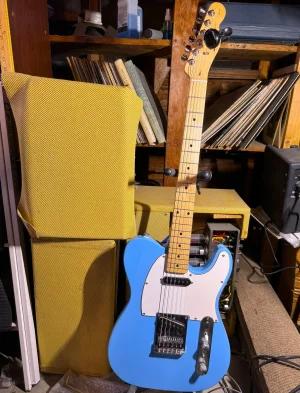
NGD ordered Squier Affinity tele - pickups?

justFred

Well-known member
First Tele for me. Have read up and it seems the Affinity is a crap shoot in general but the one guaranteed issue is the pickups stink.
Would appreciate some recommendations on classic Telecaster sounding pickups.
Have probed the subject myself and the opinions from the general WEB are all over the place and some make no sense at all (like lil 59 Telecaster bridge, how could a humbucker have a Tele sound, it can’t). No offense to SD group, am confident it sounds great, just not Tele like.
 

Attachments

  • IMG_3125.webp
    IMG_3125.webp
    224.8 KB · Views: 4
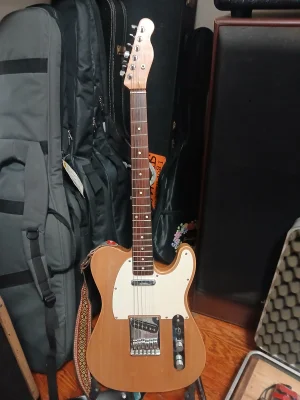
ive not played a '71 tele that i can recall, but ive played some old teles. if you want a vintage tele sound, i highly recommend the antiquity II tele set.
 
How do early 70s Teles differ from older ones?
Think the early ones used AlNiCo 3 were not as tightly wound in the mid 60s shifted to A5 with a tighter wind. So if shifted from a slightly mid range to a brighter sound. Not sure about this but heard a rumor long ago....
 
Think the early ones used AlNiCo 3 were not as tightly wound in the mid 60s shifted to A5 with a tighter wind. So if shifted from a slightly mid range to a brighter sound. Not sure about this but heard a rumor long ago....
According to Grok I am wrong: "
The Fender Telecaster bridge pickup underwent several evolutionary changes from the 1950s into the mid-1960s (roughly 1950–1965), though the core design remained a single-coil with six Alnico rod magnets, fiber flatwork, and no adjustable poles (except for stagger introduced mid-decade).Key changes and timeline:
  • Early 1950s (Broadcaster/early Tele, ~1950–1953/54):
    Started with Alnico 3 magnets (weaker, contributing to a warmer, somewhat softer output). Wire was initially 43 AWG (thinner), often Formvar-coated, with higher turn counts possible in the very earliest ones (some over 10k turns, DC resistance occasionally >9kΩ, but typically settling around 7–8kΩ range after early tweaks). Output was relatively low, with a fat, growly, mid-focused tone often compared to P-90-ish character. Magnets were initially flush (non-staggered). Around 1951–52, wire shifted to thicker 42 AWG Formvar, reducing turns slightly for more consistent ~7.3–8.1kΩ DC resistance in many '50s examples.
  • Mid-1950s (~1954–1959):
    Major shift to stronger Alnico 5 magnets (around 1954), increasing output, clarity, and bite. Pole pieces became staggered (around 1955, matching Strat influence) for better string balance. These are often seen as the "classic" vintage Tele bridge sound: bright twang, snap, good midrange growl, and overall fuller/rounder response compared to later eras. DC resistance typically in the 6.8–7.8kΩ (or slightly higher) range, with hand-wound coils using Formvar wire.
  • Early to mid-1960s (~1960–1965):
    Continued with Alnico 5 magnets and 42 AWG wire, but overall output trended slightly lower and brighter. DC resistance often dropped a bit (commonly 6.5–7.3kΩ range by mid/late '60s, though early '60s still overlapped with late '50s specs). Around 1964, minor cosmetic/production changes appeared, like switching bottom flatwork from black to grey fiberboard. The tone generally became clearer, more defined, and "harder" or twangier—less midrange warmth/growl, more high-end snap and articulation (often likened to "Barden"-style clarity). This aligned with alder bodies (more common in '60s), steel saddles (brighter than brass), and evolving player preferences toward cleaner, cutting lead tones.
Overall sonic generalizations (player/enthusiast consensus):
  • 1950s bridge pickups → Warmer, fatter, more midrange-heavy, "bouncy," and rock 'n' roll/P-90-like growl.
  • Mid-1960s bridge pickups → Brighter, clearer, snappier, more treble-focused, with tighter bass and enhanced definition (great for country twang or cutting through mixes, but sometimes described as thinner or "harder").
These are averages—hand-winding meant variation even within the same year, and factors like magnet strength, exact turns, and aging affect real-world examples. The bridge pickup evolved more than the neck (which stayed fairly consistent). By the CBS era (post-1965), changes accelerated further (e.g., enamel wire shift, lacquer potting instead of wax in some cases, auto-winding). If you're chasing a specific era's tone, reissues like Fender's Pure Vintage '52 (Alnico 3, lower output) or '60s models highlight these differences clearly."
 
golly gee i hate ai. there is a lot of trash in there. p90 like? no. they did use a3 in the early 50s with 43 wire, but those dont sound anything like p90. nor do the mid/late 50s.

late 60/early 70s tele pups are 43 pe for the neck, 42 pe for the bridge, both a5 rods. they switched to poly wire in the 70s, but i dont think it was early. i stand by my suggestion for the ant ii set.
 
Last edited:
golly gee i hate ai. there is a lot of trash in there. p90 like? no. they did use a3 in the early 40s with 43 wire, but those dont sound anything like p90. nor do the mid/late 50s.

late 60/early 70s tele pups are 43 pe for the neck, 42 pe for the bridge, both a5 rods. they switched to poly wire in the 70s, but i dont think it was early. i stand by my suggestion for the ant ii set.
Antiquity II bridge pup on order, the neck may go for SSL-1 just because I really, really like as a neck pup.
 
Back
Top