
You are using an out of date browser. It may not display this or other websites correctly.
You should upgrade or use an alternative browser.
You should upgrade or use an alternative browser.
Ok i need some real good tech advise. Zerb, guys?
- Thread starter tone?
- Start date


J Moose
New member
Re: Ok i need some real good tech advise. Zerb, guys?
But shims CAN and DO affect the tone.
That krappy Fender microtilt on the American series are the worst... and probably best example of a poor shim & neck angle vs. tone.
Raise the neck angle & the heel of the neck makes less contact with the body, the principle point of vibration transfer becomes not the wood, but that little 1/4" bolt, if it's even a full 1/4". Sure... the joint is still "tight" and not flopping around, but the loss in 'body' of tone & sustain is really not all that negligible. On the contrary... I find it highly noticeable.
Tone ~ Is this a new Axis that came all bunged up?
I don't understand the logic that says that neck pitch alters a guitar's tone.
The amount by which you are changing the pitch of a neck when you are shimming it is negligible and you can't compare the sound of guitars as different as Les Pauls, strats and EVHs as there are too many other variables having a much greater effect.
But shims CAN and DO affect the tone.
That krappy Fender microtilt on the American series are the worst... and probably best example of a poor shim & neck angle vs. tone.
Raise the neck angle & the heel of the neck makes less contact with the body, the principle point of vibration transfer becomes not the wood, but that little 1/4" bolt, if it's even a full 1/4". Sure... the joint is still "tight" and not flopping around, but the loss in 'body' of tone & sustain is really not all that negligible. On the contrary... I find it highly noticeable.
Tone ~ Is this a new Axis that came all bunged up?

octavedoctor
New member
Re: Ok i need some real good tech advise. Zerb, guys?
i think like everything, if it rings your bell then that's fine but really; what's with this headstock design?
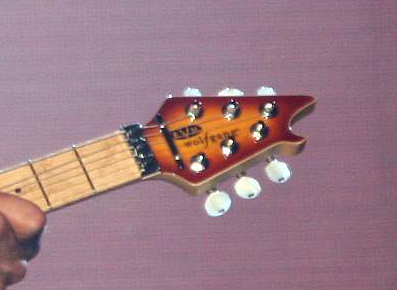
With the truss rod adjuster at the opposite end they could have given it an elegant and much more functional rake.
the whole thing is an aesthetic abortion and the dog-leg kink the string is forced through by the nut and the tie bar makes it a nightmare to tune.. The bridge clunks against the body when the trem is used and the d-tuner doesn't really work properly.
It's truly one of the most horrible guitars in the world. It wasn't designed so much as thrown together. And look at the fit of that nut! there's about a millimetre gap on the treble side where the nut is too short for the width of the fingerboard at that point.
About the only thing it has going for it is the gunstock oil neck finish but even that is poorly done with insufficient coats so that it always looks a bit grubby.
They were not that bad IMO but, how you ever noticed how the ergonomics are all kinds of wacked on them??? They just feel all kinds of wrong to play.
i think like everything, if it rings your bell then that's fine but really; what's with this headstock design?
With the truss rod adjuster at the opposite end they could have given it an elegant and much more functional rake.
the whole thing is an aesthetic abortion and the dog-leg kink the string is forced through by the nut and the tie bar makes it a nightmare to tune.. The bridge clunks against the body when the trem is used and the d-tuner doesn't really work properly.
It's truly one of the most horrible guitars in the world. It wasn't designed so much as thrown together. And look at the fit of that nut! there's about a millimetre gap on the treble side where the nut is too short for the width of the fingerboard at that point.
About the only thing it has going for it is the gunstock oil neck finish but even that is poorly done with insufficient coats so that it always looks a bit grubby.
octavedoctor
New member
Re: Ok i need some real good tech advise. Zerb, guys?
Only, JM, if it hasn't been implemented properly. Neck angle is irrelevant because you are only making a fraction of a degree difference at most.
For example, on a Strat or Tele a .2mm shim results in a change in neck pitch of just 0.22 degrees of arc; a Strat with a 1.5mm action at the 12th fret breaks from the fingerboard at the nut with an angle of just over 0.25 degrees so that shim is enough to make a huge difference in saddle height.
You are right about the microtilt neck system but the problems with that are more serious. On the modern 4-point necks the microtilt uses the truss rod anchor slug as a pressure plate. This bears on the underside of the fingerboard with only a few millimetres between the top of it and the joint. It's very common to see a bulge in the fingerboard where the microtilt has been overtightened. I always disable it and replace it with shims.
I can't possibly agree with you on the assertion that even a properly shimmed neck will affect sustain and tone; you are being way too precious about the effect of surface contact in a bolt on joint. In reality, the surface to surface contact in the average bolt on neck is only about 45% anyway (try inking the underside of a neck joint, tightening it and seeing how much of the ink is transferred!). The idea that increased surface contact somehow transmits "more sound" is to misunderstand the mechanics of guitar vibration. it is the overall stiffness between bridge and tuner that counts. Providing there is no appreciable movement in the joint there will be no loss of energy at that point. In fact it could be successfully argued that a glued joint is worse for sustain than a bolt on since it relies less on mechanical strength than the gap filling properties of the glue as anyone who has ever seen inside a Gibson neck joint can attest to...
It may be that the guitars you have played have not had the necks properly shimmed.
My experience is that there is absolutely no difference in the acoustic performance of a guitar after the neck has been elevated.
But shims CAN and DO affect the tone.
Only, JM, if it hasn't been implemented properly. Neck angle is irrelevant because you are only making a fraction of a degree difference at most.
For example, on a Strat or Tele a .2mm shim results in a change in neck pitch of just 0.22 degrees of arc; a Strat with a 1.5mm action at the 12th fret breaks from the fingerboard at the nut with an angle of just over 0.25 degrees so that shim is enough to make a huge difference in saddle height.
krappy Fender microtilt on the American series are the worst... and probably best example of a poor shim & neck angle vs. tone.
Raise the neck angle & the heel of the neck makes less contact with the body, the principle point of vibration transfer becomes not the wood, but that little 1/4" bolt, if it's even a full 1/4". Sure... the joint is still "tight" and not flopping around, but the loss in 'body' of tone & sustain is really not all that negligible. On the contrary... I find it highly noticeable.
You are right about the microtilt neck system but the problems with that are more serious. On the modern 4-point necks the microtilt uses the truss rod anchor slug as a pressure plate. This bears on the underside of the fingerboard with only a few millimetres between the top of it and the joint. It's very common to see a bulge in the fingerboard where the microtilt has been overtightened. I always disable it and replace it with shims.
I can't possibly agree with you on the assertion that even a properly shimmed neck will affect sustain and tone; you are being way too precious about the effect of surface contact in a bolt on joint. In reality, the surface to surface contact in the average bolt on neck is only about 45% anyway (try inking the underside of a neck joint, tightening it and seeing how much of the ink is transferred!). The idea that increased surface contact somehow transmits "more sound" is to misunderstand the mechanics of guitar vibration. it is the overall stiffness between bridge and tuner that counts. Providing there is no appreciable movement in the joint there will be no loss of energy at that point. In fact it could be successfully argued that a glued joint is worse for sustain than a bolt on since it relies less on mechanical strength than the gap filling properties of the glue as anyone who has ever seen inside a Gibson neck joint can attest to...
It may be that the guitars you have played have not had the necks properly shimmed.
My experience is that there is absolutely no difference in the acoustic performance of a guitar after the neck has been elevated.

metalspider
Member
Re: Ok i need some real good tech advise. Zerb, guys?
i dont use or have a capo so i just fret the strings on the first fret and compare the fret buzz with the open string.
Exactly how I do it, except I put a capo on the first fret to isolate the nut as if this is too high it can completely alter your perception of the action height.
i dont use or have a capo so i just fret the strings on the first fret and compare the fret buzz with the open string.

tone?
New member
Re: Ok i need some real good tech advise. Zerb, guys?
I can agree with the Axis having a pretty bad design, in some parts at least.
It was made in mind to be a custom axe with a specific sound in mind.
Yes the setup is a pain in the behind for the floyd and such, but if you agree with the floyd having to touch the back side of the guitar to get a better sound then you will agree with the design.
I personally agree that a Floyd resting on the guitar will sound better than a floating one. Much better in my opinion. Although i would probably do it different that Eddie did it. Not to say that he isnt innovative. I would recess the trem and THEN have it rest on the guitar. So that the trem is sitting lower on the guitar, since it is such a Large trem. Or i would test to see if doohickies like trem stops work equally well for tone and have it setup like that so you have more ease of use when doing setups.
I would like to have a bit of a forearm contour so that it doesnt cut into your arm. but then again so does a Les Paul, so whos to say thats wrong.
A good plus of the Axis compared to the EVH is that they put a tummy cut.
The Axis is built quite different than the Peavy so comparing isnt all fair.
One of the best parts of the Axis is the assymetrical neck shape that is second to none in comfort for any who have played one. It is really amazing. Yeah the 15/8 nut is a bit cramped but i dig it.
I would say that the part that i may not agree with on whole of the guitar design is the Tele shaped upper horn. Now tell me all you techs, how this alters the sound ( tone) of the instrument. From what i have noticed it leads to a slightly stiffer bass side of the neck since it has more support there as well as covering more frets up the neck. I could be wrong though. I maybe would prefer for it to be traditionaly strat shaped. I think that leads to a slightly looser flabbier bass response from the instrument that gives a 'deeper' boomier bass.
anyone want to comment on that??
I can agree with the Axis having a pretty bad design, in some parts at least.
It was made in mind to be a custom axe with a specific sound in mind.
Yes the setup is a pain in the behind for the floyd and such, but if you agree with the floyd having to touch the back side of the guitar to get a better sound then you will agree with the design.
I personally agree that a Floyd resting on the guitar will sound better than a floating one. Much better in my opinion. Although i would probably do it different that Eddie did it. Not to say that he isnt innovative. I would recess the trem and THEN have it rest on the guitar. So that the trem is sitting lower on the guitar, since it is such a Large trem. Or i would test to see if doohickies like trem stops work equally well for tone and have it setup like that so you have more ease of use when doing setups.
I would like to have a bit of a forearm contour so that it doesnt cut into your arm. but then again so does a Les Paul, so whos to say thats wrong.
A good plus of the Axis compared to the EVH is that they put a tummy cut.
The Axis is built quite different than the Peavy so comparing isnt all fair.
One of the best parts of the Axis is the assymetrical neck shape that is second to none in comfort for any who have played one. It is really amazing. Yeah the 15/8 nut is a bit cramped but i dig it.
I would say that the part that i may not agree with on whole of the guitar design is the Tele shaped upper horn. Now tell me all you techs, how this alters the sound ( tone) of the instrument. From what i have noticed it leads to a slightly stiffer bass side of the neck since it has more support there as well as covering more frets up the neck. I could be wrong though. I maybe would prefer for it to be traditionaly strat shaped. I think that leads to a slightly looser flabbier bass response from the instrument that gives a 'deeper' boomier bass.
anyone want to comment on that??
J Moose
New member
Re: Ok i need some real good tech advise. Zerb, guys?
Hmmm...
I'm not a luthier so I have to defer to more qualified folks such as yourself for a lot of things, however...
I have a mutt Strat with a '73 body and a late 80s Chandler maple neck... the body was converted to a four-bolt & was assembled by a great luthier many years ago. I've owned it for about two years now? The neck angle was horrible when I got it. Action above the 10-12th position was high & almost unplayable IMO... neck was straight, just a bit of relief.
My first shim (quick setup) was many layers of artists tape... it was quick & easy but compressed fairly quickly, rendering it useless. I've since tried a few other shims ranging from metal washers around the back two screws (towards the bridge); Mikes suggestion of sandpaper & a few others. I currently have one of those big triangular Clayton picks in there... its like .88 or so to give you an idea of the "corrected" angle.
Through all those changes... I've noticed small, subtle changes in the tone & sustain of the guitar. Maybe it's most akin to the difference in brands of strings or maybe overall action... not huge, but there. Some will pick up on it, some won't. Guess it depends on how "tuned" that person might be...
At the end of the day though... I'd rather have a correct neck angle & playable action then slightly hipper tone! I think it's more about the material of the shim & quality of the connection then the actual "angle" that affects the tone...
Besides... neck angle & tone? How about this??? :laugh2: :scratchch

That guitar weighed almost 9 1/4 pounds... a little too much for me so I marked out the depth and drilled the 1/2" (13mm) 'weight relief' holes. Shaved off well over half a pound! Didn't seem to affect the tone much either but maybe it was the ale... lol
Got a slight bit brighter w/ slighter tighter, if less round bottom end. The haggard middle carving in the pickup route was done well before I owned the guitar...
I can't possibly agree with you on the assertion that even a properly shimmed neck will affect sustain and tone; you are being way too precious about the effect of surface contact in a bolt on joint. In reality, the surface to surface contact in the average bolt on neck is only about 45% anyway (try inking the underside of a neck joint, tightening it and seeing how much of the ink is transferred!). The idea that increased surface contact somehow transmits "more sound" is to misunderstand the mechanics of guitar vibration. it is the overall stiffness between bridge and tuner that counts. Providing there is no appreciable movement in the joint there will be no loss of energy at that point. In fact it could be successfully argued that a glued joint is worse for sustain than a bolt on since it relies less on mechanical strength than the gap filling properties of the glue as anyone who has ever seen inside a Gibson neck joint can attest to...
It may be that the guitars you have played have not had the necks properly shimmed.
My experience is that there is absolutely no difference in the acoustic performance of a guitar after the neck has been elevated.
Hmmm...
I'm not a luthier so I have to defer to more qualified folks such as yourself for a lot of things, however...
I have a mutt Strat with a '73 body and a late 80s Chandler maple neck... the body was converted to a four-bolt & was assembled by a great luthier many years ago. I've owned it for about two years now? The neck angle was horrible when I got it. Action above the 10-12th position was high & almost unplayable IMO... neck was straight, just a bit of relief.
My first shim (quick setup) was many layers of artists tape... it was quick & easy but compressed fairly quickly, rendering it useless. I've since tried a few other shims ranging from metal washers around the back two screws (towards the bridge); Mikes suggestion of sandpaper & a few others. I currently have one of those big triangular Clayton picks in there... its like .88 or so to give you an idea of the "corrected" angle.
Through all those changes... I've noticed small, subtle changes in the tone & sustain of the guitar. Maybe it's most akin to the difference in brands of strings or maybe overall action... not huge, but there. Some will pick up on it, some won't. Guess it depends on how "tuned" that person might be...
At the end of the day though... I'd rather have a correct neck angle & playable action then slightly hipper tone! I think it's more about the material of the shim & quality of the connection then the actual "angle" that affects the tone...
Besides... neck angle & tone? How about this??? :laugh2: :scratchch
That guitar weighed almost 9 1/4 pounds... a little too much for me so I marked out the depth and drilled the 1/2" (13mm) 'weight relief' holes. Shaved off well over half a pound! Didn't seem to affect the tone much either but maybe it was the ale... lol
Got a slight bit brighter w/ slighter tighter, if less round bottom end. The haggard middle carving in the pickup route was done well before I owned the guitar...
T
theodie
Guest
Re: Ok i need some real good tech advise. Zerb, guys?
Looks like the iddiots cut a 1 11/16th nut width but, installed a 1 5/8 locknut. What a bunch of jackasses.
And look at the fit of that nut! there's about a millimetre gap on the treble side where the nut is too short for the width of the fingerboard at that point.

donahue
New member
Re: Ok i need some real good tech advise. Zerb, guys?
Theodie is right. This is EXACTLY what I did and it worked perfect. JohnJohn talked me through it and I am really happy with the results.
Are the shims that are currently in it full neck pocket shims?
Most times just a thin shim at the back of the neck pocket puts the neck at the correct angle and does a better job than a bunch of full pocket shims. You can use a medium pick cut in half and placed in the rear of the pocket and it usually gets you by. Not the most professional way to do it but, considering what you are asking, it is probably one of the better ways for you to do it yourself. A small peice of veneer works well too.
Theodie is right. This is EXACTLY what I did and it worked perfect. JohnJohn talked me through it and I am really happy with the results.
tone?
New member
Re: Ok i need some real good tech advise. Zerb, guys?
ok here is an update of my setup.
thank god it was easier than i though, but i still have one slight problem.
So I got the shims from the mail and picked the thinest one i could put on without buzzing. It set the action down low and is near perfect.
This made the guitar not need an extra shim at the neck.
Funny thing is that the Floyd which i though needed raising a bit doesnt. Why not? it looks from the picture and in real life that it does need raising cause the baseplate is a bit sloping downwards. BUT the plate that rests on the body is spot on straight and so are the saddles. So either it must be the make or something. I did raise it just to see, but the plate which rests on the body lifted up and slanted backwards. So it is fine where it is. Whew, no work there!
The problem now is......that the nut still leaves a hair gap between it and the fretboard. Nothing like before. But still if you hold it up to a light source like a TV you can see the hair gap between them. Is that 'Bad' in therms of setup?? Seems to me like it would throw intonation off a bit.
I loosened the screws from the nut and pushed it down with my hand and then tightened it to get it where i want it. But it still 'slipped' a tad back. When i dont have the screws tightened it stays in place fine. Any ideas??
ok here is an update of my setup.
thank god it was easier than i though, but i still have one slight problem.
So I got the shims from the mail and picked the thinest one i could put on without buzzing. It set the action down low and is near perfect.
This made the guitar not need an extra shim at the neck.
Funny thing is that the Floyd which i though needed raising a bit doesnt. Why not? it looks from the picture and in real life that it does need raising cause the baseplate is a bit sloping downwards. BUT the plate that rests on the body is spot on straight and so are the saddles. So either it must be the make or something. I did raise it just to see, but the plate which rests on the body lifted up and slanted backwards. So it is fine where it is. Whew, no work there!
The problem now is......that the nut still leaves a hair gap between it and the fretboard. Nothing like before. But still if you hold it up to a light source like a TV you can see the hair gap between them. Is that 'Bad' in therms of setup?? Seems to me like it would throw intonation off a bit.
I loosened the screws from the nut and pushed it down with my hand and then tightened it to get it where i want it. But it still 'slipped' a tad back. When i dont have the screws tightened it stays in place fine. Any ideas??


