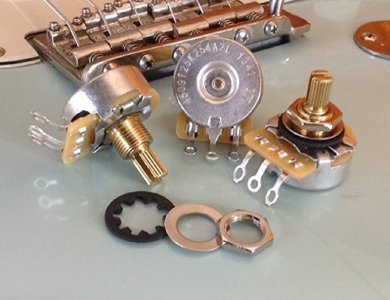
On CTS, the full part number tells you exactly what it is.
The first number is the base model of the pot (450 is a flat solid back, 500 is vintage dish-back)
The next letter is the lug style (T is a solder lug)
The next number is the mounting style (brass bushing, die cast, molded, etc.)
The next number is the shaft length
The next letter is the shaft type
The number after that is the resistance code (253 would be 25k, 104 is 100k, etc.)
The letter after that is the tolerance (A is +/- 10%, B is +/- 20%)
The next number is the taper (1 is Linear, 2 is 10% audio, 3 is 10% audio CCW)
The next letter is any switch actuation (A is none, B is SPST rotary, etc.)
The last number is any special features (1 is left side lug, 4 is right side lug, 5 is no locating lug, etc.)
Not all indicators may be present all the time. Some models may use a different order to those code segments, which means you really need the data sheet or the part drawing to read the model number.
The 25K is not the resistance. 25 is a code indicating the shaft length (you need the data sheet to figure out exactly what it is) and K means "knurled shaft"
The best thing to do is just measure to make sure it's 250k, if you have a doubt.
EDIT: looks like they've updated the sheets since I ordered my run.
https://www.ctscorp.com/wp-content/u...heet-Rev-B.pdf
2 is a .25" bushing length
5 is a .625" shaft length
K is split knurl