Question about loading pickups with resistors

Rex_Rocker

Well-known member
Hello!

I have a kind of specific question about adding resistors to load pickups down.

I have 500K pots on all my guitars. However, on my Les Pauls, I have 1M resitors soldered to the outer lugs of the pot connected to the bridge pickup for a total load of 333K-ish Ohms.

I kinda want to do the same to my Strat. I currently only have a 500K volume pot, and that's it. However, I don't really want to take the strings off, then remove the pickguard, then put the pickguard back on, then the strings back on to find out I may not like it.

I wonder if it's possible to just add the resistor soldered to the two lugs on the output jack as a temporary solution to see if I like it. Is that doable? Would I have the same effect?

Thank you
 
it should slightly change how the volume pot behaves once lowered but with all controls full up, the effect should be the same.

That said, if the guitar has a master tone pot, lowering it should have largely the same effect than putting a resistor in parallel with the output (knowing that a typical tone pot is mostly resistive during 2/3 of its curve).

FWIW. Do what you want and be happy. :-)
 
Last edited:
Seems it that the resistor accross the jack should work the same. As if you were to just move a down the hot and ground from the strats vol..they end up at the jack.
Question tho. On your gibson if it makes 333k.....doesnt it judt react like a 300k volume pot?
 
it should slightly change how the volume pot behaves once lowered but with all controls full up, the effect should be the same.

That said, if the guitar has a master tone pot, lowering it should have largely the same effect than putting a resistor in parallel with the output (knowing that a typical tone pot is mostly resistive during 2/3 of its curve).

FWIW. Do what you want and be hapy. :-)
Oh, yeah. I almost always have the pots on full.

The guitar has no tone control.

Thank you!
 
Seems it that the resistor accross the jack should work the same. As if you were to just move a down the hot and ground from the strats vol..they end up at the jack.
Question tho. On your gibson if it makes 333k.....doesnt it judt react like a 300k volume pot?
Thank you.

Yeah, pretty much. Except 300K pots are kinda harder to find locally, and even moreso long shaft ones.
 
Good question. Tempted to do the same on one of my Ibbys to tame it a bit, with the Distortion in the bridge it feels too shrill, but maybe it's just in my head?
 
When I work on a Stratocaster, I often just release tension, place a capo as low down on the fretboard as it will fit, then unbolt the neck and fold it over. When putting the screws back in, I always turn them gently backwards, 'til they "click" into their original threads, so as not to cross-thread, or "cut" new threads. Easy peasey.

If anyone thinks this is a bad practice, I'm all ears.
 
When I work on a Stratocaster, I often just release tension, place a capo as low down on the fretboard as it will fit, then unbolt the neck and fold it over. When putting the screws back in, I always turn them gently backwards, 'til they "click" into their original threads, so as not to cross-thread, or "cut" new threads. Easy peasey.

If anyone thinks this is a bad practice, I'm all ears.

I think that's one of those things that you can get away with quite a bit, but still isn't a good idea.

I used to do that too until my Mexican Strat had an issue with the heel of the neck being semi-stripped. One day when I get around too it, I'll install threaded inserts and get back to doing it again
 
I don't have a capo. :(

Also, my question is, though, if I solder the resistor to the output jack, would that mean it's still parallel to the pot? I mean, technically, it would be connected to the middle lug rather than outer lugs of the pot that way, no?

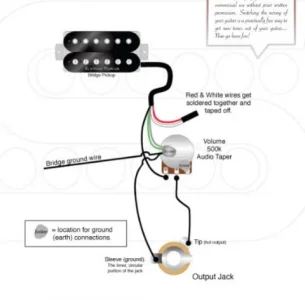
The setup, I don't think I made it clear is pickup - 500K volume pot - output jack. I followed this diagram:1770047778383.webp

I'm sorry if the question is obvious. I'm just trying to learn.
 
When I work on a Stratocaster, I often just release tension, place a capo as low down on the fretboard as it will fit, then unbolt the neck and fold it over. When putting the screws back in, I always turn them gently backwards, 'til they "click" into their original threads, so as not to cross-thread, or "cut" new threads. Easy peasey.

If anyone thinks this is a bad practice, I'm all ears.
This is always how I've done it.
 
I think that's one of those things that you can get away with quite a bit, but still isn't a good idea.

I used to do that too until my Mexican Strat had an issue with the heel of the neck being semi-stripped. One day when I get around too it, I'll install threaded inserts and get back to doing it again
I don't have a capo. :(

Also, my question is, though, if I solder the resistor to the output jack, would that mean it's still parallel to the pot? I mean, technically, it would be connected to the middle lug rather than outer lugs of the pot that way, no?

The setup, I don't think I made it clear is pickup - 500K volume pot - output jack. I followed this diagram:

I'm sorry if the question is obvious. I'm just trying to learn.
Chistopher: I'll take that on advisement.

Rex: Yes. Putting the resistor across the output jack terminals is electrically the same. (Oops. Not quite correct. Freefrog, below, got it right.)
 
Last edited:
Also, my question is, though, if I solder the resistor to the output jack, would that mean it's still parallel to the pot? I mean, technically, it would be connected to the middle lug rather than outer lugs of the pot that way, no?

When your pot is full up, the middle lug and outer lug are directly connected to each other, with all the resistance of the pot between them and ground. That's why I've said that your connection to the output jack would make a slight difference only with the pot lowered.
 
Also fwiw, I think an audio pot with a resistor of half it's value yields a much better taper than audio or linear
 
When your pot is full up, the middle lug and outer lug are directly connected to each other, with all the resistance of the pot between them and ground. That's why I've said that your connection to the output jack would make a slight difference only with the pot lowered.
Gotcha. Thanks for clarifying.
 
Last edited:
Thank you.

Yeah, pretty much. Except 300K pots are kinda harder to find locally, and even moreso long shaft ones.
I measured all my pots and used a sharpie to write their actual values. They vary quite a bit.

I wouldnt be surprised if you by 5x 250K alpha or chinese mini-pots you would get one close to 300K.
 
I measured all my pots and used a sharpie to write their actual values. They vary quite a bit.

I wouldnt be surprised if you by 5x 250K alpha or chinese mini-pots you would get one close to 300K.
Yeah, but buying 5 pots is more expensive than buying like 50 1M resistors or whatever the package came with, LOL.
 
Leave out some of the screws on the bottom of the pickguard

Add two wires from the volume pot

Hang them outside the pickguard
Experiment to your hearts content

When you come across the right combination

Solder that in and remove the hanging wires

On mine with pickguards or back plates
I do this with Gator clips

I jump stuff around to try out split coils and parallel
Different tone caps
Random things

Once happy I wire it in and move on
 
Back
Top