Question for the guitar builders.

Artie

Peaveyologist
I couldn't find the exact picture I wanted, but assume in this pic that the back and sides are black, with white binding. (And assume a solid body too.)
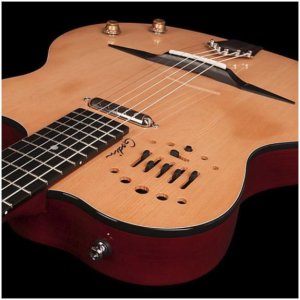
Godin.jpg

What would be the sequence of construction here? I mean, how do you avoid getting the back & side paint on the cap and binding? I assume the cap would need to be glued on before you route for the binding, but I can't imagine that you'd have the back painted and polished before you started work on the top & binding. :dunno:

Thanks all;
Artie
 
Re: Question for the guitar builders.

I would glue everything together, rout out for the neck and pups and controls, seal coat, rout, glue-in, and trim the binding. If the back is going to be painted or stained, tape off the binding getting a good edge on the side and cover the front first. And then if the top is going to be painted or stained, tape off the binding with a good edge on the top and cover the sides (after removing the first tape you put on, obviously). Some people prefer not to tape the binding at all but to just scrape the color off of the binding after staining/painting. Even when I do a "good job" of taping off the binding, sometimes I still have to do a little touch-up scraping. Then I clear coat over everything with light level-sanding after every few coats (if using nitro).
 
Re: Question for the guitar builders.

Typical would be that whole thing gets built first. Then the top and binding get masked off, allowing a little bit of overlap of the paint onto the binding. Then the back/sides painted. Then the tape gets scored and pulled. Then you go back and score the rough paint edge where the masking tape was pulled. You can do this using any number of homemade tools that hold the blade at a set distance from the top. Then after you have lightly scored a fresh paint edge all the way around, you go back and scrape the excess paint off with a second home-made scraper jig. Clean everything up, then clear coat the entire guitar (sans the face of the fretboard).
 
Re: Question for the guitar builders.

I haven't finished watching that video, but at about 1:30 you can see some binding scraping going on.
 
Re: Question for the guitar builders.

I haven't finished watching that video, but at about 1:30 you can see some binding scraping going on.

Yup, then they show it in detail at 15:20. Lot of human work (not machine) in each Rickie.


Sent from my iPad using Tapatalk
 
Re: Question for the guitar builders.

Many is the time I scraped the finish from binding... It makes more sense than masking off, doesn't leave a ridge, and in the end - takes less time. And in building or repair - time is money.
 
Re: Question for the guitar builders.

Great video. Thanks Vince. So . . . I've got my work cut out for me. But I want to give this a try.
 
Re: Question for the guitar builders.

The "ridge" is never a problem. During clear coating and level sanding it ends up perfectly smooth. But I agree that just scraping is way more time efficient.
 
Re: Question for the guitar builders.

Thanks Doc. Found another decent video. Gibson/Epiphone on this one.

 
Re: Question for the guitar builders.

Either scraping or taping will leave a ridge initially. By definition you are removing paint on a line - so it is unavoidable. But as mentioned, if you clearcoat afterwards it gets buried in the general buildup/sandback process.

All sunbursts on Gibsons and any solid colour next to binding (like a custom where binding is on back and front) will need either the mask or mask + scrape technique
 
Re: Question for the guitar builders.

Ok. Thanks Alex. I think I'm going to start by building a little box, with binding, for my wife. That way, I can kinda get my feet wet before jumping in whole hog, so to speak.
 
Re: Question for the guitar builders.

That is a great idea! It never hurts to butter up the Mrs a little and we won't tell her you did it for practice.
 
Re: Question for the guitar builders.

I love learning this kind of stuff. Thanks for posting and discussing this.
 
Re: Question for the guitar builders.

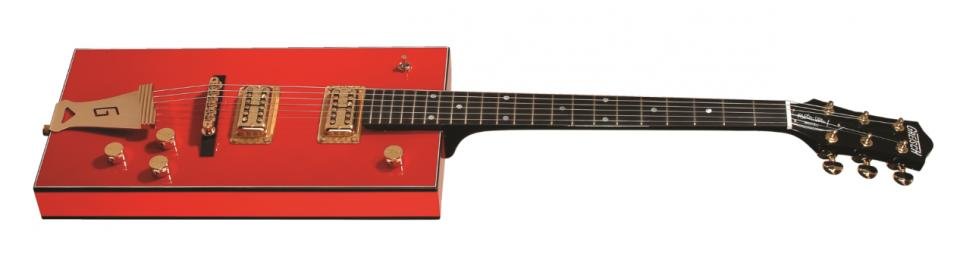
Another crazy idea I had, was to maybe build a "Bo Diddley" Gretsch. There probably doesn't exist an easier body shape to copy. :)

Gretsch_Bo-Diddley_side_65.jpg

With some Duncan Psyclones. Mine would need to be a bolt-on neck, 'cause that's what I have laying around.
 
Re: Question for the guitar builders.

Actually, an easier shape would be an oval, at least as far as binding is concerned, because you wouldn't have 4 mitered joints. The binding has to be cut perfectly to fit right and to look right. An oval is one continuous piece of binding, no joints.

But then again, this is a good project for practice because it gives you that one more element to work on.
 
Re: Question for the guitar builders.

While that's true, I've never seen an oval guitar that I liked. (Although, my Dano Bellzouki comes close.) I kinda like that "Bo" guitar.

But now, you've got me to thinking. The Dano's body is messed up, where someone tried to repaint it, and it looks horrible. Maybe that would be a cool first binding project. :scratchch
 
Re: Question for the guitar builders.

I have to admit that there is certainly some kind of vibe in the Bo guitar.
 
Re: Question for the guitar builders.

It must be an optical illusion, but the neck appears to be real short, even though it's a 25.5" scale length.
 
Re: Question for the guitar builders.

Mostly an illusion. It's because the body on those is actually pretty long...longer than you'd expect.
 
Back
Top