Rationale of J in neck

Inflames626

New member
Hey guys,
As a guitarist, I see a lot of basses, even MM's, with a J in the neck.

My question is why is this done?

On one hand, a J's being somewhat trebly (usually) may offset the bass tendencies in the neck position.

Yet my experience with a J in the neck is that a split P or humbucker sounds much better, with a J being much better in the bridge, generally, vs. in the neck.

So, why are J's so popular in the neck when, arguably, there are better shapes for the job?

Thanks.
 
Re: Rationale of J in neck

Think of how they first came to be there. A J pickup in the neck position was always accompanied by a J pickup in the bridge position. It wasn't until many years later that people started mixing and matching. The unusual thing about J pickups is that (at least when Fender first started building J basses) the pickups are single coil, but they are a matches set which cancels hum when used together.

I'm not a bass historian, but I'm pretty sure the first forray into mix-n-match with the PJ. It was a bad idea on at least two levels -- the pickup outputs were mismatched with the P overwhelming the J; and it matched a non-hum-canceling J with a hum canceling P, which meant the P was usable all the time, but using the J at all meant introducing hum to your signal.

Of course, that same problem presents itself any time someone mixes a single coil J with any humbucking pickup. People still mix single coil Js with hum canceling pickups, but the advent of the hum-canceling J changed a lot of things. Now you can match a J to just about anything.


But really, before any of that becomes relevant, I have to challenge some of the assumptions in your opening post. The first is that there are better pickups than the J for use in the neck position. That depends entirely on the job you want done, but I would venture to guess that in the vast majority of cases, the job you want done could be done with a J. The J is a tremendously flexible form factor, I believe it's because the shape was so ubiquitous and narrow that people had to get really creative to get the sound they wanted without hacking up their bass, and now there is a tremendous amount of options available. Single coil, stacked humbucking, parallel humbucking, split-coil humbucking, vintage voiced, high output, strong highs, strong mids, strong lows... I don't think there is any other pickup design that has more options available to it than the J.
 
Re: Rationale of J in neck

Whole Lotta Love is Jazz Bass neck pickup. Deep enough for yez?
 
Re: Rationale of J in neck

Sorry Funkfingers, I'm not a Zep fan. Would be like if I said something about 18th century koto music expecting everyone to get it. :)

BlueTalon, it could at least be said that the J's form factor is limiting in that its size reduces the winds and magnet size. It also reduces the amount of area over which the string vibrates.

To me, a four coil six conductor MM would do just about every job asked of it. Two of these would be ideal.
 
Re: Rationale of J in neck

I'm not recommending against doing that. In fact, I have a body for a future build that is routed for two MM pickups, and I have two SD pickups waiting to fill those holes (one alnico, one ceramic), so I'm not opposed to that arrangement.

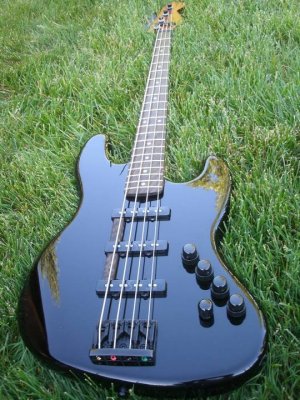
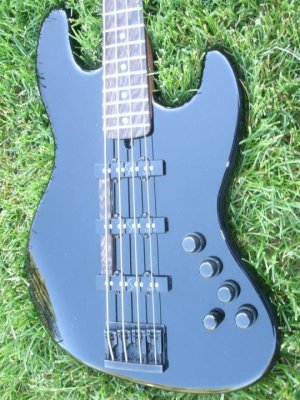
However, the J is probably my favorite pickup. And your original post simply asked why people use J's in the neck position -- my answer is that it is a tremendously flexible option. Its size is a limiting factor, but (A) people have been very creative in adapting pickup designs to fit the format, and (B) the size can be an advantage when it comes to placing pickups on a bass. Exhibit A:
 

Attachments

  • Strat-Jazz 1a.jpg
    Strat-Jazz 1a.jpg
    98.3 KB · Views: 0
  • Strat-Jazz 1b.jpg
    Strat-Jazz 1b.jpg
    79.8 KB · Views: 0
Re: Rationale of J in neck

Never seen a bass like that. And with four concentric pots. Nice.

Well, I can understand the J for hum canceling purposes and if you want to use both J's at once without one pup overpowering the other. But a J by itself in the neck makes no sense.
 
Re: Rationale of J in neck

Thanks! The pickups on my bass are hum-canceling Fender Super 55 split-coil pickups. That means I can use any combination of pickups, at full or varying volume levels. I lose nothing tone-wise by using these instead of single coil pickups. (Actually, these are single coil pickups -- serial single coil, the same way a P is.) And as far as unwanted noise is concerned, they are dead silent.

I actually agree with you, a single J in the neck position makes no sense, if it is a single coil J (unless it is matched with a single coil J at the bridge, of course). But a silent hum-canceling J can be matched with anything, including a MM pickup.
 
Re: Rationale of J in neck

It looks a lot like the Aerodyne models. Being a metal shredder, I'm drawn to the sleeker Fender models, including the 80s Japanese made stuff that had FRs and such on them.

Clyde at Bartolini told me he wasn't a big fan of stacked hum canceling J's. I take it people prefer the serials because they don't need a dummy coil?
 
Re: Rationale of J in neck

What I don't get is the J in neck MM type. Even if a J in the neck is supposed to balance out an MM's tone, looks to me like you could crank a 2 MM job and end up sounding the same tone wise, just louder.
 
Re: Rationale of J in neck

It looks a lot like the Aerodyne models. Being a metal shredder, I'm drawn to the sleeker Fender models, including the 80s Japanese made stuff that had FRs and such on them.

Clyde at Bartolini told me he wasn't a big fan of stacked hum canceling J's. I take it people prefer the serials because they don't need a dummy coil?

Some people really like the stacks, but they are more susceptible to the typical differences between single coils and humbuckers (disadvantages for those who like single coils.) The dual inline coil J is a way to get the single coil sound (very close if not exact) without the extra noise. Given the choice, I prefer split-coils over stacks.

Regarding J with MM, it's just an option. You don't have to get it. :) I personally don't get the attraction to a PJ arrangement, but it's certainly an option a lot of people like.
 
Re: Rationale of J in neck

A disadvantage of a PJ might be finding aftermarket pups in matched sets or working out differences between MIA and MIM type J bass arrangements.

For example, I'd love to get a Fender 60s J bass single to balance out my 62 P bass in a PJ job. In the used market, it will be hard to find individual J pups.
 
Re: Rationale of J in neck

That's a risk/reward thing. Or as I like to think of it, potential benefit vs. potential headache. For me personally, a P-J represents more potential headache. Actually, so does the MM-J, which is why I went with a J-J-J for my bass above, and a MM-MM for my future build.

But that's just me. Others can do whatever they want, if they feel it is worth the headache for whatever they are trying to accomplish.
 
Re: Rationale of J in neck

One problem as I see it is that P and J mix very badly in a passive bass, as in literally the mixing together with the pots. The resonance frequency goes all over the place.

J and J make for much better mixing, even though each individual pickup might be meh-ish on its own. J and J mix so that the resonance frequency goes up comparable to the notch position of a Stratocaster, and that is very good clean and clear sound to have.
 
Re: Rationale of J in neck

uOpt said articulately what I was thinking but couldn't express, as usual.

The hum canceling J's on my Peavey Foundation sound meh by themselves (bridge alone gives a good mwarrr type fretless bass tone, though, that is great for slides). But the J in the neck alone is just...bleh.

I normally leave both cranked.
 
Re: Rationale of J in neck

Yep! They are more in the middle than the neck compared to a guitar but bass pickup placement will vary.
 
Re: Rationale of J in neck

I actually love PJs. I also love the output imbalance. Can be used as a makeshift boost. Plus the tone of both together is more unique. You also have every tone a p bass can get with extra solo jazz capabilities. If anything I get more of a headache choosing between a j and a p. With the J I miss the round and big tone, you can kinda get a p bass tone but with not as much depth and power, plus it would be noisy. With the P I miss the vocal bloom of the bridge position. The between sound for the jazz is great too but I actually like the PJ between more because it has more girth to it and less of a quack. If anything PJs have more P in them then they do the J but if you're more of a P guy then a Pj is really going nowhere but up in many ways I look at it, including an extra place to rest your thumb. Not a big fan of soloed jazz neck pickups either, not that they aren't good, I just find that the P does the job so much better.
 
Re: Rationale of J in neck

I also find it much more rewarding to blend the volumes of the pickups in PJs than I do in straight Jazzes. Usually people use Jazzes for the full inbetween tone or the bridge soloed.
 
Back
Top