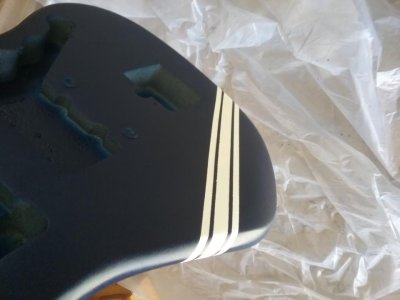
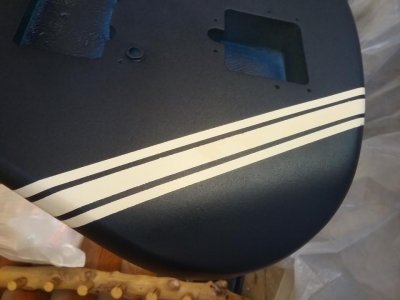
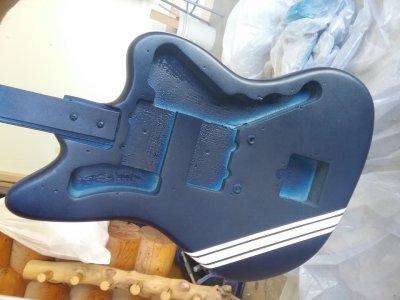
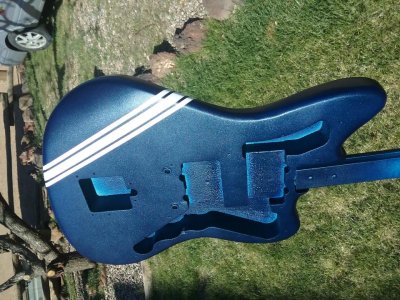
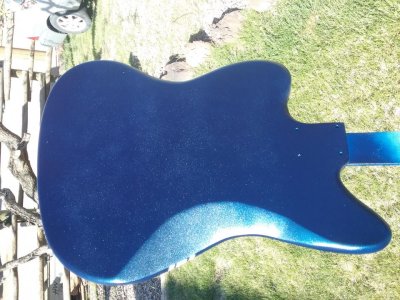
Looks cool. I kinda like the textured paint on the body.
A few notes and tips (some of which I realize are too late).
You have already stated this, but I wanted to reiterate that acrylic lacquers are what Fender used for almost all metallic colors back in the '60's. Sherwood Green was an exception, and probably any custom metallics they used in the early to mid '50's. In addition to most of the metallics, Olympic White was also an acrylic lacquer. They'd use nitro clear over the acrylics, but most of the classic Fender metallics were acrylic for the color coats. Not that you're going for old-style materials accuracy, but it's good to know that those who are going for period-correct-ish materials need not look only at nitro products. There are a fair variety of over the counter acrylic lacquers out there, and they are perfectly compatible with nitro lacquer, so that broadens your color choices quite a bit.
Looks like you might have left the original sealer intact. If my eyes serve me correctly, wise call. It's a bear to strip, and there really isn't any reason to, as it's actually a really good base for a refin.
You can mask holes (such as your bridge posts) with kneaded eraser. You can mask other difficult to tape areas with brush-on liquid frisket.
There is an absolutely invaluable trick for getting clean masking lines (works with spray or brush). It really would have helped you out here. Firstly, get the right tape. Ideally, you want lacquer masking tape, which is light green. Secondly, here's the real bit-chin trick: When you have everything masked off, before you spray over the tape with the second color, first cover everything except the stripes, then do another coat or two of the first color, just spraying where the stripes will be. This seals the edges of the tape, to prevent the second color from sneaking under. And any paint that does get under the tape will match the first color, so will be far easier to clean up (if it needs it at all).
Good luck.