Rotary Switches!

theAeronought

New member
Hi guys,

I'm looking for some information on rotary switches. I got the details for smart people on StewMac (where you can get the rotary switches themselves), but I need the dumbed down version - principally, how are you supposed to wire a rotary switch? The 5-way rotary switch made since, but the 6-way had 6 throws and an extra "0" throw in the middle. What's up with that? Also, what would you do with a 4-pole as opposed to a 2-pole? Because for pickup switching I think I want a 4-pole, but I doubt wiring it could be as simple as it looks.

In other words, if any of you out there is an expert on rotary switches, tell me everything you know about them. Thanks!
- Aero
 
Re: Rotary Switches!

Hi guys,

I'm looking for some information on rotary switches. I got the details for smart people on StewMac (where you can get the rotary switches themselves), but I need the dumbed down version - principally, how are you supposed to wire a rotary switch? The 5-way rotary switch made since, but the 6-way had 6 throws and an extra "0" throw in the middle. What's up with that? Also, what would you do with a 4-pole as opposed to a 2-pole? Because for pickup switching I think I want a 4-pole, but I doubt wiring it could be as simple as it looks.

In other words, if any of you out there is an expert on rotary switches, tell me everything you know about them. Thanks!
- Aero

I've wired up many but no expert. throws = how many connections can happen at once. pulls = how many positions the switch has.
advice: write down pickup wire colors, create a list of the combos you want... for each one write down the wire connections that have to be made (inside coils, outside coils, parallel, series, whatever). then review: if I have a 5p4t switch, I can only make up to 4 connections at any given time. can I do what I want with these combos and this switch? if not, you need to simplify.
once you've got a list of each switch position/the neccessary wire connections... draw up a pin diagram of your switch. check the orientation carefully. write down what each pin will be connected to.
check that diagram twice. then wire it up.
 
Re: Rotary Switches!

Alright, that's helpful - but, what if I need to make more than four connections? Could I hook two wires up to the same pole?

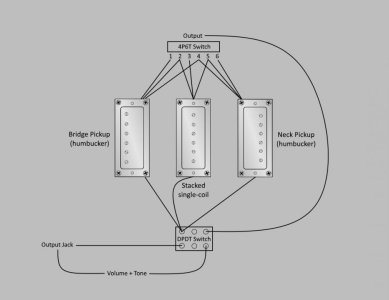
This is the general idea of what I'm trying to accomplish:
Phase 2 Wiring Sketch.jpg
Don't laugh, I know this looks like nothing more than a weird game of connect-the-dots. It's just a layout, people, I know how to make a real wiring diagram. Also, these are homemade pickups that I haven't made yet - I can do whatever I want (within reason) when it comes to leads.

So what do you think, can it be done?
- Aero
 
Re: Rotary Switches!

Alright, that's helpful - but, what if I need to make more than four connections? Could I hook two wires up to the same pole?

This is the general idea of what I'm trying to accomplish:
View attachment 68172
Don't laugh, I know this looks like nothing more than a weird game of connect-the-dots. It's just a layout, people, I know how to make a real wiring diagram. Also, these are homemade pickups that I haven't made yet - I can do whatever I want (within reason) when it comes to leads.

So what do you think, can it be done?
- Aero
there are NOT more than 2 connections anywhere here. you could use a 2p6t.
or you could use a 3p6t and replace one of the positions with a position that turns all pickups on.

as is... it would go something like: lets call your pickups B, S and N
wire both pointer lugs on a 2pdt switch to your live on your dpdt. then each pointer selects between 6 alternate lugs.
pointerA: 1/B, 2/B, 4/B, 5/N, 6/N
PointerB: 2/S, 3/S, 4/N, 5/S
(lugs not listed require no connection)

btw - in your drawing your dpdt is not correct. this would not make any connections.
it is 2 groups of 3. you'd have to use 1/2 of one group and 2/3 of another to accomplish what your intending there.

edit: one additional error - if you connect all three pickups lives together like that you would loose the ability to turn them on individually. if you wanted to accomplish that youd need 3pdt switch in place of your 2pdt switch, individually connecting ea of the three to live when thrown one direction, and connection the rotary to live in the other direction.
 
Last edited:
Re: Rotary Switches!

I've wired up many but no expert. throws = how many connections can happen at once. pulls = how many positions the switch has.
.

No. Absolutely incorrect. In order to understand basic wiring, it is essential to understand how switches work.

First of all, there is no such thing as "pulls". That should be "poles".

Poles are the inputs (or outputs depending on how the switch is used) to the switch. The throws are the connections that each pole can make. For example: in a SPST switch (two positions), there is one input which can make one connection (this is a simple on/off switch). In a SPDT on/on switch (two switch positions), the input (pole), can make either one of the two possible connections (throws). A DPDT on/on switch (again, two switch positions) is just two separate SPDT on/on switches physically connected together but electrically working independently. A DPDT switch can also come in a three position switch in three different forms: two different on/on/on forms, and an on/off/on form.

Example...here is the most commonly used DPDT on/on/on switch. The middle terminals are the poles, the upper and lower terminals are the throws:

http://www.seymourduncan.com/wp-content/uploads/2015/05/WD_Minitoggle_3.jpg
 
Back
Top