Running Two Cabinets with Different Impedances?

Re: Running Two Cabinets with Different Impedances?

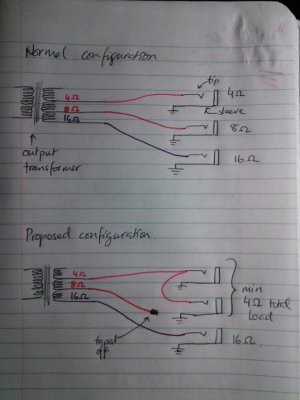
no, that's just re-purposing a jack. the tap is still active, you're just not using it. Ordinarily, the lead-wire from the transformer tap is not bridged to ground at an unused jack, it's an open circuit. Taping it off just ensures that it doesn't accidentally ground itself, sending a bunch of voltage through whatever it touches. When you plug a cab in, the circuit is closed, and the signal is grounded, but only after passing through the appropriate speaker load, and experiencing a voltage drop. Once that voltage drop has resulted, it's ok for the signal to be grounded.

It's no different from plugging in your cabs into, for example, the 8 ohm jacks, and leaving the 16 ohm and 4 ohm jacks un-used.
 
Last edited:
Re: Running Two Cabinets with Different Impedances?

no, that's just re-purposing a jack. the tap is still active, you're just not using it. Ordinarily, the lead-wire from the transformer tap is not bridged to ground at an unused jack, it's an open circuit. Taping it off just ensures that it doesn't accidentally ground itself, sending a bunch of voltage through whatever it touches. When you plug a cab in, the circuit is closed, and the signal is grounded, but only after passing through the appropriate speaker load, and experiencing a voltage drop. Once that voltage drop has resulted, it's ok for the signal to be grounded.

It's no different from plugging in your cabs into, for example, the 8 ohm jacks, and leaving the 16 ohm and 4 ohm jacks un-used.

Oh thanks., Then how bout I "repurpose" your booty for a big latino sausage?

heh, J/k

I still do not get it.Apart from a new jack, and "repurposing" an unused jack, what exactly do you do to the unwanted/ unused jack, lets say the 4 ohm? You want to hook up tip to tip ,sleeve to sleeve to the 8 ohm jack, making two 8 OHM paralell jacks for your 16 OHM load ( two cabinets).
You are tapeing off the hot wire, and then doing waht?..running the tip of the 8 Ohm jack to the tip of the jack that has the hot wire taped off? and then sleeve to sleeve?)
LOok, I understand if this is over my head. I can't ad two and two.
 
Last edited:
Re: Running Two Cabinets with Different Impedances?

Weber makes an impedance matcher if you don't want to rewire one of your cabs.

This works by using a matching transformer and will most likely affect your tone. Whether for the best or worse, it's hard to determine.

To use it, you would plug the "in" jack to your amp's 16 ohm output and set the device to match. Then plug one cab to the front "out", the other to the rear "Extra output". Set the output impedance to 2.6 ohms and you're golden.

The option above is the bestest, cheapest, most reliable and least complicated way to do it.

..Joe L
 
Re: Running Two Cabinets with Different Impedances?

Oh thanks., Then how bout I "repurpose" your booty for a big latino sausage?

heh, J/k

I still do not get it.Apart from a new jack, and "repurposing" an unused jack, what exactly do you do to the unwanted/ unused jack, lets say the 4 ohm? You want to hook up tip to tip ,sleeve to sleeve to the 8 ohm jack, making two 8 OHM paralell jacks for your 16 OHM load ( two cabinets).
You are tapeing off the hot wire, and then doing waht?..running the tip of the 8 Ohm jack to the tip of the jack that has the hot wire taped off? and then sleeve to sleeve?)
LOok, I understand if this is over my head. I can't ad two and two.

IMG_20140502_123604.jpg
 
Re: Running Two Cabinets with Different Impedances?

There is a bit of confusion in this thread on how transformers match impedance. It can be a confusing subject if you don't know the science.

On a Bassman circuit designed for 6L6s, plugging an 8 ohm cab into the 8 ohm jack reflects a 6600 ohm load to the output tubes. That is a standard used in most guitar amps designed for 6l6s and works quite well. Because the 6L6s want to see a 6600 ohm load, you need the transformer to "step up" the ohms from the 4-16 ohm speaker. Otherwise you wouldn't need the transformer and like solid state, you could hook the speakers directly to the output tubes.

Plugging a 4 ohm load into the 8 ohm jack reflects a 13200 ohm load to the output tubes. Plugging an 8 ohm load into the 16 ohm jack reflects a 13200 ohm load.

Simultaneously plugging a 4 ohm load into the 8 ohm jack and an 8 ohm load into the 16 ohm jack reflects a total of 6600 ohms to the output tubes. The amp is now happy and it really is that simple.

So again, rewire the 4 ohm cabinet to 16 ohms and plug it into the 8 ohm jack. Plug the 8 ohm speaker into the 4 ohm jack. If only using one cabinet, just plug into the matching output jack.

I've been in the electronics field since '77. I built my first amp, a Mesa Mark III reproduction, in '86. As far as I know, I built the first Soldano SLO and X88R clones in '99. I'm currently working on restoring my '74 Marshall Superlead and slightly modding it to the Mojave Scorpion circuit. I'm adding an EF86 clean channel to my Silver Jubilee reproduction, scratch building a Mesa Mark IIc+, a Soldano SLO preamp and just started an original design three independent channel amp with midi control.

..Joe L
 
Last edited:
Back
Top