Softening a floyd rose : a revelation!

greekdude

New member
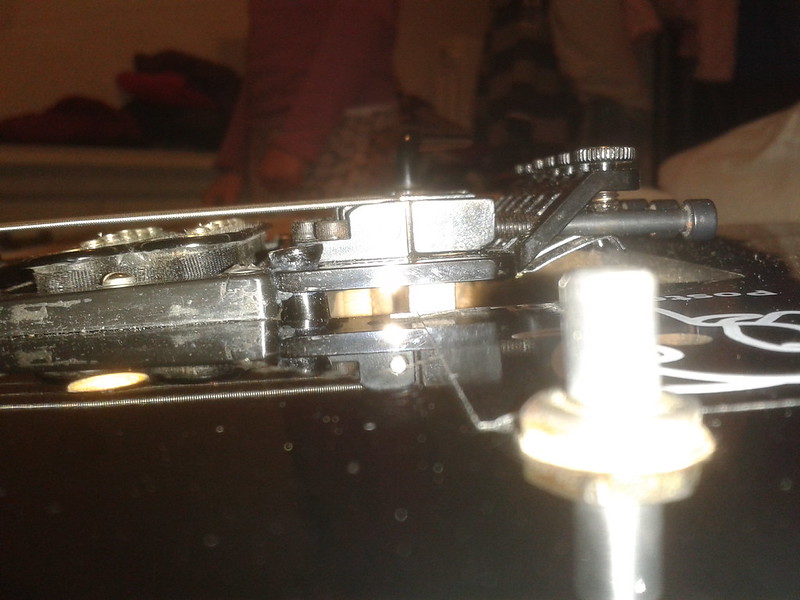
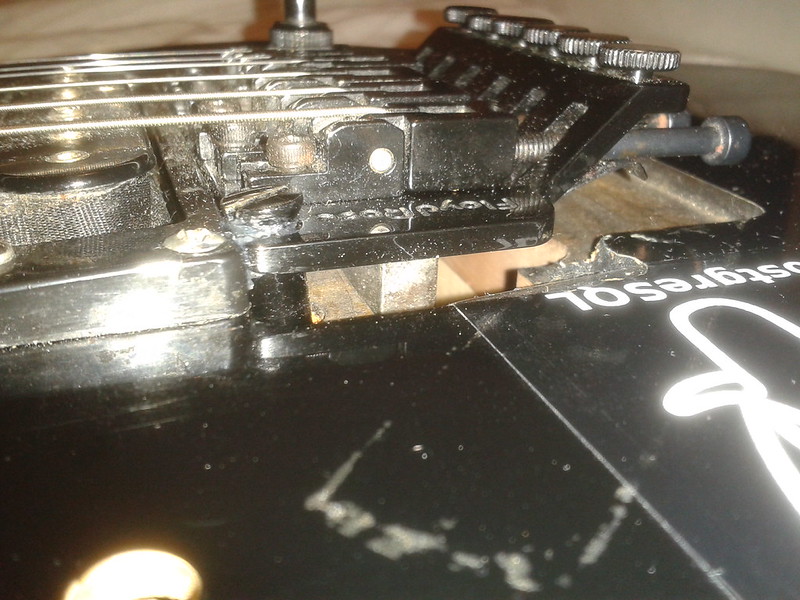
What i accidentally did and ended up softening a really stiff floyd rose, on my carvin dc135 1988/9. The main aim was to correct a minor radius/string action incompatibility between high-E, B and G, B seemed to have lower action than high E, although the saddles were in correct order and forming a decent 12" radius. What i did was to try to move the plate slightly so that the angle is towards the body end side instead of the neck side. I did that by screwing the claw screws some 3-4 mm forward. (YMMV). A new tuning process was due. This resulted so that the "gravity/force center" of the whole system moved a little from its previous "parallel to the body" position and moved slightly towards the tremolo springs side. This created the said angle so that the trem plate has longer distance from the body at the saddles and shorter at the fine tuners. The guitar needed bridge height adjustment right after.
I forgot to mention this guitar has 10s strings.
The result is a fantastic "buttery"-feeling guitar, so smooth and nice, like i don't remember it even back when fitted with 9s!!!

If you have problem with stiffness you might give it a try. What i lost (if a any) is some pull up distance, but i cannot really detect this since I still get all the pull up squelies i want and more! On the + side, i can use the trem effectively even in high E!!!

a good mod! :smokin:
 
Last edited:
Re: Softening a floyd rose : a revelation!

Can't you get the same effect (adjusting the plate angle) simply by adjusting the spring tension? It sounds to me as if you just lowered the action on the guitar, hence the "butter."

Maybe I'm missing what you did... Got any pictures?
 
Re: Softening a floyd rose : a revelation!

He increased the tension of the springs so they pulled the back of the bridge down a little more.
 
Re: Softening a floyd rose : a revelation!

Can't you get the same effect (adjusting the plate angle) simply by adjusting the spring tension? It sounds to me as if you just lowered the action on the guitar, hence the "butter."

Maybe I'm missing what you did... Got any pictures?
I must shoot some pictures and post them.
The said floyd is floating, so in theory spring tension should be kind of constant, screwing in the claw moves the angle like in my case, screwing out the claw has the opposite effect. Since the strings are tuned the same, they apply the same strength to the springs. However in my case for some reason, the result, under the very same strings and tuning was a really buttery feeling, i can't explain it actually.
As long as action height is concerned, of course this lowered the action (my initial aim was to minimize jump in action from B to G, which also remains a mystery, since the saddles seem perfectly ordered), hence i had to screw out the studs in order to achieve identical action height to my liking, which is in the ranks of 0.015mm relief, 1.6mm action at 24th fret low E and 1.2mm action at 24th fret high E.
 
Re: Softening a floyd rose : a revelation!

He increased the tension of the springs so they pulled the back of the bridge down a little more.

Right, but in fact no tension was increased, you can't adjust tension on a floating floyd, the tension from strings (which is constant) must neutralize the tension of the springs, and the system stabilizes somewhere in the middle. What happened is that the "system" moved a little bit towards the claw side, hence given that angle.
I still cannot explain this in terms of physics. Theoretically the guitar should have the same stiffness.
 
Re: Softening a floyd rose : a revelation!

I understand what you are saying. You adjusted the neutral/balance point to be in a different location. In this case, to having the rear of the bridge being closer to the body. If it doesn't float I don't like it!
 
Re: Softening a floyd rose : a revelation!

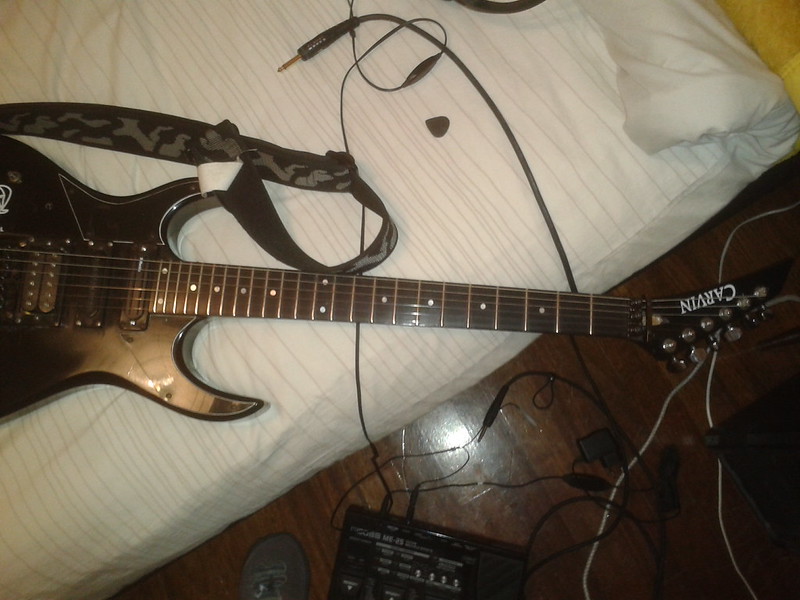
Here are the photos :
13763137994_81b8e7dcef_c.jpg


13762743685_54d83e49cb_c.jpg


13763104784_565b2c0bdf_c.jpg
 
Re: Softening a floyd rose : a revelation!

Lower the bridge and you get more "slink." I think it's as simple as that.
And more buzz, less sustain, less ability to do wide bends, as well. The string height was kept religiously equal in both (before/after) situations. Unfortunately, it's not that simple.
 
Back
Top