Speaker terminal adaptor / how-to

Jack_TriPpEr

Well-known member
I just received in the mail two used 12" speakers that have this kind of speaker wire terminal design - which looks like the only way to make a connection is to solder the two speaker wires onto it:
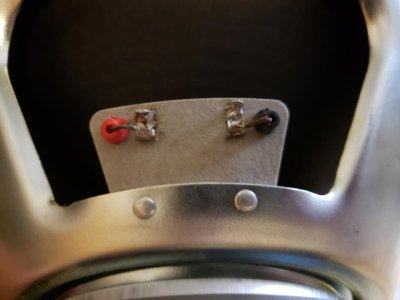
20190116_135219.jpg
Also, it lookslike it only supports connecting two wires - i.e. it does not two additional lugs to support connecting another speaker to it.

The 4x12 cabinet i want to install these in, has speaker wires with crimp/faston/quick connect terminals like this that support connecting another speaker:
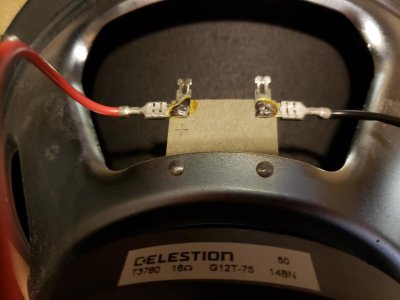
20190116_135934.jpg

How do i connect these 2 new speakers into the cabinet? And i want to connect one of the new speakers to the other?

[EDIT]: To clarify, the intent of my question is to ascertain whether there is any way to connect speaker wire to terminals without quick-connect terminals - and *without* having to do soldering, not about "which wire goes where". I was wondering if there was something like a special speaker wire that had a "conversion" terminal ending to enable this, etc.
 
Last edited:
Re: Speaker terminal adaptor / how-to

For a parallel circuit connect a wire from red on one speaker to red on the other, then do the same with the black. Then connect the Input wires to one speaker only. It's OK for one speaker to have two wires on each soldered point.
 
Re: Speaker terminal adaptor / how-to

OP

It looks like those speakers were originally used for a parallel circuit to make an 8ohm 2x12 cabinet

So the Amplifier feeds the + and - of the Celestion 16ohm Speaker with the existing dual terminals and then the extra + and - terminals feed the other Celestion 16ohm speaker with the solder globs -you can just go terminal spade lug on the 1st speaker to the solder on the second -making an 8ohm cabinet.

if you want a 16ohm cab -you will want to run them in series instead. So Amp + to Speaker 1 (dual lugs) +, Speaker 1 (Dual terminal) - to + of Speaker 2 (Solder), Speaker 2 (Solder) - to Amp -

Oh yeah, I would solder the spade lug terminal -they have a tendency to shake loose if you achieve proper rockness.
 
Re: Speaker terminal adaptor / how-to

I just received in the mail two used 12" speakers that have this kind of speaker wire terminal design - which looks like the only way to make a connection is to solder the two speaker wires onto it:
View attachment 95355
Also, it lookslike it only supports connecting two wires - i.e. it does not two additional lugs to support connecting another speaker to it.

The 4x12 cabinet i want to install these in, has speaker wires with crimp/faston/quick connect terminals like this that support connecting another speaker:
View attachment 95356

How do i connect these 2 new speakers into the cabinet? And i want to connect one of the new speakers to the other?

To clarify, the intent of my question is to ascertain whether there is any way to connect speaker wire to speaker terminals that do not have quick-connect terminals - and *without* having to do soldering. I am all set with "which wire goes where".

I was hoping that there was something like a special speaker wire that had a "conversion" terminal ending to enable this, etc.?
 
Re: Speaker terminal adaptor / how-to

To clarify, the intent of my question is to ascertain whether there is any way to connect speaker wire to speaker terminals that do not have quick-connect terminals - and *without* having to do soldering. I am all set with "which wire goes where".

I was hoping that there was something like a special speaker wire that had a "conversion" terminal ending to enable this, etc.?

Sorry, I got excited I guess.

OP,.... if you are against soldering, you can crimp the leads with a soft conductive ferrule and crimper.

Home Depot has something that will work.
 
Re: Speaker terminal adaptor / how-to

Alligator clips?

Seriously

No soldering and not looking for slip on connectors

Buy a different speaker, perhaps?
 
Re: Speaker terminal adaptor / how-to

Better just solder. It's easy, cheap and good skill to have. It may save you a lot of money in the long run.
 
Re: Speaker terminal adaptor / how-to

Alligator clips?

Seriously

No soldering and not looking for slip on connectors

Buy a different speaker, perhaps?

Alligator clips did cross my mind. One concern: would the alligator clips stand up to the voltage passing through them, or would they possibly melt / risk of fire etc.? As this isn't just a weak line-level signal....
 
Re: Speaker terminal adaptor / how-to

Sorry, I got excited I guess.

OP,.... if you are against soldering, you can crimp the leads with a soft conductive ferrule and crimper.

Home Depot has something that will work.

I googled "conductive ferrule" and there was such a variety of shapes that they can come in - could you post an image or a link of a particular shape that you thought would work in this case?
 
Re: Speaker terminal adaptor / how-to

Alligator clips did cross my mind. One concern: would the alligator clips stand up to the voltage passing through them, or would they possibly melt / risk of fire etc.? As this isn't just a weak line-level signal....

They wouldn't melt
They may slip off when transporting
And damage you amp head
When it sees no load
 
Re: Speaker terminal adaptor / how-to

I googled "conductive ferrule" and there was such a variety of shapes that they can come in - could you post an image or a link of a particular shape that you thought would work in this case?

You would select a ferrule wide/big enough to make it around those globbed up tabs pointing up on the speaker in your photo and slide them on with the speaker wire inside too and crimp it.

By the way, I'm giving you a solution as you requested, but solder is really the best way.

like these but larger:

x80-3-4mm-fence-wire-crimping-sleeves-ferrules-double-barrell-farm-garden-453-p.jpg
 
Re: Speaker terminal adaptor / how-to

By the way, I'm giving you a solution as you requested, but solder is really the best way.

Better just solder. It's easy, cheap and good skill to have. It may save you a lot of money in the long run.

Buy a different speaker, perhaps?


Another clarification: i know how to solder. Just exploring my options b4 i go that route. There's a few reasons why:
- first order of business is to quickly determine if these used speakers actually work without issue. That's one reason to minimize my time and expense invested. Cuz if the speakers have issues, i also have to spend 2x the time desoldering them foe return to seller.
- the only speaker wire i own, already has quick disconnect terminals, so any route i take, i need to spend $$ one way or the other - either on new speaker wire, or spending on a replacement terminal board. B4 spending, might as well explore the options first
- logistically, it's a PITA to solder in this particular scenario because the 4x12 cabinet is on the 2nd floor, while the soldering station, ventilation fan and other soldering supplies are down in the basement. 2nd floor is carpeted, risk of hot soldering blobs falling and getting stuck in the carpet, i have to set up a make-shift "bench" to house the soldering station, etc.
 
Re: Speaker terminal adaptor / how-to

Another clarification: i know how to solder. Just exploring my options b4 i go that route. There's a few reasons why:
- first order of business is to quickly determine if these used speakers actually work without issue. That's one reason to minimize my time and expense invested. Cuz if the speakers have issues, i also have to spend 2x the time desoldering them foe return to seller.
- the only speaker wire i own, already has quick disconnect terminals, so any route i take, i need to spend $$ one way or the other - either on new speaker wire, or spending on a replacement terminal board. B4 spending, might as well explore the options first
- logistically, it's a PITA to solder in this particular scenario because the 4x12 cabinet is on the 2nd floor, while the soldering station, ventilation fan and other soldering supplies are down in the basement. 2nd floor is carpeted, risk of hot soldering blobs falling and getting stuck in the carpet, i have to set up a make-shift "bench" to house the soldering station, etc.

Well, it's 10 minute job at most? If I need to do that sort of quick soldering I just throw a piece of plywood or something like that on the floor, open window and use a simple straight to wall iron.
 
Re: Speaker terminal adaptor / how-to

Test them with alligator clips. Fix them by either replacing the terminal board with one that Securb linked, or, solder short pigtails onto the terminals. By that I mean a short wire directly soldered to the terminals with a quick connect male on the other end (or a pair of quick connects). That would essentially give you a direct replacement for modern speaker terminals without having to replace the terminal board. You can solder them on downstairs so you don't have to worry about all the "issues" with soldering upstairs.

Like these ... .187 males ... Should be available at an auto parts store.

MDV2-187_270x199.jpg
 
Re: Speaker terminal adaptor / how-to

...or, solder short pigtails onto the terminals. By that I mean a short wire directly soldered to the terminals with a quick connect male on the other end (or a pair of quick connects). That would essentially give you a direct replacement for modern speaker terminals without having to replace the terminal board. You can solder them on downstairs so you don't have to worry about all the "issues" with soldering upstairs.

Like these ... .187 males ... Should be available at an auto parts store.

MDV2-187_270x199.jpg

What a brilliant idea! You won the internet today, please celebrate this evening and make merry! Haha. Seriously, thank you!
 
Re: Speaker terminal adaptor / how-to

What a brilliant idea! You won the internet today, please celebrate this evening and make merry! Haha. Seriously, thank you!

Wait that was my first thought too but the no soldering rule precluded it

Alligator clips for testing
The solder pigtails
 
Re: Speaker terminal adaptor / how-to

He said no solder... I'm confused. How is a solder solution the answer?

Because he said that he can solder but that soldering upstairs, in the cabinet, is a problem. His soldering stuff is in the basement. This allows him to solder in the basement.
 
Re: Speaker terminal adaptor / how-to

Wait that was my first thought too but the no soldering rule precluded it

Alligator clips for testing
The solder pigtails

Ehdwuld, i agree that the alligator clip method is a workable option - so thank you - but i just prefer the pigtail solution because the physical connection between speaker and wire will be solid and stable, isn't temporary so doesn't need rework, is also quick & easy, and allows for either soldered or quick connect hookups going forward on these speakers for myself and potential future owners.
 
Back
Top