You can fix all of your problems with pickup height and pole piece adjustments. The SD is an extremely adjustable pickup.
"Honk" and "jangle" are why that pickup is so much better than most other high output humbuckers, IMO. It's powerful, but not overbearing or muddy. It's the only high output pickup I've ever used that works for me in the neck position.
Again, adjust the thing carefully. To start, all three of your wound string pole positions should be significantly higher than the plain string pole positions. Look at the stagger of a vintage style Strat pickup to see a good starting point...with the exceptions being that: 1) you should not radius the poles quite as much (because Fenders used curvier fretboards), and 2) the G string poles should actually be your lowest ones, not your highest ones. Strat pickups were designed around a wound G string, which when you use one ends up being your quietest string. But modern string sets use a plain G string, which ends up being your
loudest string.
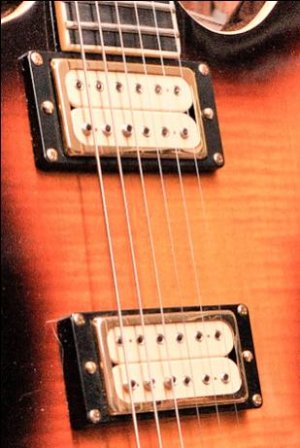
Here is how my pair of Super Ds is set. I treated one row of poles as if they were fixed (like a slug coil on a regular humbucker), and adjusted the other one for good string-to-string volume balance. This is after setting the pickup height for my preferred tone and output. I just cropped this from an old pic, so the resolution isn't great. But hopefully it gives you an idea of what a "standard" humbucker setup will probably look like, if the pickup is carefully adjusted for good string-to-string volume balance. The D pole/s will be your highest, and the G poles your lowest. B is higher than G and high E is higher than B. In other words, the G to high E pattern looks like a "staircase"). Low E is second lowest after D. And for a reason I have never been able to determine, the A pole/s usually need to be lower than the low E pole/s. So the low E to D visual pattern is like a check mark (basically a form of a "V," but with the E being lower than the D).
View attachment 102547